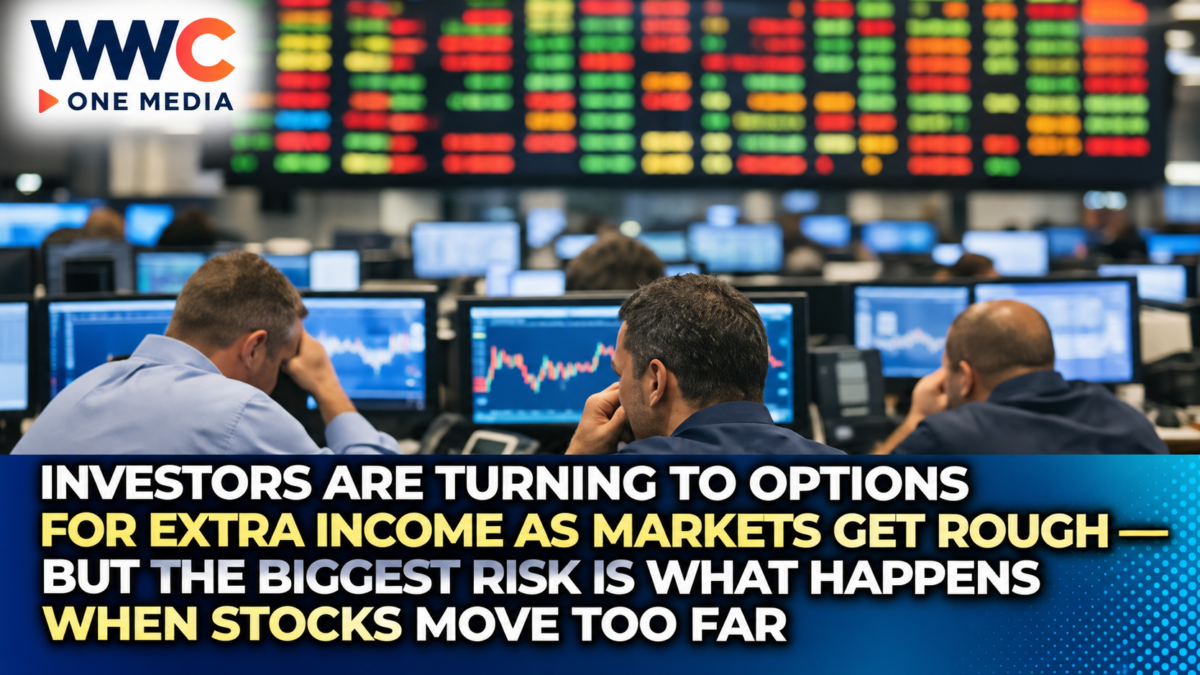
NEW YORK — With stock-market volatility rising, bond yields near multi-decade highs and investors increasingly unsure where equities are headed next, some advisers are turning to options strategies designed to generate income from portfolios without abandoning stocks altogether.
The two strategies attracting particular attention are covered calls and cash-secured puts—approaches that can generate option premiums when markets move sideways or rise only modestly.
But neither is free money.
Covered calls can force investors to give up gains if a stock rallies sharply.
Cash-secured puts can obligate investors to buy a falling stock at a price far above its new market value.
That makes the central tradeoff simple:
investors can collect more income today, but only by accepting a different set of risks tomorrow.
Volatility Is Making Income More Valuable
The market backdrop helps explain the renewed interest.
The S&P 500 fell roughly 0.5% in September, while the Dow declined more sharply and the Nasdaq managed to remain positive.
At the same time, Treasury yields surged.
Reuters reported that the 10-year Treasury yield reached about 5.29%, its highest level since 2007 at the time, while the 30-year yield climbed above 5.62%, the highest since 2002.
That combination creates a difficult environment.
Stocks remain capable of rallying.
But higher yields make bonds more competitive.
And expensive borrowing costs can pressure:
technology stocks,
real estate,
highly leveraged companies,
and other rate-sensitive assets.
For investors who do not want to sell their equities entirely, options can provide another way to generate cash flow.
Strategy No. 1: Covered Calls
A covered call begins with something straightforward:
the investor already owns a stock or ETF.
They then sell a call option against those shares.
In exchange, they receive an upfront premium.
A standard U.S. equity option contract generally represents 100 shares, meaning an investor typically needs 100 shares of the underlying security for each covered call sold.
The strategy works best when the investor expects the stock to:
stay relatively flat,
or rise only modestly.
If the share price stays below the option’s strike price, the option may expire worthless.
The investor keeps both the shares and the premium.
Why Investors Like Covered Calls
The attraction is income.
Imagine an investor owns 100 shares of a stock trading at $100.
They sell a call with a $110 strike price and receive a $3 premium.
That premium generates $300 immediately.
If the stock remains below $110 through expiration, the investor keeps the $300 and continues owning the stock.
If the stock rises above $110, however, the shares may be called away.
The investor still keeps the premium.
But the stock may have to be sold at $110—even if the market price later reaches $120, $130 or higher.
That is the biggest cost of the strategy.
Covered Calls Exchange Upside for Income
Fidelity describes covered calls as an income-generating strategy particularly suited to investors who expect a stock to remain stable or rise only slightly.
The premium provides a small amount of downside protection.
But only a small amount.
If the stock collapses, the investor still owns it.
Schwab notes that the downside can theoretically extend all the way toward zero in the underlying stock, while upside is capped by the strike price plus the premium collected.
That is why covered calls should not be confused with true portfolio insurance.
They generate income.
They do not eliminate equity risk.
The Biggest Covered-Call Risk Is Missing a Rally
The strategy can look especially attractive during uncertain markets.
But it can become frustrating very quickly during a sharp rebound.
Suppose the investor sells that $110 call.
Then unexpectedly strong earnings push the stock to $140.
The investor may still be required to sell at $110.
They keep the option premium.
But they miss most of the rally above the strike.
That opportunity cost can be enormous in fast-moving growth stocks.
For that reason, covered calls are generally better suited to positions an investor would already be comfortable selling at the selected strike price.
Covered Calls Can Also Create Tax Complications
There is another issue that receives less attention.
If an investor has held a stock for years and accumulated a large unrealized gain, assignment can create a taxable sale in a regular brokerage account.
Fidelity warns that this can generate capital-gains consequences that investors may not have intended when they originally sold the option.
That makes strike-price selection more than a market decision.
It can also become a tax-planning decision.
Strategy No. 2: Cash-Secured Puts
The second strategy reverses the logic.
Instead of owning a stock and agreeing to sell it at a higher price, the investor sells a put and agrees to buy the stock at a predetermined price if assigned.
The investor keeps enough cash in the account to purchase the shares.
That is why it is called a cash-secured put.
This can be useful for an investor who already wants to buy a particular stock—but only at a lower price.
Investors Can Get Paid While Waiting
Imagine a stock trades at $100.
An investor would happily buy it at $90.
Instead of simply placing a limit order at $90, the investor sells a $90 put and receives a $2 premium.
If the stock stays above $90, the option may expire worthless.
The investor keeps the $200 premium and never buys the shares.
If the stock falls below $90, the investor may be assigned and required to buy 100 shares at $90.
Because they already received $2 per share in premium, the effective purchase price becomes roughly $88 before commissions or taxes.
That sounds attractive.
Until the stock falls much further.
The Risk: You Still Have to Buy During a Crash
Suppose the same stock falls from $100 to $60.
The investor may still be required to purchase it at $90.
The $2 premium reduces the effective cost to about $88.
But the market value is now only $60.
That means the investor is immediately sitting on a substantial loss.
Fidelity says cash-secured puts carry risks similar to owning the stock itself, because an assigned investor can suffer large losses if the underlying shares collapse.
The premium cushions the decline.
It does not remove it.
Cash-Secured Puts Work Best When You Truly Want the Stock
This is arguably the most important rule.
A cash-secured put should generally be written only at a price where the investor would genuinely be comfortable buying the underlying security.
Cboe describes the approach as potentially useful for investors willing to own a stock or ETF at a lower predetermined price while earning premium income in the meantime.
That means the strategy should not be chosen simply because the premium looks attractive.
High premiums often exist because the underlying stock is risky.
The market is paying more because the possibility of a large move is greater.
Volatility Raises Premiums — and Risk
Options premiums are heavily influenced by expected volatility.
When markets become nervous, option prices often rise.
That can make selling options more profitable.
But it also means the market expects larger price moves.
In other words:
higher option income usually comes with higher underlying risk.
Investors should be careful not to interpret a large premium as free yield.
The premium is compensation for accepting an obligation.
High Bond Yields Make the Decision Harder
There is another major difference in 2026.
Investors can earn meaningful yields from relatively safer fixed-income securities.
The 10-year Treasury yield has recently moved above 5%, while some high-quality corporate bonds have offered yields above 6%.
That changes the income calculation.
During the era of near-zero interest rates, selling options could look unusually attractive because cash and government bonds paid very little.
Today investors have alternatives.
They can earn substantial income without accepting the assignment risk of short options.
That means options strategies need to justify their extra complexity.
Why Options Still Appeal Despite 5% Treasury Yields
The answer is flexibility.
A Treasury investor receives interest.
A covered-call investor receives option premium while retaining partial stock exposure.
A cash-secured-put investor receives premium while potentially gaining entry into a stock at a lower price.
Those strategies combine income with equity positioning.
But that flexibility comes with more uncertainty.
Treasury payments are contractually defined.
Option income depends on:
volatility,
strike price,
expiration,
stock movement,
and assignment.
So the yield comparison is not apples-to-apples.
Income Is Not the Same as Total Return
This distinction is especially important.
A portfolio generating 10% in option premiums does not necessarily earn a 10% total return.
If the underlying stock falls 20%, the investor can still lose money overall.
Likewise, a covered-call portfolio may generate attractive cash distributions while underperforming a rising stock market because upside is repeatedly capped.
Cboe notes that option-writing strategies are often designed to produce smoother returns or additional income rather than maximize upside in strongly rising markets.
Investors therefore need to separate:
income yield
from
actual investment return.
Covered-Call ETFs Have Made the Strategy Mainstream
Investors no longer need to trade individual options contracts themselves to access the strategy.
Covered-call and equity-premium ETFs have become increasingly popular.
These funds typically own stocks while systematically selling calls to produce distributions.
For income-focused investors, that offers simplicity.
But the same tradeoff remains.
A covered-call ETF can distribute significant cash while lagging an ordinary equity index during powerful bull markets.
The income is being generated partly by selling away future upside.
September’s Market Shows Why the Strategy Is Getting Attention
The current environment is almost tailor-made for the sales pitch.
September delivered:
weak stock-market breadth,
rising bond yields,
high oil prices,
inflation concerns,
and uncertainty over Federal Reserve policy.
The S&P 500 itself fell only modestly.
But the equal-weighted version performed much worse, showing that weakness was broader beneath the headline index.
That kind of choppy market can favor option-selling strategies because investors can repeatedly collect premiums without needing stocks to surge.
But the environment can change quickly.
Q4 Could Produce a Strong Rally
There is already disagreement on Wall Street about what comes next.
Some strategists believe September’s weakness created the setup for a stronger fourth quarter.
Barron’s reported that analysts see potential support from:
strong corporate earnings,
post-midterm seasonal patterns,
corporate stock buybacks,
and renewed investor demand.
That is precisely the type of environment where covered-call sellers can regret capping their upside.
If stocks jump sharply into year-end, the premium collected may look small compared with the gains surrendered.
Options Work Best When the Strategy Matches the Goal
That may be the most important lesson.
Covered calls are not inherently good or bad.
Cash-secured puts are not inherently conservative or aggressive.
Their usefulness depends on why the investor is using them.
A covered call makes sense when someone:
already owns the stock,
is willing to sell at the strike price,
and prefers income over unlimited upside.
A cash-secured put makes sense when someone:
already wants the stock,
has enough cash to buy it,
and is comfortable owning it at the strike price even if the market falls further.
The strategy becomes dangerous when investors begin with the premium and ignore the obligation.
FINRA Warns Options Are Complex Products
FINRA notes that options are derivatives requiring special brokerage approval and can expose sellers to contractual obligations when positions are assigned.
That means options are not simply higher-yielding versions of stocks or bonds.
They are contracts.
When an investor sells one, they are accepting a future obligation.
For covered calls, that obligation may be to sell shares.
For cash-secured puts, it may be to buy them.
Understanding that obligation is more important than focusing on the premium received upfront.
The Premium Can Create a Dangerous Illusion
There is also a behavioral risk.
Option premiums arrive immediately.
Losses may appear later.
That can make option selling psychologically attractive.
Investors see cash deposited into the account and may interpret it as profit.
But economically, the trade remains open.
The investor has been paid because somebody else purchased the right to force a transaction under certain conditions.
The real profitability of the trade is known only after the position is closed, expires or is assigned.
The Worst Strategy Is Chasing the Highest Premium
This is where inexperienced investors often get into trouble.
Stocks with the highest option premiums are usually volatile for a reason.
They may face:
earnings uncertainty,
financial distress,
regulatory issues,
binary clinical-trial results,
takeover speculation,
or extreme investor sentiment.
Selling a put simply because it pays 10% in a month can expose the investor to losses many times larger than the premium.
Likewise, selling covered calls on highly volatile growth stocks can repeatedly eliminate the upside that originally justified owning the shares.
The premium should therefore be the last part of the decision—not the first.
Cash-Secured Puts Benefit From Higher Cash Yields Too
There is one interesting advantage in today’s high-rate environment.
The cash held as collateral for a cash-secured put may itself earn interest depending on the brokerage and account structure.
Cboe notes that higher short-term interest rates can therefore create a tailwind for put-writing strategies.
That means an investor can potentially receive:
interest on the cash collateral,
plus the option premium.
But again, the downside risk remains the obligation to buy shares if the stock falls below the strike price.
These Strategies Do Not Replace Diversification
Another danger is using options income as an excuse to concentrate heavily in one stock.
A covered call on a single volatile technology company remains exposure to that company.
A cash-secured put on a single speculative stock remains a bet on that stock.
The option premium does not magically create diversification.
That is why advisers cited in CNBC’s coverage emphasized using these strategies as supplements to a broader portfolio rather than replacements for:
bonds,
dividend stocks,
cash,
and diversified equity exposure.
Bonds Are Now Competing Directly for Income Investors
This may be the biggest difference from the last decade.
Investors seeking income no longer need to stretch as aggressively.
With Treasury yields above 5%, a conservative investor can generate meaningful cash flow without selling options.
That raises the bar.
An options strategy must offer enough additional expected return or portfolio flexibility to compensate for:
complexity,
tax consequences,
assignment risk,
equity downside,
and capped upside.
For many investors, it may not.
Volatile Markets Make Options More Attractive — and More Dangerous
That is the paradox.
The conditions that increase option premiums are often the same conditions that make assignment more likely.
More volatility means:
more income,
but also
more uncertainty.
That is why experienced options investors tend to focus less on how much premium they can collect and more on whether they are comfortable with the outcome if the option is exercised.
A covered-call seller should ask:
Am I genuinely willing to sell this stock at this price?
A put seller should ask:
Am I genuinely willing to buy this stock at this price even if markets are panicking?
If the answer is no, the premium may not be worth it.
The Bigger Question Is What Investors Actually Want
The current market environment offers investors more income choices than they have had in years.
Treasuries yield more than 5%.
High-grade corporate bonds yield even more.
Dividend stocks remain available.
Covered calls can monetize existing equity positions.
Cash-secured puts can pay investors while they wait for lower entry prices.
There is no single best strategy.
Each solves a different problem.
And that is why the renewed popularity of options should be viewed cautiously.
Covered calls and cash-secured puts can create additional cash flow during volatile markets.
But that income exists because investors are selling someone else a valuable right.
When markets move sharply, that right can become very expensive for the seller.
So the biggest mistake is not using options.
It is forgetting that every premium comes with an obligation attached.