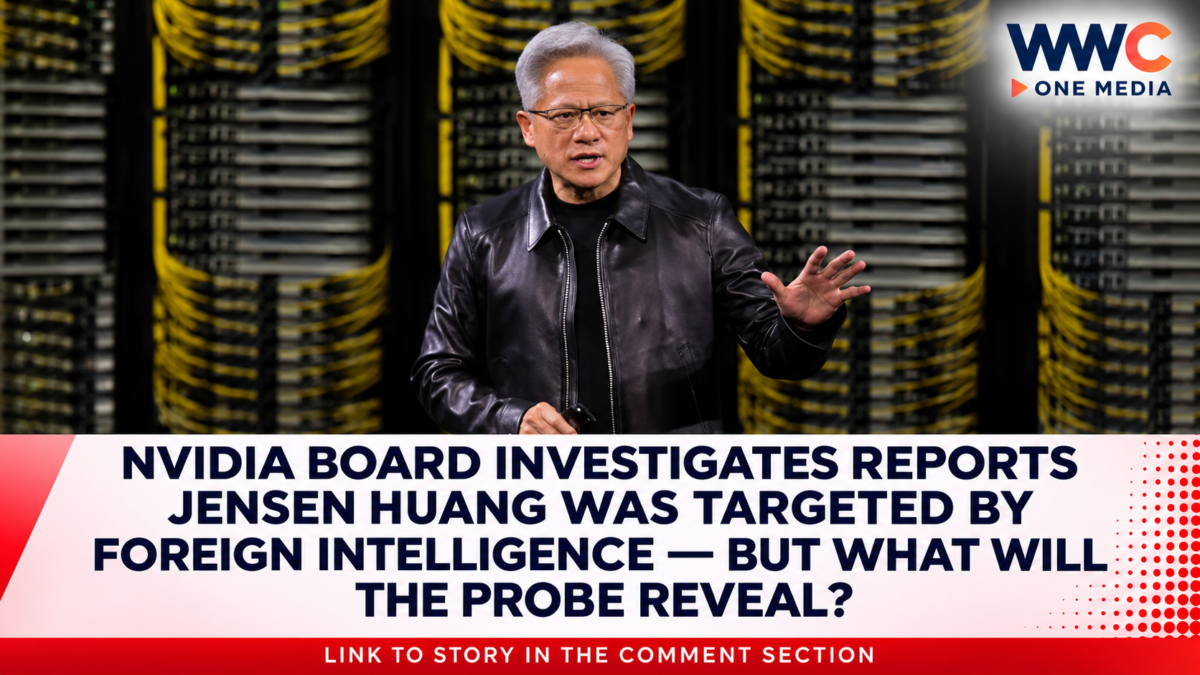
SANTA CLARA, CALIFORNIA — November 10, 2026 — Nvidia, the semiconductor powerhouse at the center of the global artificial intelligence revolution, is confronting an extraordinary leadership crisis after its board launched an independent investigation into allegations that chief executive Jensen Huang was targeted by a foreign intelligence operation.
The controversy sent Nvidia shares tumbling 4.3% on Monday, November 9, closing at $178.67 as investors weighed the implications for one of the world’s most influential technology companies.
The company announced the investigation on Sunday after reports concerning Huang’s relationship with a former executive of Singapore-based AI infrastructure company Megaspeed.
According to reporting by The New York Times and Reuters, US intelligence officials suspected the woman, identified as Alice Huang, of gathering information for China.
Huang subsequently acknowledged that he had been unfaithful to his wife.
However, the allegations of intelligence activity have not been established in a public criminal proceeding, and there is no confirmed finding that Huang knowingly participated in espionage or disclosed sensitive information.
Nvidia’s board says it has no reason to believe company secrets or American national-security information have been compromised.
The investigation nevertheless comes at a dangerous moment for the company.
Investors are already questioning the sustainability of the enormous spending boom surrounding artificial intelligence, while data-center developers face rising electricity costs, financing pressures and increasing regulatory scrutiny.
CNBC’s November 9 coverage, including commentary involving Jim Cramer, highlighted the unusual combination of Nvidia’s leadership controversy and wider concerns about the AI infrastructure trade.
But the greatest uncertainty may be whether Nvidia can preserve investor confidence if its celebrated founder becomes a distraction from the technology business he helped build.
Nvidia Board Launches Independent Investigation Into Jensen Huang
Nvidia confirmed on November 8 that its directors had opened an independent investigation following reports that Huang was the target of a foreign intelligence effort.
The inquiry will be overseen by a committee of independent directors working with outside legal counsel.
The board emphasized that protecting US national and economic security was a priority.
It also expressed continued confidence in Huang and his executive team.
Huang has pledged to cooperate with the investigation.
These details matter because the inquiry is being conducted by Nvidia’s board, rather than representing a public announcement that Huang has been criminally charged.
The distinction is essential.
An internal corporate investigation can examine whether executives complied with company policies, governance responsibilities and disclosure obligations.
A government investigation may address entirely different legal questions.
The existence of one does not establish wrongdoing under the other.
For now, Huang remains Nvidia’s chief executive.
No final investigative finding or board decision to remove him has been announced.
Why Alice Huang and Megaspeed Are at the Center of the Controversy
The controversy involves Alice Huang, a former executive associated with Singapore-based Megaspeed, a business connected to AI data-center infrastructure.
According to reports citing US intelligence assessments, officials suspected that she had links to Chinese intelligence.
Investigators were reportedly interested in her interactions with Jensen Huang and whether those contacts could have provided access to commercially or strategically sensitive information.
The allegations are serious because Nvidia’s chips are essential to the development of advanced artificial intelligence systems.
Huang also maintains close relationships with technology executives and government officials involved in US semiconductor policy.
However, intelligence suspicions reported by unnamed sources are not equivalent to proven findings.
China’s Foreign Ministry has rejected the spying allegations, describing them as an attempt to discredit Beijing.
Nvidia has said it does not believe sensitive company or national-security information was compromised.
The independent board investigation is intended to examine the available information.
Jensen Huang Acknowledges Personal Misconduct
Huang addressed Nvidia employees after reports of the relationship became public.
He acknowledged being unfaithful to his wife and expressed regret for the consequences of his personal conduct.
His admission confirmed the existence of a personal relationship, but it did not establish the separate allegation that the woman was acting on behalf of Chinese intelligence.
Those issues must not be conflated.
The first concerns Huang’s acknowledged personal conduct.
The second concerns allegations of espionage and the possibility that sensitive information could have been exposed.
The investigation may also examine whether Nvidia’s leadership provided complete and accurate information to its board and investors.
But there has been no publicly established conclusion that Huang misled shareholders.
Megaspeed’s AI Chip Business Raises Export-Control Questions
The case has broader implications because Megaspeed has previously faced scrutiny over its business involving advanced Nvidia processors.
US authorities have investigated concerns that powerful AI equipment purchased through regional business arrangements might have reached restricted Chinese customers.
American export controls place limits on sales or transfers of certain advanced semiconductors to China.
Those restrictions are designed partly to prevent sensitive computing technology from supporting military or intelligence activities.
According to earlier reporting, a company associated with Megaspeed purchased billions of dollars in equipment containing Nvidia chips.
However, equipment purchases alone do not demonstrate illegal diversion.
Investigators must establish whether specific transactions violated applicable restrictions.
As previously reported by WWC ONE MEDIA, the controversy involving Megaspeed and suspected Chinese intelligence activity had already raised concerns before Nvidia announced its latest board investigation.
Related WWC ONE MEDIA coverage: US Intelligence Investigates Alleged Chinese Spy With Links to Nvidia’s CEO — Could Singapore’s AI Data-Centre Industry Face Tougher Scrutiny Next?
The November 8 announcement marks a new stage because Nvidia’s directors have now formally initiated their own review.
Nvidia Shares Fall 4.3% as Investors Reassess Leadership Risk
Nvidia shares closed at $178.67 on November 9, down 4.3%, according to the Associated Press.
The decline represented a substantial reduction in market capitalization for one of the world’s largest publicly traded companies.
Nvidia had already experienced significant volatility during the preceding weeks.
Concerns about AI infrastructure spending, increasingly cautious lenders and changing political expectations have placed pressure on technology stocks.
The leadership controversy added another source of uncertainty.
Investors must now consider two questions simultaneously.
Can Nvidia continue delivering extraordinary growth as its customers spend heavily on AI infrastructure?
And can Huang continue leading the company without the ongoing investigation undermining management’s credibility?
A falling stock price does not establish that Nvidia’s business has deteriorated by an equivalent amount.
Market capitalization represents investors’ valuation of the company, not cash that has been withdrawn from its balance sheet.
Nevertheless, the selloff demonstrates how quickly concerns about corporate leadership can affect investor sentiment.
Jim Cramer Says Nvidia’s Technology Remains Valuable
CNBC commentator Jim Cramer has emphasized Nvidia’s central role in the artificial intelligence economy, even as the controversy surrounding Huang creates new uncertainty.
Reporting on his November 9 commentary indicated that Cramer saw the chipmaker’s core technology as valuable regardless of the potential disruption to its leadership.
That view is based on Nvidia’s market position.
Its processors, networking equipment and software ecosystem support many of the world’s largest AI computing installations.
Replacing that technological infrastructure would be difficult for numerous customers.
However, a strong product portfolio does not eliminate governance risk.
Cramer also discussed the importance of investors preparing for the possibility of leadership changes.
His comments should be understood as market analysis rather than confirmation that Huang is about to resign or be dismissed.
The board has explicitly expressed confidence in its CEO.
No succession announcement has been made.
Why Jensen Huang Is So Important to Nvidia’s Identity
Huang co-founded Nvidia in 1993 and has led the business through several major technology transitions.
The company began as a graphics-chip manufacturer closely associated with gaming.
It later expanded into professional computing, scientific applications, high-performance networking and artificial intelligence.
That transformation made Huang one of Silicon Valley’s most recognizable executives.
He became a central figure in the industry’s shift toward accelerated computing.
His public presentations and relationships with major customers have also helped shape market expectations.
This creates what investors call key-person risk.
A company may depend heavily on the experience, relationships and leadership of one individual.
When that person faces unexpected uncertainty, investors can question how smoothly the business would operate under different management.
Analysts cited by the Associated Press described Huang as unusually important to Nvidia’s strategy.
That does not mean Nvidia cannot operate without him.
It means succession planning and governance have become more important questions for shareholders.
Does Nvidia Have a Clear Successor?
One issue receiving increased attention is whether Nvidia has prepared a sufficiently clear leadership succession plan.
The company maintains a team of senior executives overseeing finance, operations, engineering, product development and other functions.
However, Huang has been unusually prominent in its strategy and public identity.
A sudden leadership change could create uncertainty about customer relationships, strategic decisions and the company’s dealings with governments.
That potential risk does not mean Huang’s departure is inevitable.
The board may ultimately determine that no action against him is necessary.
But investors are increasingly asking whether Nvidia’s corporate structure is prepared for unexpected changes at the top.
Those questions are especially consequential for a company whose influence extends across the global AI supply chain.
Data Centers Remain the Foundation of Nvidia’s Growth
Beyond the investigation, Nvidia faces another major question: how long can the AI infrastructure spending boom continue?
The company supplies processors used to train and operate artificial intelligence models.
Its customers include major cloud-computing providers, AI laboratories and data-center operators.
Advanced AI systems require expensive chips, networking equipment, cooling and enormous amounts of electricity.
As demand grows, companies continue planning large computing facilities around the world.
But developers are encountering constraints.
Electricity networks may need substantial upgrades.
Construction projects can face local opposition.
Financing costs have risen for some borrowers.
And investors are becoming more demanding about the returns those projects will generate.
For Nvidia, delayed data-center construction could affect the timing of future equipment orders.
That does not mean every project cancellation translates directly into lost Nvidia revenue.
But it makes the pace of infrastructure development an increasingly important variable in the company’s growth outlook.
US Data-Center Opposition Adds Pressure to the AI Industry
The political environment is becoming another challenge.
Communities across the United States have raised concerns about electricity prices, water consumption and the environmental effects of large computing facilities.
Following the November 3 midterm elections, data-center development faced renewed political scrutiny.
As previously reported by WWC ONE MEDIA, local voting measures across the United States revealed substantial opposition to certain AI infrastructure proposals.
Related WWC ONE MEDIA coverage: America Rejects AI Data Centers in 46 of 47 Local Votes as Big Tech Faces a Massive Backlash — But Could the Trillion-Dollar AI Boom Be in Danger?
That political backlash is separate from Nvidia’s internal investigation.
However, both developments can influence investor confidence in the future growth of the AI sector.
Projects delayed by permitting or power shortages may affect the schedule of infrastructure purchases.
For semiconductor suppliers, the important issue is whether customers can deploy new computing equipment as quickly as they originally planned.
Congress Is Asking Questions About Government Land for AI Projects
The debate over data centers is also reaching the federal government.
US lawmakers have questioned plans to use public land for large AI infrastructure developments.
Environmental concerns include energy consumption, water requirements and the use of federally controlled property.
As WWC ONE MEDIA previously reported, Senator Martin Heinrich demanded additional information about proposed data-center projects covering more than 17,000 acres across western US states.
Related WWC ONE MEDIA coverage: Trump’s AI Data Center Plan Targets Over 17,000 Acres of US Public Land as Top Democrat Demands Answers — But Who Will Pay the Environmental Price?
Those questions are unrelated to the personal allegations involving Huang.
But they show how the investment environment for AI infrastructure is becoming more politically complicated.
The industry must demonstrate not only that its technology is valuable, but also that its facilities can operate responsibly and deliver benefits to surrounding communities.
Nvidia’s Investigation Could Intensify US–China Chip Restrictions
The allegations involving Megaspeed also threaten to complicate an already sensitive commercial relationship between Nvidia and China.
Washington restricts the transfer of certain advanced AI processors because of concerns about their potential military applications.
Nvidia has argued that access to international markets is important for American technology leadership.
Huang has personally advocated for policies that would allow US technology firms to compete overseas while respecting national-security safeguards.
The current controversy may increase political pressure for tougher enforcement.
Former US antitrust official Jonathan Kanter told CNBC that heightened scrutiny could affect chip suppliers beyond Nvidia.
But stricter export rules are not automatic.
Any specific policy change would require action by the relevant government authorities.
There is also no confirmed public finding that Huang personally authorized illegal exports.
The immediate question is whether investigators can establish that export rules were violated and, if so, which individuals or businesses were responsible.
Nvidia’s Valuation Faces a Double Test
The company has also been under pressure from broader stock-market concerns.
Investors are questioning whether enormous AI infrastructure investments can generate sufficient profits over time.
Higher borrowing costs and slower deployment schedules could influence the valuations of AI-related businesses.
As previously reported by WWC ONE MEDIA, Jim Cramer has warned that investors may be underestimating the effect of elevated Treasury yields on highly valued technology stocks.
Related WWC ONE MEDIA coverage: AI Stocks Keep Defying 5% Treasury Yields — But Cramer Warns the Market May Be Ignoring a Dangerous Signal
The issue is particularly relevant to Nvidia.
A company valued on expectations of extraordinary future growth may face sharp market reactions when investors become less confident about those expectations.
The investigation introduces an additional source of uncertainty.
But valuation risk and the allegations concerning Huang are distinct issues.
One concerns the economics of AI investment.
The other concerns leadership, governance and possible national-security implications.
What Should Investors Watch Next?
The next developments will be important for Nvidia’s shareholders and customers.
First, the independent board committee must examine the available evidence concerning the alleged foreign intelligence effort.
Second, investors will watch for any further official information regarding Megaspeed and possible chip-export violations.
Third, Congress may intensify its scrutiny of Nvidia’s relationships with companies involved in international AI infrastructure.
Fourth, leadership questions could continue affecting the stock until the company provides additional clarity.
Finally, Nvidia’s scheduled November 17 earnings report will give investors another opportunity to assess the underlying business.
Strong financial results could reassure the market about demand for AI processors.
But earnings alone would not resolve the independent investigation.
Similarly, the investigation’s outcome would not settle broader questions about the sustainability of AI infrastructure spending.
The Bigger Picture: Is Nvidia Facing a Crisis Beyond Its CEO?
Nvidia’s latest controversy arrives at a moment when the global AI industry is undergoing a significant reassessment.
The company remains a leading supplier of advanced processors.
Its technology supports data centers, cloud platforms and artificial intelligence applications around the world.
But market expectations are enormous.
Infrastructure developers face growing political and financial constraints.
US–China technology tensions remain intense.
And Nvidia’s famous founder is now the subject of an independent corporate investigation.
The company has made clear that it currently has no reason to believe sensitive information was compromised.
The allegations remain under review.
There is no confirmed finding that Huang engaged in espionage, knowingly disclosed confidential information or violated export-control laws.
Yet the case has exposed a wider vulnerability.
A business that influences the direction of the global AI economy must be able to maintain strong governance, investor confidence and operational continuity even when questions arise about its most prominent leader.
Nvidia’s technology remains valuable. The unresolved question is how much uncertainty investors are willing to tolerate around the company and the executive most closely associated with its success.
And as Jensen Huang faces an independent investigation while Wall Street questions the future of AI data-center spending, one question now dominates the debate: Will Nvidia emerge with its leadership and reputation intact—or could the combination of political scrutiny, export-control risks and market pressure trigger a far deeper crisis for the AI giant?