NEW YORK — November 10, 2026 — America’s biggest restaurant chains are discovering that cheaper meals may no longer be enough to win back customers.
After years of battling inflation, rising operating costs and weakening consumer demand with discounts, fast-food and casual-dining companies are returning to something more fundamental: making their food taste better.
Burger King is upgrading its famous Whopper and chicken nuggets. Wendy’s is testing crispier bacon, creamier Frosty desserts and improved salads. Chipotle is refining its premium brisket, while McDonald’s is experimenting with hand-breaded chicken and higher-quality coffee.
Even Chili’s and Applebee’s are investing in better ingredients and food preparation as consumers become more selective about where they spend their money.
The strategy marks an important change in the US restaurant industry.
For much of the past two years, companies have emphasized affordability through value meals, promotional bundles and limited-time discounts.
But research from Black Box Intelligence indicates that customers have been dining out less frequently and becoming more demanding about the restaurants they choose.
That means the restaurant business is facing a new challenge.
Customers still want affordable meals, but they increasingly expect better taste, freshness, service and overall experience in return for every dollar they spend.
The early results suggest the strategy could work.
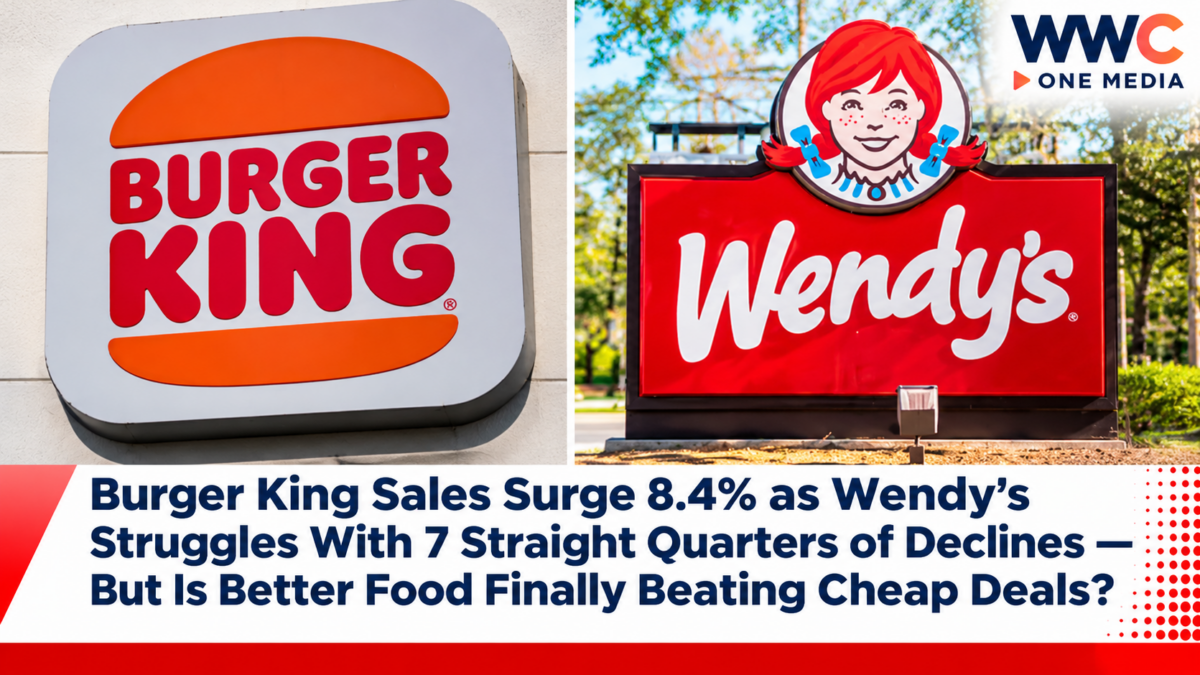
Burger King’s US same-store sales climbed 8.4% during the third quarter of 2026.
Meanwhile, Wendy’s reported its seventh consecutive quarter of declining comparable sales, and McDonald’s recorded a 0.2% decrease in its US business.
The question is whether better food can restore long-term restaurant traffic—or whether financially pressured consumers will continue cutting back regardless of how much the recipes improve.
Burger King’s Comeback Starts With the Whopper
Burger King has become one of the clearest examples of a restaurant chain investing in its core menu.
The brand has spent several years implementing its Reclaim the Flame turnaround program, which includes restaurant modernization, advertising, operational improvements and menu upgrades.
Its flagship Whopper received changes to its bun and mayonnaise.
The company also introduced a redesigned chicken nugget featuring 100% white-meat chicken, crispier breading and an improved marinade.
Burger King reformulated its dipping sauces as well.
According to Restaurant Brands International CEO Josh Kobza, the company focused first on products with significant sales potential and improvements that restaurants could execute without excessive operational complexity.
The results have been encouraging.
During the third quarter, Whopper sales increased by a double-digit percentage.
Chicken nugget sales climbed more than 35%.
Most significantly, US comparable sales increased 8.4%.
That figure measures sales growth at comparable restaurants, rather than simply counting revenue from additional locations.
But the results should not be attributed exclusively to recipe changes.
Burger King has also invested in promotions, advertising, restaurant renovations and franchise operations.
The menu improvements are one important component of a broader turnaround.
As previously reported by WWC ONE MEDIA, Burger King has also been transferring more company-operated US restaurants to local franchisees to improve operating performance.
Related WWC ONE MEDIA coverage: Burger King Bets Its U.S. Comeback on Local Franchisees as Turnaround Gains Momentum
The challenge now is whether Burger King can maintain its sales momentum after the initial excitement surrounding improved menu items fades.
Wendy’s Tests Better Bacon and Creamier Frosties as Sales Continue Falling
Wendy’s faces a more difficult situation.
The hamburger chain reported a 5.7% decline in US same-restaurant sales during the third quarter.
It was the seventh consecutive quarterly decline for the company.
Global systemwide sales fell 5.9%, while reported quarterly net income dropped to approximately $15.1 million from $44.3 million a year earlier.
The results demonstrate why the company is pursuing a major turnaround.
On November 5, Wendy’s introduced its Dave’s Way strategy, a multiyear program intended to strengthen customer traffic, restaurant profitability and competitive positioning.
One pillar of the plan involves improving the food itself.
CEO Bob Wright said the company was testing thicker and crispier bacon, richer Frosty desserts, whole-leaf lettuce and upgraded salads.
Wendy’s hopes those changes will make familiar menu items more appealing without requiring customers to learn an entirely new product lineup.
The company is also reviewing its breakfast strategy and franchise portfolio.
Its financial problems have attracted takeover interest.
Wendy’s rejected a proposed $1.4-billion acquisition led by Nelson Peltz’s Trian Partners and other investors, arguing that the offer undervalued the potential of its turnaround.
The company’s board also introduced measures designed to protect shareholders during the takeover process.
For Wendy’s, the next challenge is demonstrating that better food can translate into stronger traffic and sustainable earnings.
An improved Frosty may attract attention, but it will take more than one menu upgrade to reverse seven straight quarters of declining comparable sales.
Chipotle Is Betting on More Appealing Premium Ingredients
Chipotle Mexican Grill is also emphasizing product quality.
The fast-casual chain has been working to strengthen customer perceptions of its food as competition intensifies.
CEO Scott Boatwright recently highlighted improvements to the company’s brisket, which returned as a limited-time offering.
Chipotle believes stronger flavor and food execution can help encourage repeat visits.
But the chain faces a particular challenge.
Its meals often cost more than traditional fast food.
That means customers may compare the overall experience with less expensive alternatives.
A consumer deciding between a burrito and a discounted burger meal may consider not just taste but also price, portion size, freshness and convenience.
Chipotle must convince customers that its food provides enough additional value to justify their spending.
The company is therefore focusing on core menu execution as well as new product introductions.
Limited-time offerings can encourage trial purchases.
However, sustained growth depends on whether customers return after the promotion ends.
Chili’s Proves Customers May Pay More for a Better Restaurant Experience
The movement toward food quality is not limited to fast-food operators struggling with sales.
Chili’s, owned by Brinker International, has experienced substantial growth while improving its menu and overall dining proposition.
According to CNBC, Chili’s comparable sales increased approximately 52% cumulatively over the past three years.
The company has invested in products including burgers, baby back ribs and nachos.
Management is now focusing on improving steaks and salads.
Brinker CEO Kevin Hochman said the company plans to use additional dry-aging techniques to make beef more tender.
Those methods can increase costs.
But management believes customers may be willing to pay for a noticeable improvement in quality.
This represents an important shift in how restaurant companies define value.
Value does not necessarily mean the lowest price.
A customer may consider a meal worthwhile if it provides better taste, a satisfying portion and enjoyable service.
Chili’s recent performance suggests that consumers can still be attracted to restaurant dining when the overall offering meets their expectations.
However, its success cannot be attributed entirely to food quality.
Pricing, marketing, menu positioning and operational improvements also influence results.
Applebee’s Wants Juicier Chicken and Better Protein Options
Applebee’s is pursuing a similar strategy.
The casual-dining brand recently introduced an improved chicken tender designed to be juicier and more appealing.
Parent company Dine Brands plans to continue upgrading protein-based menu items during 2027.
CEO John Peyton has identified proteins as an important opportunity because customer preferences increasingly emphasize foods such as chicken and beef.
The strategy reflects the importance of signature items.
For many diners, the decision to visit a restaurant depends on a relatively small number of familiar dishes.
If those meals become noticeably better, customers may have a reason to return.
However, the economics remain challenging.
Higher-quality ingredients or more labor-intensive preparation can increase costs.
Restaurants must therefore ensure that better food supports stronger sales and restaurant-level profitability.
An upgrade that customers enjoy but that costs too much to deliver may not become a sustainable business strategy.
McDonald’s Tests Hand-Breaded Chicken as US Sales Slip
McDonald’s is also reexamining parts of its food offering.
The world’s largest burger chain reported a 0.2% decline in US comparable sales during the third quarter.
According to Reuters, customer visits also fell 4.6% year over year.
Management has been using promotional deals and advertising to attract financially pressured customers.
But the company is increasingly emphasizing food quality and consistency.
McDonald’s is testing hand-breaded chicken wings, strips and sandwiches at selected Chicago-area restaurants.
The company plans to expand testing to additional US and Irish locations in early 2027.
These products are not yet confirmed as permanent nationwide menu additions.
McDonald’s is also working to improve its coffee through fresher beans and upgraded equipment.
The changes could help the company compete in product categories where customer demand remains attractive.
Another important initiative is Make It Golden, a multiyear program launched in October to improve restaurant training and operational execution.
The company recognizes that better recipes are only valuable if customers receive the intended product consistently.
Even a popular menu item can disappoint if it is poorly prepared.
Domino’s Famous Recipe Overhaul Offers a Lesson
The strategy has a historical precedent.
In 2009, Domino’s Pizza acknowledged widespread criticism of its food and introduced major recipe changes.
The company updated its pizza sauce, crust seasoning and cheese blend.
It also used advertising that openly addressed customers’ previous complaints.
The turnaround became a notable example of product improvement and marketing working together.
Domino’s reported 9.9% US same-store sales growth in 2010.
The comparison is especially relevant because Burger King US president Tom Curtis previously worked at Domino’s.
Burger King is now using a similar approach by acknowledging opportunities to improve its most recognizable menu items.
But history does not guarantee the same outcome.
Consumer preferences, labor costs, ingredient prices and the competitive environment have changed.
A recipe overhaul may help restore demand, but its success depends on execution and how customers respond.
Why Discounts Alone May No Longer Be Enough
Restaurant chains spent much of the past two years promoting low-cost meals.
Those offers were designed to attract households affected by inflation and higher living expenses.
In some cases, value campaigns successfully encouraged traffic.
But frequent discounting creates financial challenges.
Lower prices can reduce profit margins.
Some customers may purchase discounted meals without buying additional products.
Franchisees may also have to absorb higher food, labor and operating costs.
If promotions encourage only short-term visits, restaurants can struggle to generate lasting improvements.
That is why companies are broadening their interpretation of value.
Instead of competing exclusively through price, they are emphasizing food that tastes better, feels fresher and provides a more satisfying experience.
However, the new strategy does not mean discounts are disappearing.
Affordability remains important, particularly for lower-income households and younger consumers.
The most successful restaurant brands may need to combine competitive prices with consistent quality.
Rising Food Costs Could Make Better Ingredients More Expensive
The move toward premium ingredients introduces another challenge.
Beef prices, labor expenses and other operating costs remain significant concerns for restaurant companies.
Improved meat quality or more complex preparation techniques may require additional investment.
For franchise operators, those costs can affect profitability even if sales improve.
The same issue is relevant to the Philippine restaurant industry.
As previously reported by WWC ONE MEDIA, Jollibee has faced pressure from commodity prices, logistics and supply-chain expenses while evaluating menu price adjustments.
Related WWC ONE MEDIA coverage: Jollibee Set for Four More Price Hikes This Year—But the Next Increase May Not Be the Last
That Philippine report is separate from the US restaurant earnings discussed here.
But the underlying business challenge is similar.
Restaurants must balance ingredient quality, customer affordability and operating margins.
Raising prices too aggressively can discourage visits.
Reducing prices without controlling costs can weaken profitability.
Improving food quality adds another variable to that calculation.
The Philippines Is Seeing Its Own Battle for Better Food and Value
The global shift toward menu innovation is also visible in the Philippines.
McDonald’s Philippines recently introduced its 2026 Christmas menu, featuring Sweet BBQ Chicken McDo and new McFlurry varieties inspired by familiar Filipino flavors.
The lineup includes Ube with Oreo, Choco Pinipig and a Mindanao-exclusive Durian McFlurry.
The campaign also features promotional deals starting at ₱109.
As WWC ONE MEDIA previously reported, the combination of seasonal products, local flavors and affordable bundles forms part of the company’s attempt to attract diners during the holiday period.
Related WWC ONE MEDIA coverage: McDonald’s Philippines Unleashes ₱109 Christmas Deals, Sweet BBQ Chicken and 3 New McFlurry Flavors — But Can It Steal the Holiday Spotlight From Jollibee?
The Philippine Christmas campaign and McDonald’s US chicken tests are different programs.
However, both illustrate the importance of offering products that customers consider distinctive and worth buying.
The challenge is moving beyond initial curiosity and generating repeat demand.
Jollibee Turns Viral Food Trends Into New Menu Products
Jollibee is also using innovation to strengthen its competitive position.
The company introduced a Pistachio Choco Sundae inspired by the international Dubai chocolate trend.
Priced at ₱79, the dessert combines familiar vanilla soft serve with chocolate and pistachio flavors.
It was developed in collaboration with Filipino pastry chef Nouel Catis, whose work is associated with the Dubai chocolate phenomenon.
As WWC ONE MEDIA reported, the product is being offered as a limited-time seasonal item through December 31, 2026, subject to availability.
Related WWC ONE MEDIA coverage: Jollibee Brings Viral Dubai Chocolate Craze to the Philippines With ₱79 Christmas Sundae — But Filipinos Have Only Until December 31 to Try It
The example illustrates how restaurant operators can use familiar products and new flavors to generate consumer interest.
But a viral product is not automatically a long-term success.
Restaurants need to assess customer satisfaction, repeat purchases and profitability before deciding whether new items deserve a permanent place on the menu.
What Restaurant Investors Should Watch in 2027
The industry-wide shift toward better food creates several important questions for investors.
First, restaurant companies need to demonstrate stronger customer traffic.
An increase in average spending is less reassuring if fewer people are visiting.
Second, comparable sales must improve consistently.
One successful quarter may reflect a promotion or temporary product launch rather than a lasting recovery.
Third, restaurant-level margins will matter.
Menu improvements must generate enough additional sales to justify their costs.
Fourth, franchisees need to benefit.
A corporate strategy that looks attractive to shareholders may fail if individual restaurants cannot implement it profitably.
Finally, companies must demonstrate consistent execution.
Better ingredients are only part of the process.
Training, kitchen equipment, preparation standards and customer service determine whether the improved experience reaches diners.
The Bigger Picture: Is Taste Becoming the New Fast-Food Battleground?
The latest restaurant-industry strategy reflects a change in consumer priorities.
Americans are not necessarily abandoning dining out.
But many are choosing more carefully when and where to spend.
Burger King’s encouraging sales figures show that a turnaround combining improved food, promotions and operational changes can produce substantial gains.
Wendy’s continuing declines demonstrate that other chains still have significant work ahead.
McDonald’s is testing new chicken products and upgrading coffee.
Chipotle is strengthening its premium ingredients.
Chili’s and Applebee’s are investing in better versions of familiar menu items.
The trend suggests that the next phase of restaurant competition may revolve less around who can advertise the cheapest meal and more around who can deliver the most convincing combination of price, quality and experience.
But the strategy is not guaranteed to succeed.
Better ingredients can raise costs.
New recipes can disappoint customers.
And even an excellent meal may struggle to attract people who are reducing discretionary spending.
The restaurants that win may not be those offering the cheapest food or the most expensive ingredients. They may be the ones that consistently convince customers every visit is worth the money.
And as Burger King’s sales rebound while Wendy’s and McDonald’s struggle to rebuild momentum, one question could shape the future of the restaurant industry: Will better burgers, chicken and desserts finally bring diners back—or has the era of expensive restaurant meals changed consumer habits for good?