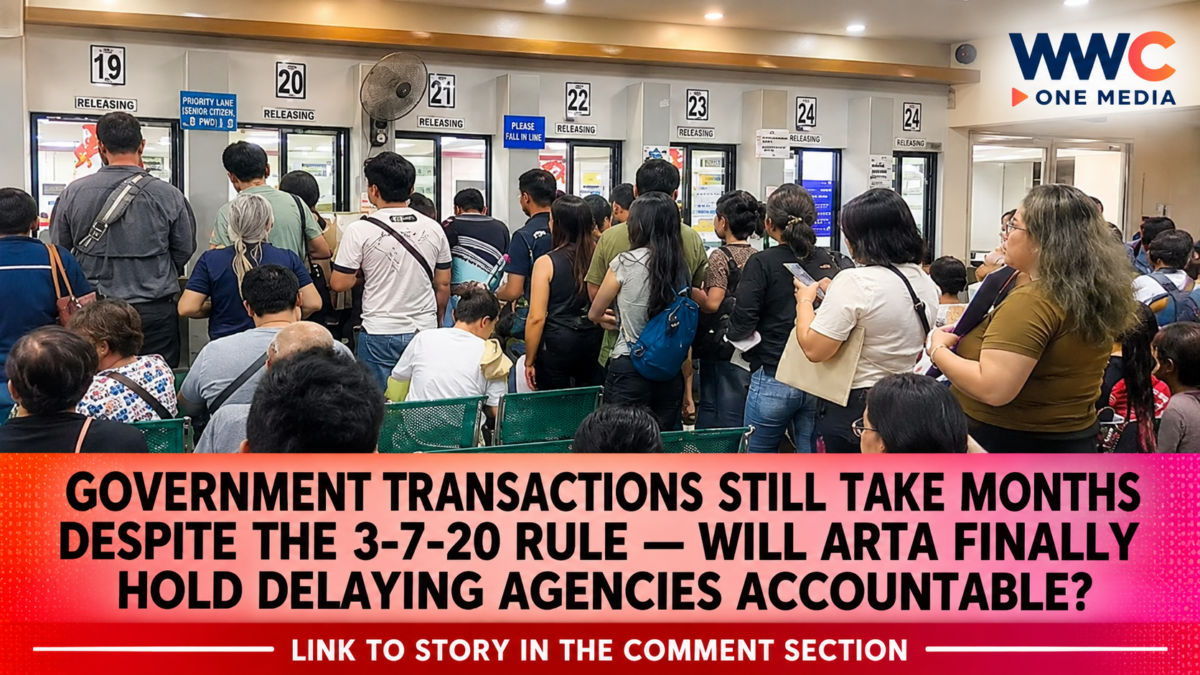
Despite years of government digitalization efforts and the implementation of the country’s anti-red-tape law, residents and businesses in Eastern Mindanao continue to encounter delays when dealing with government offices.
Unstable internet connections, system outages, inadequate equipment, staff shortages and lengthy approval procedures remain major obstacles to faster public service delivery, according to regional agencies and local government units (LGUs) that participated in a government reform workshop in Davao City.
The concerns were raised during the November 5, 2026, regional rollout of the Anti-Red Tape Authority’s (ARTA) Philippine Ease of Doing Business (EODB) Reform Guidebook and the World Bank Group’s Business Ready (B-Ready) report.
The workshop brought together national and regional government agencies, local officials and business representatives to examine why government transactions remain slow despite reforms intended to simplify procedures and improve efficiency.
The findings reveal a major challenge for the Philippines: passing laws and introducing online platforms are not enough if government offices still lack the infrastructure, personnel and coordination needed to deliver services efficiently. SunStar Publishing Inc.+1
Internet Problems and System Outages Continue to Disrupt Government Services
One of the most significant problems identified during the workshop was unreliable digital infrastructure.
Government offices reported unstable internet connectivity, insufficient equipment and inadequate server capacity. These weaknesses can interrupt online applications, delay document processing and force personnel to return to manual procedures.
Other problems include inconsistent requirements between offices, different interpretations of government policies, lengthy approval processes and bottlenecks involving permits and clearances.
Limited budgets and insufficiently trained personnel add another layer of difficulty. Even when an agency introduces an online system, its ability to serve the public can remain limited if employees lack the necessary training or technical support.
Digital literacy among citizens is also uneven, meaning that some applicants continue to struggle with online government services even when electronic options are available.
Participants recommended harmonizing national and local government requirements, improving internet connectivity, strengthening server capacity, increasing staffing and establishing clearer processing timelines.
These recommendations point to a wider problem: digital transformation must improve the entire government process, not simply replace paper forms with electronic versions. SunStar Publishing Inc.+1
The 3-7-20 Rule Is Being Ignored in Some Government Transactions
ARTA Eastern Mindanao Regional Field Office Chief Administrative Officer Eldie Barrientos said many complaints received by the agency involve government offices that fail to follow the processing periods stated in their Citizen’s Charters.
Under Republic Act No. 11032, also known as the Ease of Doing Business and Efficient Government Service Delivery Act of 2018, government agencies are generally required to follow the 3-7-20 processing-time standards:
- Three working days for simple transactions.
- Seven working days for complex transactions.
- Twenty working days for highly technical applications.
Barrientos said some transactions that should take only three days can instead stretch to one or two months.
The delays are particularly concerning because the law was specifically designed to reduce unnecessary procedures, discourage inefficiency and make government services more predictable for the public.
The prescribed periods generally begin once a complete application or request has been received. Certain legal exceptions and authorized extensions may apply, so not every government transaction automatically falls under the same deadline. SunStar Publishing Inc.+2
ARTA Says Complaints Are Increasing as More Filipinos Learn Their Rights
Although Barrientos did not provide a specific number of complaints, he said reports of delayed government transactions have been increasing as more people become aware of ARTA and its complaint mechanisms.
Residents who experience unreasonable delays can report concerns through the agency’s regional office, either in person or by email. Complaints can also be submitted through the Electronic Complaints Management System available on the eGovPH application.
The Citizen’s Charter is an important reference for applicants because it identifies the requirements, procedures, fees, responsible personnel and expected processing time for a particular government service.
For citizens, knowing these standards can help them determine whether an office is following its published procedures or causing an unreasonable delay.
ARTA’s official guidance also clarifies that Republic Act No. 11032 covers both business-related and non-business-related government transactions. This means the law’s scope is not limited to permits and business registrations; other government services are covered as well. Anti-Red Tape Authority+1
One Valid ID Should Be Enough for Government Transactions
Another important issue raised during the reform rollout concerns identification requirements.
ARTA Director General Ernesto Perez said in a November 6 interview with GMA Network’s Unang Hirit that government agencies should no longer require applicants to present two valid identification cards when one valid ID is sufficient.
The Philippine National ID is particularly important in this policy.
Executive Order No. 162, issued in 2022, recognizes the PhilID and PhilSys Number as sufficient proof of identity and age for government and private transactions covered by the order, without requiring additional identification documents.
The policy is intended to eliminate unnecessary requirements that force people to secure multiple IDs before completing basic transactions.
However, simplifying identification requirements is only one part of the solution. Government offices must also ensure that their employees understand the rules and apply them consistently.
Davao City Is Exploring Digital Signatures to Reduce Paperwork Delays
Davao City is among the local governments pursuing digital solutions to improve internal government operations.
In a separate development, the City Council authorized Mayor Sebastian Duterte to sign an agreement with the Department of Information and Communications Technology (DICT) that would allow the city to process and approve digital-signature applications for its own employees.
The proposed arrangement would make Davao City the first local government unit in the Philippines to serve as a Registration Authority under the Philippine National Public Key Infrastructure.
Councilor Bonz Andre Militar said applications for digital certificates had reportedly taken months to process, despite the DICT’s stated policy of issuing certificates within five calendar days after identity verification.
The initiative is intended to reduce the administrative bottleneck and help city officials process documents more efficiently.
However, the agreement still needs to be signed and the relevant personnel trained before the arrangement becomes operational. It should not yet be interpreted as a guarantee that all Davao City government transactions will become faster.
Government Offices Have Already Introduced Online Services, but Implementation Remains Uneven
The ARTA workshop also acknowledged that several agencies and LGUs have already introduced measures to improve public transactions.
These include online appointment systems, electronic payments, one-stop shops, electronic queueing systems and complaints desks.
Some government services and professional examinations have also been brought closer to regional communities, reducing the need for applicants to travel to major urban centers.
However, the progress is uneven. While some offices have made significant improvements in digitalizing their processes, others continue to struggle with limited resources, unreliable connectivity and coordination problems.
This uneven implementation means that a transaction may be convenient in one government office but unnecessarily complicated in another.
The experience of residents therefore depends not only on national policies but also on the capacity of individual agencies and local governments to put those policies into practice.
Previous ARTA Findings Show That Digitalization Remains a National Problem
The challenges identified in Davao are consistent with concerns raised in ARTA’s earlier nationwide assessments.
In an October 2025 report, the Philippine Information Agency cited results from ARTA’s 2024 Report Card Survey 2.0, which covered 904 government offices and gathered feedback from more than 25,500 clients.
Of the 868 offices successfully scored, 535, or 61.64 percent, received the lowest rating category, described as requiring thorough review.
The survey identified payments and processes as the weakest area of government service delivery. Four out of 10 clients reportedly were not offered digital or electronic payment options, forcing them to rely on slower manual transactions.
Only 78 of the 904 assessed offices reported having no pending transactions, while just 25 of 200 local government units had fully automated their Electronic Business One-Stop Shops.
These findings demonstrate that the difficulties discussed during the November 2026 Davao workshop are part of a broader national challenge rather than an isolated regional problem. Philippine Information Agency
Digital Government Expansion Must Come With Reliable Infrastructure
The Philippines continues to invest in digital government systems, including national identification, electronic payments and online public-service platforms.
WWC ONE MEDIA previously reported on the government’s ₱2.48-billion public-private partnership project to upgrade the Digital National ID system, which is intended to strengthen registration, authentication and related technology infrastructure.
Read more: ₱2.48-Billion PPP Approved to Upgrade Philippines’ Digital National ID System
Another development involves the planned integration of Social Security System identification and selected membership services into the eGovPH platform.
These projects could make public services more accessible, but they also increase the importance of reliable internet connections, secure data systems, trained employees and effective coordination between government agencies.
A digital platform cannot deliver its full benefits if it regularly crashes, cannot communicate with other systems or remains inaccessible to the people who need it.
ARTA Expands Reform Efforts Through Partnerships With Universities
The November 5 rollout also included agreements between ARTA and Ateneo de Davao University, Saint Mary’s University and the University of the Philippines.
The partnerships aim to integrate ease-of-doing-business topics into academic curricula, including master’s programs.
Barrientos said ARTA was also finalizing an agreement with the Commission on Higher Education in Davao Region. The agency was scheduled to hold a symposium for approximately 700 students at Holy Cross of Davao College on November 9.
The initiative reflects an effort to make government efficiency and public-service reform part of wider institutional education, rather than limiting the discussion to government employees.
ARTA’s Eastern Mindanao Regional Field Office covers the Davao Region, Soccsksargen and mainland areas of the Bangsamoro Autonomous Region in Muslim Mindanao, including Maguindanao del Norte, Maguindanao del Sur and Cotabato City.
The scale of its coverage makes effective regional coordination especially important.
The Real Test Is Whether Filipinos Will Finally Spend Less Time in Government Offices
For ordinary Filipinos, the success of anti-red-tape reforms is not measured by the number of workshops conducted, agreements signed or digital platforms launched.
It is measured by whether people can obtain permits, clearances, benefits and other essential services without unnecessary delays.
Businesses need predictable approval schedules to operate and expand. Workers need accessible government services. Families need reliable assistance, while students and professionals need documents processed within reasonable periods.
The November 2026 findings show that important obstacles remain, even as agencies continue introducing reforms.
The next challenge for ARTA and local governments is to turn recommendations into measurable improvements: fewer manual procedures, reliable online systems, consistent requirements, adequate staffing and strict compliance with processing deadlines.
Until those improvements reach the frontline, Filipinos may continue facing the same frustrating experience—long queues, repeated visits and applications that take weeks or months despite rules designed to make government service faster.
Two alternative cliffhanger headlines: