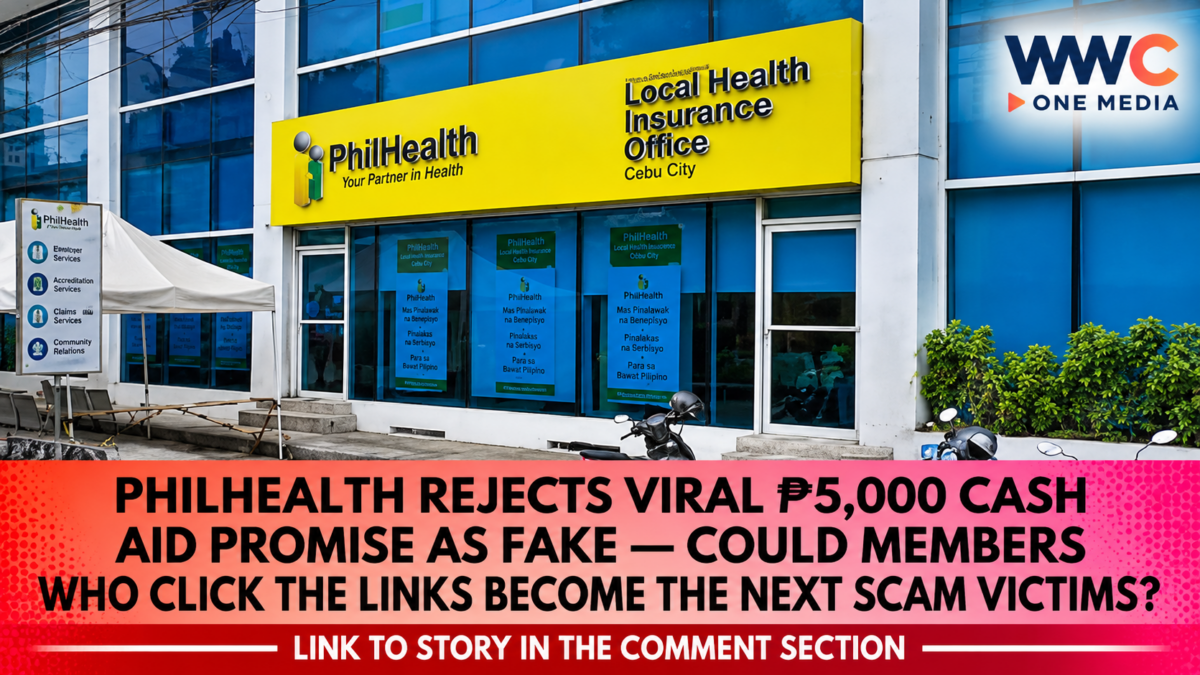
PhilHealth has warned millions of Filipinos not to believe a viral social media video promising ₱5,000 in automatic cash assistance to every member, declaring the announcement fake and denying that any such nationwide payout has been authorized.
In an advisory issued on November 9, 2026, the Philippine Health Insurance Corporation (PhilHealth) clarified that it has no program distributing an unconditional ₱5,000 cash benefit to all members under the Department of Social Welfare and Development’s (DSWD) Ayuda para sa Kapos ang Kita Program (AKAP).
The misleading video reportedly claimed that members could collect the money even without paying PhilHealth contributions, presenting a supposed payout schedule for November 9.
PhilHealth rejected both claims, stressing that it had not announced or approved the alleged distribution.
The warning is particularly important because the video could encourage people to click fraudulent links, disclose personal information or provide banking details to individuals pretending to facilitate government assistance. SunStar Publishing Inc.+2
PhilHealth Benefits Are Health Coverage, Not Automatic Cash Handouts
PhilHealth emphasized that its primary responsibility is to provide health insurance coverage and healthcare benefits under established policies—not to distribute unrestricted cash to every registered member.
For qualified inpatient cases, PhilHealth generally pays accredited healthcare facilities through its All Case Rates system. The corresponding benefit is deducted from the patient’s hospital bill, including applicable professional fees.
This means members generally receive the value of their PhilHealth coverage through reduced hospital expenses rather than receiving the benefit as cash deposited into their personal bank accounts.
The agency also provides outpatient and specialized benefit packages, including coverage for selected medical procedures, dialysis, cancer treatment and other qualified healthcare services.
These benefits have specific eligibility conditions, medical requirements and coverage limits. Simply possessing a PhilHealth identification card or Member Data Record does not create an entitlement to an automatic cash payout. SunStar Publishing Inc.+1
AKAP Is a DSWD Program, Not a PhilHealth Benefit
One of the biggest problems with the viral announcement is that it combines two separate government agencies and their responsibilities.
The Ayuda para sa Kapos ang Kita Program, or AKAP, is implemented by the Department of Social Welfare and Development—not PhilHealth.
AKAP is intended to assist qualified low-income individuals and workers whose earnings are insufficient to meet their basic needs, particularly amid rising prices of goods and services.
Under the program’s 2025 guidelines, applicants are subject to eligibility requirements and assessment. Assistance may cover:
- Medical expenses
- Funeral assistance
- Food assistance
- Cash relief
- Rice subsidies
The amount is not automatically fixed at ₱5,000 for every applicant. The type and value of assistance depend on the applicant’s circumstances, supporting documents and assessment by a DSWD social worker.
Most importantly, being a PhilHealth member does not automatically qualify someone for AKAP assistance.
This distinction matters because the viral video makes it appear that PhilHealth membership alone guarantees a cash benefit, which the agency has explicitly denied. SunStar Publishing Inc.+1
The Supposed November 9 Payout Schedule Is Also Fake
PhilHealth specifically rejected the video’s claim that a cash distribution was scheduled for November 9, 2026.
The agency stressed that no such payout had been officially announced or authorized.
Members should therefore be cautious about posts asking them to register, submit identification documents or provide account information to supposedly claim the ₱5,000.
A legitimate government assistance program should have verifiable eligibility rules, official announcements and authorized application or distribution procedures.
A viral video, social media post or forwarded message is not proof that a government payout exists.
The agency encouraged members to verify announcements through its official website and communication channels before sharing information or taking action.
PhilHealth Has Already Warned About Fake Websites and Phishing Messages
The latest warning comes amid other attempts by scammers to impersonate PhilHealth.
In an advisory dated June 1, 2026, the agency warned about suspicious text messages directing recipients to fraudulent websites that claimed to be affiliated with PhilHealth.
The messages reportedly asked members to update their health insurance identification information.
PhilHealth said the websites and messages were unauthorized and could be part of phishing schemes designed to steal personal and financial information.
The agency specifically reminded the public that it does not send unsolicited text messages containing links that require members to update their personal or account information.
It also warned people not to click suspicious links, submit personal data or share confidential information through unofficial websites. PhilHealth+1
Scammers Are Also Impersonating PhilHealth Officials
The warning is not limited to fake cash-aid announcements.
On November 4, 2026, the Philippine News Agency reported that PhilHealth had cautioned the public, healthcare providers and partner organizations about scammers impersonating its acting president and chief executive officer, Beverly Lorraine Ho.
The fraudulent messages allegedly used the names of PhilHealth officials to solicit money, donations and sponsorships.
PhilHealth clarified that its officers and employees are not authorized to request personal bank transfers or solicit funds from the public and partner organizations.
The agency advised anyone receiving suspicious messages, calls or emails not to engage with the sender and to report the incident through its official channels.
These separate warnings show why members should be especially careful when an online offer promises money in exchange for personal information, registration fees or banking details. Philippine News Agency+1
How to Verify Legitimate PhilHealth Announcements
Members who encounter the supposed ₱5,000 payout or similar offers should take several precautions:
- Check the official PhilHealth website at www.philhealth.gov.ph.
- Verify announcements through the agency’s official social media accounts.
- Do not click links from suspicious text messages or unofficial Facebook pages.
- Never disclose passwords, one-time passwords (OTPs), MPINs or banking credentials.
- Do not pay registration or processing fees to individuals promising access to government assistance.
- Report suspicious posts, accounts and websites to the relevant social media platform and the Cybercrime Investigation and Coordinating Center (CICC).
PhilHealth’s published contact channels include its Corporate Action Center hotline at (02) 8662-2588 and email address actioncenter@philhealth.gov.ph.
The agency also lists these mobile contact numbers:
- Smart: 0998-857-2957 and 0968-865-4670
- Globe: 0917-127-5987 and 0917-110-9812
Members should use the official website to confirm contact information before sharing sensitive details.
Government Cash Assistance Is Real, but Eligibility Depends on the Program
The false PhilHealth announcement also highlights a broader problem: legitimate government assistance programs are increasingly being used as bait for online misinformation and scams.
The DSWD operates several assistance initiatives for qualified Filipinos, including its Assistance to Individuals in Crisis Situation (AICS) program and other targeted relief efforts.
These programs have their own eligibility requirements, assessment procedures and funding arrangements. They should not be confused with PhilHealth’s health insurance benefits.
WWC ONE MEDIA previously reported on the government’s expansion of digital cash assistance through the DSWD’s UPLIFT program, including arrangements allowing eligible beneficiaries to receive assistance through GCash.
Read more: DSWD Taps GCash for Digital UPLIFT Aid as Government Moves ₱2,000 Payouts Straight to E-Wallets
The distinction between legitimate assistance and fake announcements is crucial. UPLIFT beneficiaries are subject to the program’s specific qualifications and validation procedures; it is not an automatic benefit for every Filipino.
PhilHealth’s Financial Controversies Have Also Put Its Benefits Under Scrutiny
The state health insurer has faced public scrutiny over how its funds are managed and whether available resources are translating into better healthcare benefits for members.
In a previous report, WWC ONE MEDIA examined Senator JV Ejercito’s calls for government health funds to be used to improve healthcare services amid the controversy surrounding ₱89.9 billion in unused PhilHealth funds transferred to the National Treasury in 2024.
That controversy is separate from the fake ₱5,000 cash-aid claim. However, both developments reinforce the importance of clear public information about what PhilHealth actually provides and how its resources are used.
DSWD Cash Assistance Scams Have Targeted Filipinos Before
The DSWD has also repeatedly warned the public about fraudulent offers involving government financial assistance.
In April 2026, the department cautioned beneficiaries against messages demanding ₱1,000 in exchange for the release of supposed ₱5,000 cash relief assistance under its Assistance to Individuals in Crisis Situation program.
The department stressed that it does not collect payments in exchange for financial assistance.
WWC ONE MEDIA has also covered the government’s efforts to prepare additional cash assistance for transport workers amid rising fuel costs.
Read more: DOTr Prepares New Cash Aid for Drivers and Operators—But Another Fuel Shock Could Change Everything
These cases illustrate a recurring pattern: scammers exploit the public’s need for financial relief by attaching fake registration procedures, payment demands or payout schedules to familiar government programs.
What PhilHealth Members Should Remember
There is no confirmed nationwide PhilHealth program automatically giving every member ₱5,000 in cash.
The supposed November 9 payout schedule is false, according to the agency. AKAP is a DSWD program, and its assistance is subject to eligibility checks and assessment—not guaranteed simply because someone has PhilHealth membership.
For members, the safest approach is to verify every cash-aid announcement through official government channels and avoid sharing sensitive information with unknown accounts.
The warning carries a bigger message for Filipinos facing rising living costs: a promise of easy government money can become an opportunity for scammers to steal personal information and savings.