MANILA, Philippines — November 3, 2026
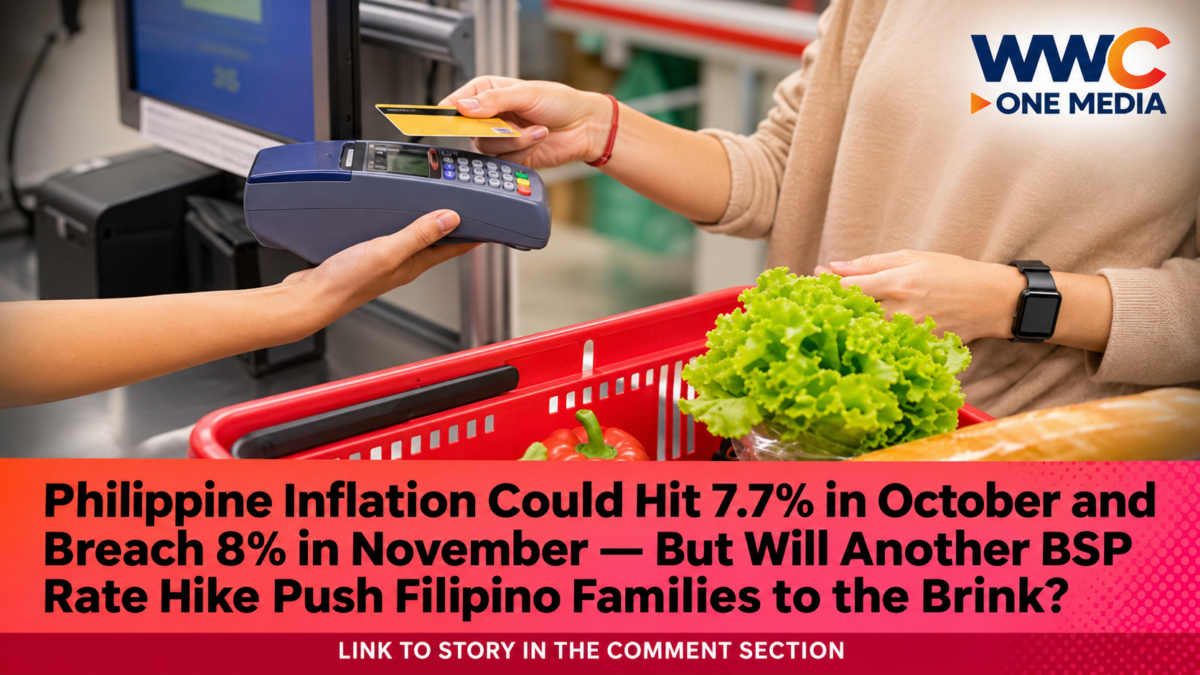
Filipino households could face another wave of rising prices before the year ends, with a leading bank economist warning that Philippine inflation may accelerate to 7.7% in October and potentially exceed 8% in November as higher transportation fares, wage adjustments, electricity costs and a weakening peso spread inflationary pressure across the economy.
Bank of the Philippine Islands (BPI) lead economist Emilio S. Neri Jr. warned that the country may not yet have reached the peak of its latest inflation surge.
His October estimate represents a further acceleration from September’s official 7.2% inflation rate, which was already considerably higher than the Bangko Sentral ng Pilipinas’ (BSP) target range of 2% to 4%.
The latest warning, first reported by InsiderPH on November 2 and corroborated by The Philippine Star, BusinessMirror and The Freeman, suggests that the Philippines is facing a more persistent inflation problem than the earlier fuel-driven price increases.
Although some food products and petroleum prices showed signs of relief during October, rising labor costs, transport fares and imported expenses could continue pushing up the prices of goods and services.
With the BSP already raising its benchmark interest rate to 5.50%, analysts are now considering whether additional monetary tightening will be needed.
But as the central bank attempts to control inflation through higher borrowing costs, could Filipino families face a painful combination of expensive daily necessities and more costly loans?
Inflation May Reach 7.7% in October — but Official Figures Are Still Pending
Neri estimates that Philippine headline inflation accelerated to 7.7% in October, compared with September’s 7.2%.
If confirmed, it would represent the fastest year-on-year consumer price increase since February 2023.
He also estimates that prices increased approximately 0.6% from September to October on a month-on-month basis.
That suggests price pressures may remain significant even after accounting for the already elevated cost of living.
However, these figures remain forecasts.
The Philippine Statistics Authority is scheduled to publish its official October inflation report on November 5, 2026.
Until then, the actual inflation rate has not been established.
Other economists have offered slightly different estimates.
A Philippine Star survey of 12 economists produced a median October forecast of 7.6%, with individual predictions ranging from 7.3% to 7.8%.
The BSP’s own October forecast was broader, ranging from 7.1% to 8.1%.
These differences highlight the uncertainty surrounding the latest inflation data.
Why Inflation Is Becoming Harder to Control
The central concern is that inflation appears to be spreading beyond volatile food and fuel prices.
Earlier price increases were heavily influenced by global energy costs.
The latest inflationary pressures increasingly involve transportation services, labor expenses, electricity and other business operating costs.
Economists describe this process as second-round inflation.
It occurs when an initial increase in costs spreads to other prices throughout the economy.
For example, a transport fare increase may raise employee commuting expenses and business delivery costs.
Higher wages may help workers manage living expenses but may also increase operating costs for labor-intensive enterprises.
Businesses can respond by improving productivity, reducing margins or raising prices.
When enough companies pass on higher expenses, inflation becomes more widespread.
WWC ONE MEDIA previously examined these developments in Philippines Faces Broader, Stickier Inflation Wave as Food, Fuel and Labor Costs Rise.
That earlier report warned that a combination of wage, transportation, food and energy pressures could produce a more persistent inflation cycle.
The latest October and November forecasts suggest those risks remain significant.
Higher Jeepney and Public Transport Fares Are Hitting Commuters
One major driver is the increase in public transportation fares.
Fare adjustments of approximately ₱1 to ₱2 took effect on September 28.
October was therefore the first full month during which these increases affected consumer spending.
The difference may appear small for an individual journey, but regular commuters often make multiple trips each day.
For someone taking two rides daily, a ₱2 increase per ride could add approximately ₱88 over 22 commuting days.
<text></text>For workers making several transfers, the additional cost could be greater.
Fare increases can also affect business expenses.
Employers may face additional pressure to adjust compensation, while workers have less disposable income for other household needs.
Transportation providers, meanwhile, continue facing fuel, maintenance and operating costs.
This makes transportation inflation a difficult issue for policymakers because fare increases may reflect genuine cost pressures within the transport industry.
The ₱60 Metro Manila Wage Increase Creates a Complicated Trade-Off
The latest Metro Manila minimum wage adjustment is another factor influencing inflation expectations.
A ₱60 daily minimum wage increase took effect on September 26 under Wage Order NCR-28.
The adjustment provides financial relief to eligible workers facing higher living costs.
For an employee working 22 paid days at the increased daily rate, the adjustment corresponds to approximately ₱1,320 in additional gross wages over those days, assuming all are covered.
However, the wage increase can also raise costs for affected employers.
Restaurants, retail stores and other labor-intensive service businesses may need to adjust their budgets.
Some may absorb the cost.
Others could respond through productivity improvements or changes in prices.
The economic effect therefore has two sides.
Higher wages support household purchasing power, while businesses must manage additional labor expenses.
It would be misleading to suggest that the wage increase alone caused the inflation surge.
The economy is facing several overlapping price pressures, including imported energy, currency movements and supply conditions.
A Weaker Peso Is Making Imported Goods More Expensive
The Philippine peso has also contributed to the inflation challenge.
According to the InsiderPH report, the currency had weakened by as much as 8.4% year to date and had touched ₱64.170 against the US dollar.
Currency depreciation can make imported products more expensive when measured in pesos.
This matters because the Philippines imports substantial amounts of petroleum, industrial inputs and other essential products.
A weaker peso can affect the cost of goods purchased in dollars, depending on contracts, international prices and the timing of purchases.
Electricity supply agreements involving dollar-denominated costs may also be affected.
WWC ONE MEDIA previously explored the issue in Peso Slips as US-Iran Tensions, Wage Hike and Higher Fares Fuel Inflation Concerns.
The report explained how currency weakness, geopolitical uncertainty and domestic operating costs can combine to create inflationary pressure.
However, a weaker peso does not automatically cause all imported goods to rise by the same percentage.
The actual impact depends on international prices, sourcing arrangements, inventories and business pricing decisions.
Electricity Bills Add Another Burden
Electricity is another area of concern.
Meralco raised its overall residential electricity rate by approximately 2.2% in October after two consecutive months of reductions.
The increase adds to household expenses and can also affect business operating costs.
Electricity is especially important for food retailers, restaurants, manufacturers and other businesses using refrigeration, cooling or electrical equipment.
Some businesses may eventually pass a portion of these costs to customers.
Others may absorb them through lower margins.
WWC ONE MEDIA previously examined related energy concerns in Visayas-Mindanao Power Shortage Faces Senate Probe as Electricity Rates Surge.
That report discussed broader power supply and electricity-cost issues affecting consumers and businesses.
The latest inflation forecast reinforces the importance of reliable and affordable electricity throughout the Philippines.
Food Prices Offer Some Relief — but the Risk Has Not Disappeared
Not every inflation indicator deteriorated during October.
Neri noted that the easing of the southwest monsoon, or Habagat, helped reduce supply disruptions affecting important food products.
Improved agricultural conditions provided some relief for rice, meat, fish and vegetables.
Fuel price rollbacks during parts of the month also reduced certain cost pressures.
But the improvement may not be enough to offset rising prices elsewhere.
More importantly, food supply conditions remain vulnerable to adverse weather.
Economists have raised concerns about a potentially severe El Niño episode that could affect crop production and water supplies.
WWC ONE MEDIA previously examined this risk in El Niño Emerges as Biggest Threat to Philippine Inflation as Prices Surge.
That article discussed the possibility of agricultural disruptions and additional food-price increases.
The impact of El Niño depends on how weather conditions develop, the crops affected and the effectiveness of government interventions.
A severe inflation shock should therefore be treated as a risk, not an inevitable outcome.
Could Inflation Breach 8% in November?
Neri believes the inflation rate could exceed 8% in November if existing pressures persist.
That would place inflation at more than twice the upper end of the BSP’s 2% to 4% target range.
However, other economists are less certain that November will mark the peak.
Some expect October to be the highest month of the current inflation cycle.
Others believe elevated inflation could continue into early 2027.
The Philippine Star’s November 2 survey highlights the disagreement.
BPI’s Neri and Chinabank economist Domini Velasquez expect inflation to peak in November.
Pantheon Macroeconomics economist Miguel Chanco believes October may already represent the high point.
The differences reflect uncertainty over future energy prices, exchange rates, demand and supply conditions.
November inflation exceeding 8% is a credible forecast scenario, not a confirmed result.
Core Inflation Signals a More Persistent Problem
Another important warning comes from core inflation.
Core inflation excludes certain volatile food and energy components and is used to assess underlying price pressures.
The Philippines’ core inflation rate reached 4.7% in September.
This was the highest level in approximately three years.
Velasquez expects it could increase to 5.4% in October.
That prediction suggests inflation may be spreading into categories that do not normally experience the same short-term volatility as food or fuel.
If core inflation continues rising, bringing overall inflation back toward target could become more difficult.
The central bank would need to consider whether higher prices are becoming embedded in business decisions and household expectations.
That is one reason the next official inflation report will be particularly important.
BSP’s Surprise 50-Basis-Point Rate Hike Changes the Outlook
The BSP has already responded with more aggressive monetary tightening.
On October 22, the Monetary Board increased its benchmark interest rate by 50 basis points to 5.50%.
The decision exceeded the smaller increase expected by most economists.
It was the fourth rate hike of the year.
WWC ONE MEDIA covered the move in BSP Stuns Markets With a 50-Basis-Point Rate Hike — What Happens Next to Loans, Prices and the Peso?.
Higher interest rates can help restrain inflation by making borrowing more expensive and moderating demand.
They may also support confidence in the peso under certain market conditions.
But monetary policy cannot directly increase agricultural harvests, eliminate transportation shortages or lower global oil prices.
Its effect on inflation also takes time.
This creates a difficult balancing act.
If the BSP raises rates too slowly, inflation could become more persistent.
If it raises rates too aggressively, borrowing costs could place additional pressure on consumers and businesses.
Will Another BSP Rate Hike Follow?
The latest inflation forecasts increase the likelihood that policymakers will consider additional tightening.
However, no further increase has been confirmed.
The BSP’s next scheduled policy meeting is on December 17, 2026.
Before that decision, officials will receive additional information about inflation, economic activity, the peso and international financial conditions.
The October inflation report is scheduled for November 5.
November’s actual inflation result will become available later.
These data will help determine whether price pressures are accelerating or beginning to stabilize.
Economists may expect another increase, but that is not the same as a decision by the Monetary Board.
Higher Borrowing Costs Could Hurt Households and Businesses
A prolonged period of higher interest rates can create additional financial pressure.
Borrowers with floating-rate loans may eventually face higher repayments, depending on their contracts.
Businesses seeking new credit could also encounter more expensive financing.
This may influence investment decisions and expansion plans.
For households, the combination of inflation and higher borrowing costs can reduce financial flexibility.
But not every loan or credit card rate changes automatically following a BSP rate increase.
Existing fixed-rate arrangements, bank pricing policies and applicable regulations all influence the final impact.
Some savers may benefit if banks offer higher deposit interest rates.
However, any improvement in savings returns may be reduced in real terms when inflation remains elevated.
Why the Government Cannot Rely on Interest Rates Alone
Several causes of inflation are outside the central bank’s direct control.
Agricultural supply conditions depend on weather, irrigation, transportation and distribution systems.
Electricity prices depend partly on fuel costs, generation capacity and regulated charges.
Imported inflation is influenced by global commodity prices and exchange rates.
Transportation expenses reflect fuel prices, operating costs and fare regulations.
Addressing these pressures may require coordination across government agencies.
Measures improving food supply, reducing logistics bottlenecks and strengthening energy reliability could help limit future cost increases.
But their effectiveness would depend on actual implementation.
There is no single policy capable of bringing inflation down immediately.
What 7.7% Inflation Means for Filipino Families
Inflation measures the rate at which the general consumer price level changes.
If annual inflation reaches 7.7%, that does not mean every individual product has become exactly 7.7% more expensive.
Some items may increase faster, while others may rise more slowly or decline.
For illustration, a basket of goods and services that cost ₱10,000 a year earlier would cost approximately ₱10,770 if its prices rose at the same rate as the overall consumer price index.
That would represent roughly ₱770 in additional annual-comparison cost for the same basket.
However, a household’s actual experience depends on its spending patterns.
Families spending a large share of their income on food, transportation and electricity may face different inflation pressures from those reflected in the national average.
Importantly, a lower inflation rate in a future month would generally mean prices are increasing more slowly—not that prices have returned to previous levels.
The Bigger Question: Is Philippine Inflation Becoming Entrenched?
The Philippines is facing several overlapping economic challenges.
Transportation fares have increased.
Wage adjustments are affecting labor costs.
Electricity expenses remain volatile.
The peso has weakened.
And adverse weather could threaten agricultural output.
While some food and fuel prices have provided relief, economists are increasingly concerned that inflation is spreading into more persistent categories.
The BSP’s October interest rate increase demonstrates the seriousness of the challenge.
But the coming months will test whether monetary policy and government supply measures can prevent further acceleration.
The Bottom Line
BPI lead economist Emilio S. Neri Jr. estimates that Philippine inflation accelerated to 7.7% in October 2026 and warns that it could exceed 8% in November.
The latest official reading remains September’s 7.2%, while the BSP projects October inflation within a 7.1%–8.1% range.
Rising transportation fares, higher labor costs, electricity rates and a weaker peso are contributing to broader inflation risks.
The BSP has already increased its benchmark interest rate to 5.50% following a surprise 50-basis-point hike in October.
But economists remain divided over when inflation will peak and whether additional tightening will be necessary.
The official October data, scheduled for November 5, will provide the next major test.
As Filipino households brace for another possible surge in prices, the most important question is no longer simply whether inflation will breach 8%. It is whether the government and BSP can stop rising costs from becoming a lasting burden—or whether families will enter 2027 facing expensive necessities, higher borrowing costs and even greater financial uncertainty.