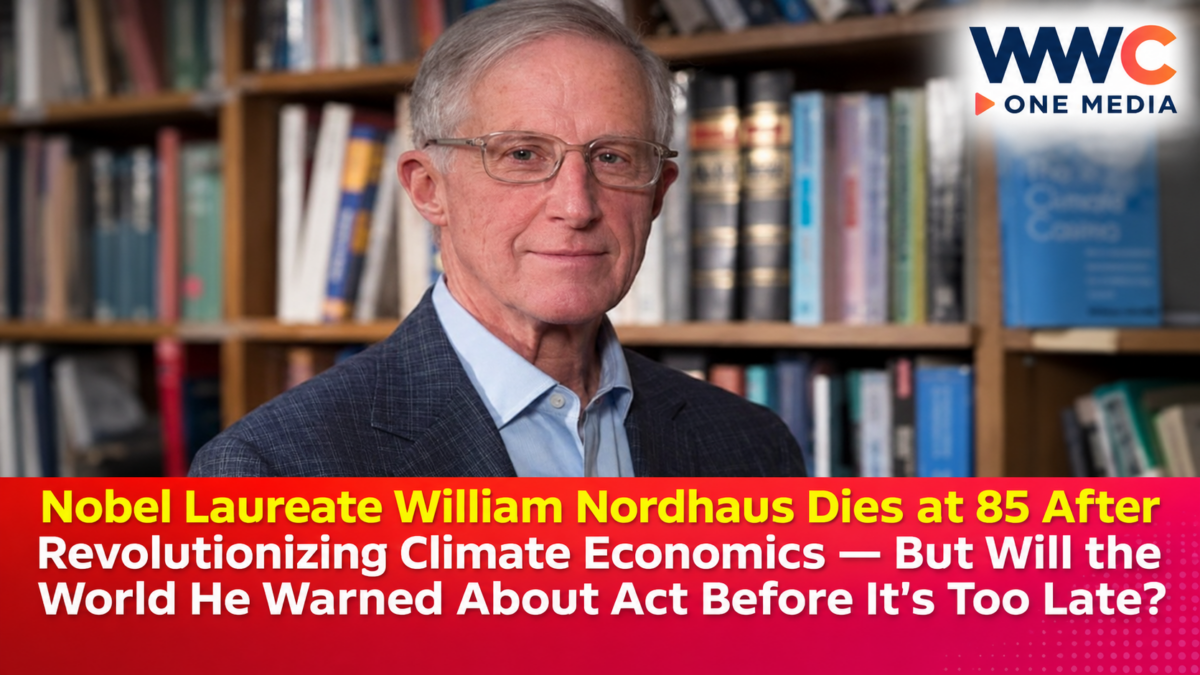
NEW HAVEN, Connecticut — November 3, 2026. William D. Nordhaus, the Nobel Prize-winning American economist whose groundbreaking research transformed how governments measure the economic consequences of climate change, has died at the age of 85, leaving behind a legacy that continues to shape one of humanity’s most urgent policy debates.
Nordhaus died on October 30 following a battle with aggressive brain cancer, Yale University confirmed in an official announcement.
A professor at Yale for more than five decades, he was widely recognized for pioneering the economic analysis of global warming and developing mathematical models that connected greenhouse-gas emissions, rising temperatures, and long-term economic growth.
His work helped establish a fundamental principle that continues to influence climate policy: pollution creates economic costs, even when those costs are not reflected in the price of the goods and services producing it.
In 2018, Nordhaus received the Sveriges Riksbank Prize in Economic Sciences in Memory of Alfred Nobel for integrating climate change into long-run macroeconomic analysis.
He shared the year’s prize with economist Paul Romer, who was separately recognized for research on technological innovation and economic growth.
But as governments continue struggling to balance economic development with emissions reductions, Nordhaus’s death raises a larger question.
Will the world finally embrace the economic lessons he spent decades developing, or will future generations inherit the enormous financial consequences of delayed climate action?
William Nordhaus: The Economist Who Put a Price on Global Warming
Long before climate change became a central issue in international politics, Nordhaus was examining how rising greenhouse-gas emissions could affect economic prosperity.
He began researching the economics of climate change during the 1970s, when relatively few economists were incorporating global warming into their analyses of economic growth.
At the time, traditional economic models generally concentrated on production, employment, investment, consumption, and technological progress.
Environmental damage was often treated as a separate issue.
Nordhaus challenged that separation.
He argued that economic activity and the natural environment were fundamentally connected.
Factories, electricity generation, transportation, and other productive activities could generate wealth while releasing greenhouse gases that imposed costs on society.
Those costs could emerge through damaged agricultural production, rising sea levels, extreme weather, and other climate-related consequences.
His research helped economists develop tools for evaluating those damages alongside the financial costs of reducing emissions.
Rather than treating climate change solely as an environmental problem, Nordhaus helped establish it as a central question of economic policy.
The DICE Model Changed How Governments Calculate Climate Risks
One of Nordhaus’s most influential contributions was the development of the Dynamic Integrated Climate-Economy model, commonly known as DICE.
The model connects major elements of the global economy with the physical processes driving climate change.
It examines how economic production generates emissions, how emissions influence atmospheric conditions, how warming affects economic welfare, and how policies can alter those relationships.
The model also allows researchers to compare the estimated cost of cutting greenhouse-gas emissions against the future economic damage associated with climate change.
In the mid-1990s, Nordhaus developed one of the earliest influential integrated assessment models connecting economic and climate systems.
His work became a foundation for subsequent climate-economics research.
DICE has been updated repeatedly as scientific understanding, economic data, and policy assumptions have evolved.
The model does not predict the future with certainty.
Its findings depend on assumptions involving climate sensitivity, economic growth, technological change, future damages, and the way costs and benefits are valued across generations.
Nevertheless, its importance lies in providing a structured way to evaluate difficult climate-policy choices.
The Royal Swedish Academy of Sciences recognized this contribution when awarding Nordhaus the Nobel Memorial Prize in 2018.
Why Nordhaus Believed Carbon Emissions Should Carry a Price
Central to Nordhaus’s research was the economic concept of an externality.
An externality occurs when an economic activity imposes costs or generates benefits that are not fully reflected in market prices.
Carbon emissions are a prominent example.
A company burning fossil fuels may pay for equipment, labor, and energy.
But the price of its products may not fully account for the climate-related damages associated with its greenhouse-gas emissions.
Those damages can affect people and communities far removed from the original source of pollution.
Nordhaus argued that carbon pricing could help correct that imbalance.
Under a carbon tax, emitters pay an amount linked to the greenhouse gases they release.
In economic theory, a properly designed tax can encourage businesses and consumers to reduce emissions when the cost of avoiding pollution is lower than the tax.
The objective is not simply to collect government revenue.
It is to make environmental damage part of everyday economic decisions.
Nordhaus’s research helped strengthen the intellectual foundation for carbon taxes and other market-based approaches to reducing emissions.
However, carbon pricing involves difficult policy decisions, including how high prices should be, how revenues should be used, and how households and vulnerable industries should be protected from disproportionate costs.
These questions remain central to climate-policy debates worldwide.
His Ideas Continue to Matter in the Philippines
Although Nordhaus conducted much of his research in the United States, the economic questions he examined are especially relevant to countries vulnerable to climate change.
The Philippines faces significant exposure to typhoons, flooding, rising sea levels, agricultural disruptions, and other climate-related risks.
At the same time, the country must balance economic development, energy affordability, infrastructure investment, and its international climate commitments.
WWC ONE MEDIA previously reported that the Philippine Climate Change Commission warned about rising emissions and persistent challenges in reducing the carbon intensity of economic activity.
Read the related report: Climate Commission Flags Rising Carbon Intensity in the Philippines.
According to that report, Philippine fossil carbon dioxide emissions had increased by approximately 25% since 2021, highlighting the difficulty of reducing emissions while supporting economic growth.
The commission also emphasized the importance of reliable emissions data, investment in cleaner technologies, and cooperation between government and the private sector.
These challenges closely resemble the economic questions Nordhaus investigated.
How can a developing economy grow while reducing environmental damage?
What level of investment is necessary to avoid future climate losses?
And how should the financial burden of climate action be distributed?
Nordhaus did not provide a single solution suitable for every country.
But his work offered a framework for examining those trade-offs systematically.
Climate Finance Is Becoming a Major Economic Challenge
Reducing emissions requires significant financial resources.
Countries need investments in clean electricity, modern transportation, efficient buildings, improved agricultural systems, and industrial technologies.
At the same time, communities already experiencing climate impacts need funding for adaptation measures.
WWC ONE MEDIA explored the Philippines’ emissions-reduction strategy in Philippines Targets Methane, Black Carbon and HFCs as 75% Climate Goal Enters New Phase.
The report detailed government efforts to address methane, black carbon, and hydrofluorocarbons, as well as the financing requirements associated with the country’s climate commitments.
The Philippines’ climate targets involve a substantial conditional component dependent on international assistance, technology transfer, and capacity building.
That financial dependence reflects a broader challenge confronting developing economies.
Countries with relatively limited financial resources may face some of the world’s most severe climate risks.
Yet they must also finance essential economic development.
Nordhaus’s research provided a basis for comparing the immediate costs of climate policies with the potential future economic damage associated with continued warming.
His work emphasized that environmental protection and economic prosperity cannot be evaluated independently.
Carbon Markets Are Turning Environmental Policy Into Financial Strategy
The evolution of carbon markets provides another example of how environmental economics has influenced business decisions.
Under certain regulated or voluntary frameworks, projects that achieve qualifying emissions reductions may generate tradable carbon credits.
These systems seek to attach financial value to verified reductions in greenhouse-gas emissions.
But not every claimed reduction qualifies for a credit.
Credible carbon markets require reliable measurement, independent verification, and safeguards against double counting or exaggerated environmental claims.
WWC ONE MEDIA examined this developing business model in Hooxi Partners Wants to Turn Carbon Cuts Into Revenue — But Can Emissions Data Become a New Asset?.
The report explored how companies are using digital systems to measure emissions and assess opportunities involving carbon assets.
Carbon taxes, emissions trading systems, and voluntary carbon credits are distinct policy mechanisms.
Nevertheless, they all reflect a broader effort to make environmental consequences more visible in financial decision-making.
Nordhaus was particularly influential in establishing the economic case for pricing carbon pollution.
A Nobel Prize That Redefined Economic Research
On October 8, 2018, the Royal Swedish Academy of Sciences announced that Nordhaus would receive half of the year’s Nobel Memorial Prize in Economic Sciences.
The other half went to Paul Romer.
Nordhaus was honored for integrating climate change into long-run macroeconomic analysis.
Romer was recognized for incorporating technological innovation into theories of long-term growth.
Together, their research expanded the way economists examined the forces shaping economic development.
Nordhaus’s contribution was especially notable because it connected scientific understanding of the climate system with economic decision-making.
The Nobel committee highlighted his development of integrated assessment models that could be used to study the potential consequences of policies such as carbon taxes.
The award elevated climate economics into the international spotlight and recognized decades of work that had begun when global warming attracted much less attention from mainstream economic researchers.
Nordhaus’s Climate Models Also Faced Criticism
Despite his enormous influence, Nordhaus’s approach was not without controversy.
Some climate economists and environmental researchers argued that traditional cost-benefit models could underestimate the damages associated with catastrophic or irreversible climate change.
A central disagreement concerned how future costs should be valued.
Economic models often apply discount rates, which convert future costs and benefits into present-day values.
The choice of discount rate can significantly influence estimates of how aggressively governments should reduce emissions today.
Critics argued that higher discount rates could place too little weight on harms affecting future generations.
Others questioned whether economic models could adequately account for tipping points, ecosystem destruction, biodiversity losses, and the possibility of exceptionally severe climate outcomes.
Nordhaus’s work became a focal point for these debates.
Researchers subsequently developed alternative models, revised assumptions, and explored a wider range of climate-damage scenarios.
These debates did not erase his contribution.
They demonstrated how the field he helped develop continued evolving as scientific and economic understanding improved.
Nordhaus himself acknowledged substantial uncertainty in climate-policy analysis and continued updating his models.
His legacy therefore includes not only the policies his work supported but also the extensive research and debate it inspired.
He Also Proposed a Global Climate Club
Nordhaus recognized that climate change presents an international coordination problem.
A country may benefit from emissions reductions undertaken by others even if it does not contribute proportionately to the costs.
Economists describe this as a free-rider problem.
To address it, Nordhaus proposed the creation of a climate club.
Under such a framework, participating countries would agree to coordinated emissions policies, while nonparticipants could face trade-related penalties designed to encourage cooperation.
The proposal sought to make international climate agreements more effective by attaching economic consequences to nonparticipation.
The idea influenced debates about climate cooperation, trade policy, and carbon border measures.
However, his proposed climate club should not be confused with any particular government policy already in force.
Existing carbon border adjustment systems have their own legal structures, economic objectives, and implementation requirements.
Nordhaus’s broader insight was that international environmental cooperation may be more successful when countries face meaningful incentives to participate.
His Research Went Far Beyond Climate Change
Although Nordhaus became internationally famous for climate economics, his academic interests extended across several major areas of economic research.
He studied technological progress, productivity, economic welfare, energy resources, and the relationship between political and business cycles.
His work included research with Nobel laureate James Tobin.
He also co-authored editions of the influential economics textbook Economics, originally written by Paul Samuelson.
The textbook helped educate generations of students and introduced fundamental economic concepts to readers around the world.
Nordhaus also held important public and academic positions.
He served on President Jimmy Carter’s Council of Economic Advisers from 1977 to 1979.
He was Yale University’s provost from 1986 to 1988.
He held leadership roles within the American Economic Association and contributed to advisory work involving national economic statistics and public policy.
His career reflected an unusually broad engagement with both academic research and practical economic problems.
Yale Remembers a Scholar Who Served for More Than Five Decades
Nordhaus joined Yale’s faculty in 1967 after completing his doctorate at the Massachusetts Institute of Technology.
He previously earned his undergraduate degree at Yale in 1963.
Over the following decades, he became one of the university’s most distinguished faculty members.
Yale named him a Sterling Professor, one of its highest academic distinctions.
He taught generations of students while contributing to university governance and long-term financial planning.
In 2014, he helped develop Yale’s internal carbon-charge system, putting principles associated with carbon pricing into practice within the university.
Yale colleagues remembered him not only for his academic accomplishments but also for his curiosity, intellectual rigor, and commitment to the institution.
Former Yale president Richard Levin emphasized the connection between Nordhaus’s work on climate economics and his commitment to protecting future generations from avoidable environmental harm.
Nordhaus retired from Yale’s faculty in 2024 but remained connected to scholarship and educational initiatives.
In his later years, he was reportedly working on efforts to make economics education more accessible.
The Human Cost of Climate Change Makes His Research Increasingly Relevant
For countries exposed to flooding and extreme weather, the economic impact of climate change is not an abstract academic question.
Damaged roads, destroyed homes, interrupted business activity, agricultural losses, and emergency response costs all impose significant financial burdens.
Those costs may not be fully reflected in traditional measures of economic production.
WWC ONE MEDIA previously explored these challenges in Philippines Revives Old Flood Master Plan as Climate Threats Worsen — But Will It Finally Work?.
The report examined the country’s renewed efforts to strengthen flood management and improve long-term infrastructure planning.
Not every flood can be attributed specifically to human-caused climate change, and inadequate drainage, land use, and infrastructure maintenance can also increase losses.
Nevertheless, the growing need to evaluate long-term climate risks illustrates the relevance of Nordhaus’s economic framework.
His approach encouraged policymakers to examine not only the cost of taking action but also the cost of failing to prepare.
That distinction remains particularly important for developing countries with limited public resources.
The Legacy of William Nordhaus: An Unfinished Global Economic Challenge
William Nordhaus helped transform climate change from an issue largely addressed by environmental scientists into a central concern of economists, financial institutions, businesses, and governments.
His research showed that environmental damage could be incorporated into economic models.
His DICE model provided a framework for studying the interaction between emissions, temperature change, and economic growth.
His advocacy for carbon pricing helped influence debates over how to make polluters account for the costs associated with greenhouse-gas emissions.
His climate-club proposal challenged governments to think more seriously about international cooperation.
And his willingness to engage with difficult questions encouraged further research that continues to refine, challenge, and extend his work.
Nordhaus did not solve climate change.
Nor did his models settle every dispute over how quickly countries should reduce emissions or how climate costs should be shared.
But he fundamentally changed the way policymakers could examine those questions.
His death comes at a time when the world continues struggling to reconcile economic growth with increasingly urgent environmental risks.
He is survived by his wife, Barbara, their three children, Jeff, Monica and Rebecca, and three grandchildren.
Yale said funeral arrangements would be private, with a memorial service planned for a later date.
William Nordhaus spent decades demonstrating that climate change carries an economic price. Now, as the Nobel laureate’s life comes to an end, the challenge he leaves behind is greater than ever: Will governments finally act on the financial consequences of global warming — or will the world discover the true cost of inaction only after it is too late?