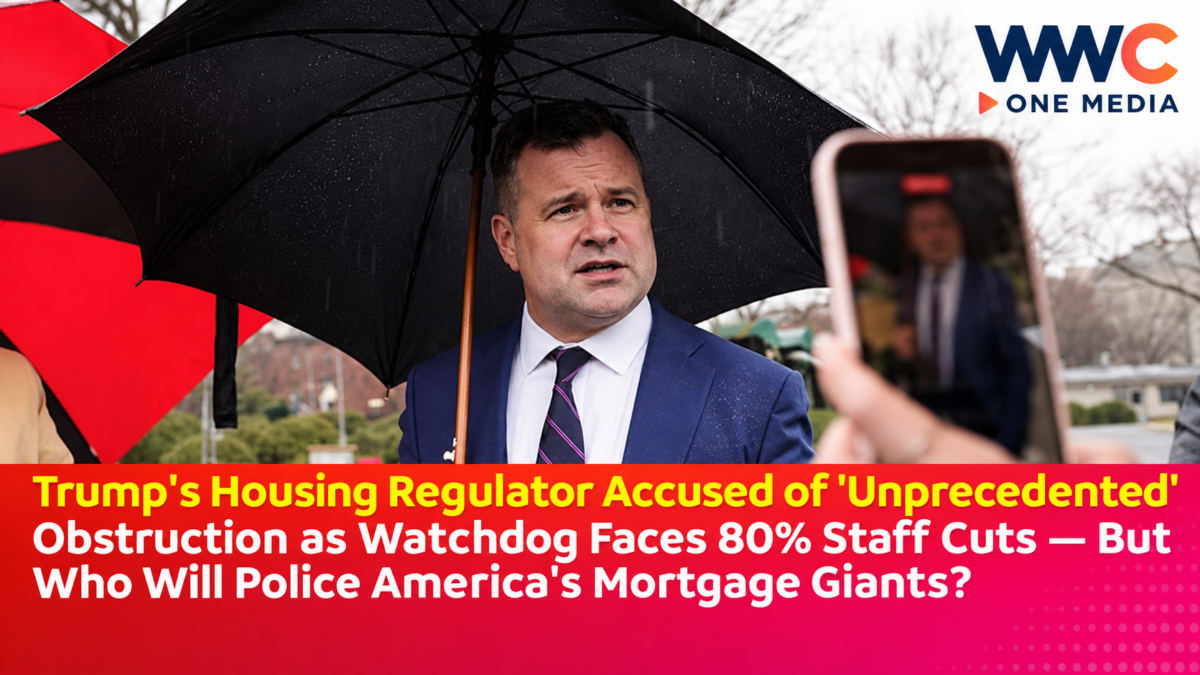
WASHINGTON, United States — November 3, 2026. A serious oversight dispute has erupted inside one of America’s most powerful housing-finance regulators after an internal government watchdog accused the Federal Housing Finance Agency (FHFA), led by President Donald Trump’s appointee Bill Pulte, of obstructing investigations and undermining its independence.
The allegations emerge as the agency moves forward with sweeping budget reductions that its inspector general warns could eliminate as much as 80% of the watchdog’s workforce and severely weaken its ability to investigate mortgage fraud and financial misconduct.
According to reporting by Bloomberg and Reuters, the FHFA’s Office of Inspector General (OIG) accused the regulator of withholding information required for at least three congressionally mandated oversight reviews.
The inspector general described the interference as unprecedented, raising concerns about accountability at an agency responsible for supervising Fannie Mae, Freddie Mac and the Federal Home Loan Bank System.
But the FHFA strongly disputes the allegations.
The regulator maintains that it has cooperated with oversight requests, provided documents and participated in meetings with investigators.
The dispute raises a fundamental question about the American financial system.
If the government agency responsible for overseeing America’s mortgage giants is accused of restricting its own watchdog, who can ensure that misconduct, fraud and financial risks are properly investigated?
Inspector General Accuses Pulte’s Agency of Blocking Oversight
The controversy intensified on October 30, when Reuters reported details from an inspector general report sent to Congress.
The report alleged that the FHFA refused to provide records and information needed for at least three separate evaluations.
Those reviews concerned the regulator’s oversight responsibilities, including supervision of entities connected to the US mortgage market.
One evaluation involved FHFA oversight of a lender associated with multifamily mortgage loans that defaulted in June 2024.
The report did not establish that the particular defaults resulted from wrongdoing by Pulte.
Instead, the concern was whether the watchdog could obtain the information needed to evaluate the regulator’s performance.
The inspector general argued that its office possesses statutory authority to access records necessary for independent oversight.
According to Reuters, the watchdog’s general counsel had attempted to resolve the dispute by explaining the office’s congressionally established powers.
The disagreement appeared to ease temporarily in August.
However, relations deteriorated again when the agency notified its inspector general that its funding would be substantially reduced.
The watchdog characterized the combination of restricted information and budget reductions as a major threat to its independence.
FHFA Rejects the Allegations and Defends Its Cooperation
The FHFA denies that it improperly interfered with the inspector general.
In comments reported by Reuters, an agency spokesperson said its staff had fulfilled 56 document requests and attended 16 hour-long meetings covering three recent reviews.
The agency maintained that it respects the inspector general’s role and independence.
Those figures provide important context.
They demonstrate that the FHFA says it provided substantial information and participated in oversight activities.
However, completing some requests does not necessarily resolve whether other legally required materials were withheld.
That distinction is central to the dispute.
The watchdog alleges that necessary information remained unavailable for certain reviews.
The FHFA argues that its cooperation has been appropriate.
The publicly reviewed information does not establish a final court judgment resolving these competing claims.
The accusations must therefore be reported as allegations made by an independent oversight office, not as a criminal conviction or a proven personal offense by Pulte.
Watchdog Budget Cut by 61.3%, Raising Alarm Over Mortgage Fraud Investigations
The dispute became more serious when the FHFA announced major changes to the inspector general’s funding.
On September 30, the agency confirmed that it was reducing the oversight office’s budget.
According to Federal News Network, the allocation for fiscal 2027 was set at $20 million, representing a 61.3% decline from fiscal 2026 funding levels.
The reduction prompted immediate concerns about whether the office could continue performing its statutory functions.
Acting watchdog leader James Hodge warned lawmakers that the budget decision could force staffing reductions of approximately 70% to 80%.
That could mean the elimination of roughly 80 positions.
The inspector general also warned that the office might have to discontinue most of its criminal investigative activities.
Those activities have historically included investigations into mortgage fraud and other misconduct involving entities overseen by the regulator.
The projected job reductions should not be described as 80 completed dismissals.
Rather, the reported figures concern staffing reductions that the watchdog said would be required under the new funding allocation.
The financial consequences could nevertheless be substantial.
FHFA Says the Cuts Are About Financial Discipline
Pulte’s agency has defended the budget decision as an effort to bring spending into line with comparable federal oversight offices.
In its September 30 announcement, the FHFA said it was applying a zero-based budgeting approach.
Under that method, expenditures must be justified rather than automatically carried forward from previous budgets.
The regulator argued that its inspector general’s requested allocation was unusually large relative to the agency’s operating budget.
According to the FHFA, the watchdog requested a budget equivalent to approximately 16% of the regulator’s operating expenses, compared with an average of roughly 2% among other federal inspector general offices.
The agency also stated that inspector general employees represented approximately 18% of its workforce, versus a governmentwide comparison of about 4%.
These figures form the basis of the FHFA’s defense.
However, comparing oversight offices only by budget percentages may not capture differences in their responsibilities.
The FHFA inspector general oversees an unusual financial environment involving enormous mortgage portfolios, complex financial institutions and potential fraud affecting housing-finance markets.
That helps explain why the watchdog argues that the reductions could severely damage its investigative capabilities.
Whether the FHFA’s comparisons justify the magnitude of the cuts remains contested.
Why Fannie Mae and Freddie Mac Matter to Millions of Americans
The controversy involves institutions that are central to the US housing-finance system.
Fannie Mae and Freddie Mac purchase qualifying mortgages from lenders and support the secondary mortgage market.
By buying and guaranteeing mortgages, they help lenders replenish capital and continue issuing housing loans.
Their activities also support the market for mortgage-backed securities.
Both enterprises have remained under federal conservatorship since the 2008 financial crisis.
The FHFA serves as their conservator and regulator.
This gives the agency significant influence over the institutions’ operations, financial controls and risk management.
The inspector general’s role is to provide independent oversight of FHFA’s activities.
If the watchdog’s access to information or investigative capacity is materially weakened, lawmakers may have fewer tools to evaluate how effectively the agency is supervising major housing-finance institutions.
However, the current allegations do not establish that Fannie Mae or Freddie Mac are insolvent, that customer mortgages are unsafe, or that another 2008-style financial crisis has begun.
The concern centers on the integrity of oversight and accountability.
Bill Pulte’s Leadership Has Already Attracted Controversy
Pulte became director of the FHFA in March 2025.
A member of a prominent American homebuilding family, he was selected by President Trump to lead the housing regulator.
After taking office, Pulte appointed himself chairman of the boards of both Fannie Mae and Freddie Mac.
The move concentrated significant leadership responsibilities within the agency’s senior management.
Pulte also oversaw major personnel changes at the regulator and the government-sponsored mortgage enterprises.
His administration has become politically controversial because of referrals involving alleged mortgage fraud by prominent public officials.
Those allegations have included matters involving Federal Reserve Governor Lisa Cook and New York Attorney General Letitia James.
Both officials have denied wrongdoing.
Pulte has defended the referrals as part of efforts to identify and investigate potential fraud.
Critics have questioned whether the regulator’s powers are being used selectively against individuals viewed as political opponents of the president.
The oversight controversy raises additional questions about whether independent investigators are receiving the information and resources necessary to examine such decisions.
However, allegations of political motivation require supporting evidence and should not be presented as conclusively established findings.
Senator Elizabeth Warren Demands Answers
The confrontation has attracted attention from congressional Democrats, including Senator Elizabeth Warren.
Warren, the ranking Democratic member of the Senate Banking, Housing and Urban Affairs Committee, challenged Pulte in an October 6 letter.
She accused the FHFA of failing to cooperate adequately with requests from the Government Accountability Office (GAO), another independent oversight body.
Her concerns involved information requests related to mortgage fraud referrals and the agency’s oversight obligations.
The GAO and the FHFA Office of Inspector General are separate institutions.
The GAO conducts audits and investigations for Congress.
The FHFA inspector general independently reviews activities within the housing regulator and its oversight responsibilities.
Warren argued that withholding information from government watchdogs could weaken congressional accountability.
She also questioned the legality of the inspector general budget reduction.
These are allegations and legal positions advanced by a senator, not a final judicial determination.
The FHFA has continued defending its management decisions.
The dispute now involves both the regulator’s internal oversight arrangements and its cooperation with congressional investigations.
The Watchdog Had Already Warned About Mortgage Market Risks
The FHFA inspector general’s responsibilities extend beyond examining administrative decisions.
In its September 2025 management-challenges report, the watchdog identified several significant risks facing the housing-finance system.
These included vulnerabilities associated with multifamily lending, information security, staffing, third-party relationships and supervision of regulated institutions.
Multifamily loans finance properties containing multiple residential units, including apartment buildings.
These transactions can involve large amounts of capital and complex financial relationships.
If borrowers default or collateral values deteriorate, lenders and mortgage guarantors may face financial losses.
That makes independent monitoring important.
The inspector general’s work helps determine whether the regulator is effectively identifying and responding to risks.
Reducing the office’s investigative capacity could limit the number of reviews it can complete.
But the existence of this risk does not establish that an actual wave of mortgage defaults has resulted from the current dispute.
America’s Housing Market Is Already Under Pressure
The oversight controversy comes during a difficult period for American housing.
Higher mortgage rates, affordability challenges and weakening buyer demand have complicated the outlook for homeowners and lenders.
WWC ONE MEDIA previously examined the situation in US Housing Market Hits 25-Year Low as Mortgage Rates Reach 7.4% — But the Federal Reserve’s Next Move Could Make Things Worse.
The report described slowing home sales and the financial difficulties facing borrowers and developers.
These problems do not arise directly from the inspector general controversy.
However, they illustrate why effective housing-finance supervision remains important.
When interest rates are elevated and borrowers face financial pressure, lenders and mortgage investors need reliable information about credit quality, lending standards and potential fraud.
Independent oversight can help identify weaknesses before they develop into more serious problems.
That is one reason the dispute over access to documents and investigative resources has implications beyond internal agency administration.
Mortgage Debt Investors Are Watching Credit Risks
Institutional investors are also examining changes in America’s mortgage market.
Rising borrowing costs and volatility in mortgage-backed securities have created opportunities for specialized investment funds.
But those opportunities come with significant financial risks.
WWC ONE MEDIA reported on the development in Deer Park Launches Second US Mortgage Debt Fund as Bond Spreads Widen — But Is Wall Street Buying Opportunity or the Next Housing Risk?.
The report explored how investors assess discounted mortgage-backed securities and potential credit losses.
Not all mortgage-backed securities carry the same government guarantees or regulatory protections.
The risks associated with private-label mortgage securities differ from those involving securities guaranteed by Fannie Mae or Freddie Mac.
Nevertheless, transparent financial information and effective supervision are important across mortgage markets.
A dispute affecting a major housing regulator’s oversight arrangements could create broader questions about institutional accountability, even without producing an immediate financial-market disruption.
Rising Insurance Costs Are Adding Pressure to Homeowners
The US housing market faces additional pressures beyond mortgage interest rates.
Homeowners insurance premiums have increased substantially in recent years, creating greater financial challenges for some households.
Higher insurance expenses can increase the total monthly cost of homeownership and reduce the income available for mortgage payments.
WWC ONE MEDIA covered related congressional scrutiny in Nearly Half of US Home Insurance Claims End Without Payment — But Senators Want to Know Whether Insurers Are Profiting From the Trend.
The report examined questions involving insurance costs, claims practices and consumer protection.
Insurance-company regulation is distinct from the FHFA’s oversight of housing-finance institutions.
However, the two issues are connected through their effects on household financial stability.
Borrowers facing higher insurance premiums and mortgage expenses may be more vulnerable to financial difficulties.
That makes comprehensive assessment of housing-market risks particularly important.
Homeownership Is Becoming More Difficult for Younger Americans
America’s housing affordability crisis is also changing how families finance home purchases.
Some parents are providing substantial assistance to help adult children meet down-payment requirements and manage rising housing costs.
WWC ONE MEDIA examined the trend in Parents Are Helping Their Children Buy Homes as Housing Costs Soar — But One Financial Mistake Could Put Their Retirement at Risk.
The report described how family financial support has become increasingly important for younger homebuyers.
These affordability challenges are separate from the allegations involving Pulte.
Nevertheless, they demonstrate why the governance of housing-finance institutions remains a major public-policy concern.
A well-functioning mortgage market depends on responsible lending, transparent financial practices and confidence in institutions.
The current dispute raises questions about whether the systems designed to monitor those institutions are receiving adequate support.
Why Independent Inspectors General Matter
Inspectors general play an important role in federal government accountability.
They conduct audits, evaluations and investigations intended to identify fraud, waste, abuse and mismanagement.
Their work can reveal problems that would otherwise remain hidden within large government agencies.
They also provide information to Congress, helping lawmakers evaluate whether agencies are fulfilling their legal responsibilities.
For financial regulators, these responsibilities can be particularly important.
The institutions involved may control or influence substantial amounts of capital.
Weak oversight can increase the risk that questionable practices remain undetected.
However, inspectors general must also operate within their statutory mandates and remain accountable for their own spending and administrative practices.
That is why the dispute between the FHFA and its watchdog raises competing questions.
The regulator argues that its financial controls are appropriate.
The watchdog argues that the agency is undermining its independence and limiting its ability to perform legally required functions.
The public interest lies in ensuring that both claims can be evaluated transparently.
Could Congress Intervene?
Congress has several potential ways to examine the dispute.
Lawmakers can request documents, hold oversight hearings and question agency officials.
They can also review statutory requirements governing inspectors general and their access to information.
The Senate Banking Committee has already become involved through correspondence and public criticism.
The inspector general’s report to Congress adds another source of information for lawmakers.
However, there has been no independently confirmed final court ruling establishing that Pulte personally committed criminal obstruction.
Nor does the existence of the report guarantee that Congress will impose sanctions or enact new legislation.
The next developments will depend on whether lawmakers seek further evidence, whether the FHFA changes its position and whether the inspector general’s office can continue its operations under the reduced budget.
The Bigger Question: Who Watches America’s Mortgage Watchdog?
The controversy surrounding Bill Pulte and the Federal Housing Finance Agency has become a serious test of institutional accountability.
The inspector general alleges that the regulator withheld records needed for legally mandated reviews.
The FHFA denies the allegations and points to dozens of fulfilled document requests and meetings.
Meanwhile, the inspector general faces a major budget reduction that could substantially diminish its investigative workforce.
The dispute matters because the FHFA oversees institutions that support a large portion of America’s mortgage-finance system.
Fannie Mae and Freddie Mac remain critical to mortgage funding and housing-market liquidity.
Independent oversight helps ensure that the regulator responsible for these institutions is itself subject to scrutiny.
The question is not whether the current dispute has already caused a mortgage crisis.
No evidence reviewed establishes that conclusion.
The more immediate concern is whether a government watchdog can continue performing its responsibilities when it disputes both the information it receives and the financial resources allocated to its work.
As Bill Pulte’s housing agency rejects accusations of unprecedented obstruction and its inspector general warns of devastating staff reductions, will Congress intervene to protect independent mortgage-market oversight — or could the institutions safeguarding America’s housing-finance system face a dangerous accountability gap?