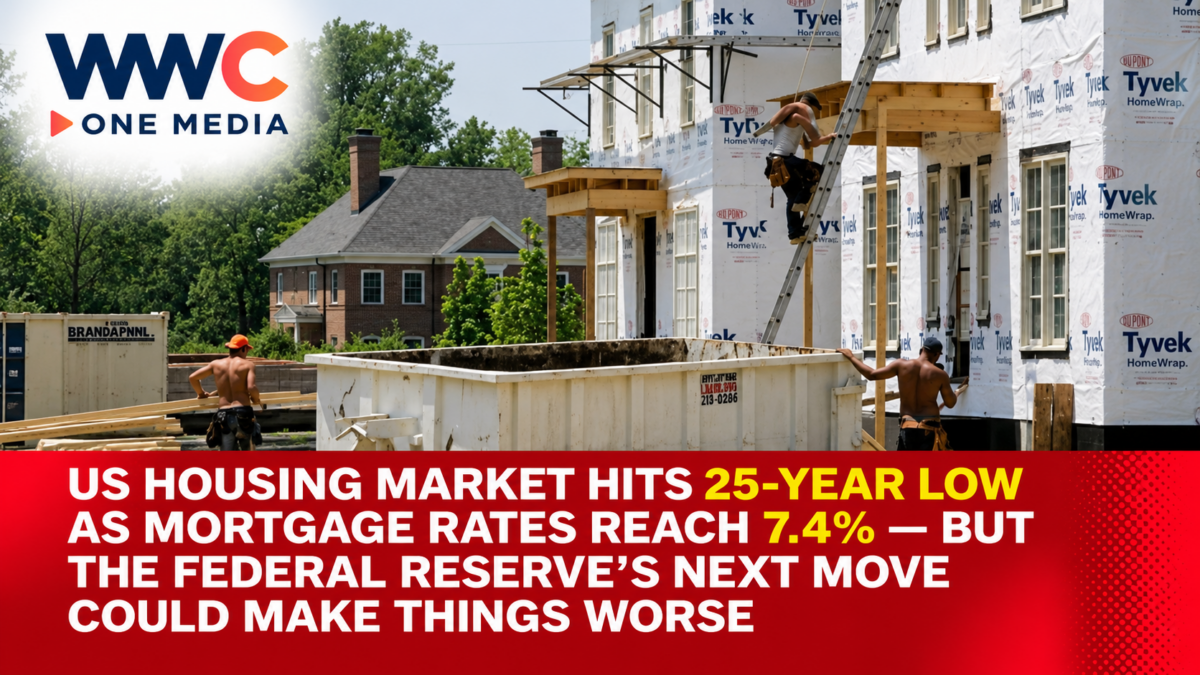
WASHINGTON, United States — America’s housing market is showing mounting signs of distress as higher mortgage rates, weakening buyer demand and rising construction costs combine to create one of the toughest environments for homebuyers and builders in years.
New figures released on October 20, 2026, show that pending home sales fell 7.3% in September from August, reaching the lowest level recorded since the National Association of Realtors began its current index in 2001.
The decline was considerably worse than economists’ expectations of a 0.5% drop.
Meanwhile, construction of new homes declined as borrowing costs and expensive building materials continued to weigh on developers.
The average U.S. 30-year fixed mortgage rate reached 7.40% during the week ending October 15, according to Freddie Mac.
That was substantially above the 6.27% recorded a year earlier.
And with the Federal Reserve still confronting inflation driven partly by elevated energy prices, economists are warning that housing affordability could remain under pressure into 2027.
The bigger question is whether the Fed can control inflation without pushing more prospective buyers out of the housing market—and whether millions of existing homeowners will remain financially trapped in properties they cannot afford to leave.
Pending Home Sales Fall 7.3% to Record Low
The National Association of Realtors reported that its Pending Home Sales Index fell to 66.0 in September.
That was the lowest index reading since the series began in 2001.
Contract signings dropped 7.3% compared with August and 11.3% compared with September 2025.
Economists surveyed before the report had expected a much smaller monthly decline.
The figures show that fewer buyers were entering contracts to purchase existing homes.
Pending sales are considered a forward-looking housing indicator because signed contracts generally precede completed transactions.
A fall in pending sales can therefore signal weaker existing-home sales activity in subsequent months.
However, pending home sales are not the same as completed home purchases.
The figures measure contract activity, not the total number of properties transferred to new owners in September.
All Four US Regions Report Weaker Demand
The decline was widespread.
According to the National Association of Realtors, pending home sales weakened in the Northeast, Midwest, South and West.
The West registered the largest monthly decline at 9.2%.
The South followed with an 8.2% drop.
The Midwest and Northeast also recorded lower contract activity.
Year-on-year declines affected all four major regions.
This matters because the weakness is not confined to one expensive coastal market or a particular metropolitan area.
The national figures indicate that higher borrowing costs are affecting housing demand across a broad range of markets.
However, local conditions still differ.
Some areas have more homes for sale and greater seller competition.
Others continue to face restricted inventory, high prices or limited new construction.
Buyers and investors should not assume that every city is experiencing identical conditions.
Mortgage Rates Climb to 7.40%
One of the biggest obstacles is the cost of financing a home.
Freddie Mac reported that the average 30-year fixed mortgage rate reached 7.40% during the week ending October 15.
The 15-year fixed mortgage rate averaged 6.71%.
For comparison, the average 30-year rate was 6.27% in the same period a year earlier.
That difference has a substantial effect on monthly mortgage payments.
Higher rates reduce the amount that buyers can reasonably borrow while keeping payments within their budgets.
They also make homeowners less willing to sell if they would have to replace an existing low-rate mortgage with a much more expensive new loan.
The result is a difficult cycle.
Potential buyers struggle with affordability while some existing owners delay moving.
This can keep the supply of desirable homes restricted even when demand weakens.
How Much More Expensive Has Buying a Home Become?
The effect of higher mortgage rates becomes clearer through a simple example.
Consider a buyer taking out a $320,000 mortgage over 30 years.
At a 6.27% fixed rate, monthly principal and interest payments would be approximately $1,975.
At a 7.40% rate, the payment increases to roughly $2,215.
That represents about $240 more every month, or approximately $2,880 annually.
Over time, the difference can become substantial.
These calculations exclude property taxes, homeowners insurance, association dues, mortgage insurance and other expenses.
They are illustrative figures rather than actual lender quotations.
For households already facing higher costs for fuel, food and other essentials, even a few hundred dollars in additional monthly housing expenses can influence whether purchasing a home remains practical.
Federal Reserve Policy Is Part of the Problem
The Federal Reserve has raised interest rates in response to renewed inflation pressures.
Those policy decisions influence borrowing costs throughout the economy.
But mortgage rates are not set directly by the Fed.
Thirty-year fixed mortgage rates are more closely tied to longer-term bond yields, particularly the 10-year U.S. Treasury yield, together with mortgage market conditions and lender pricing.
Inflation expectations, government borrowing and investor demand for bonds can also affect mortgage costs.
This distinction matters because even if the Fed leaves its benchmark rate unchanged at its next meeting, mortgage rates may still rise or fall.
The market is already anticipating that interest rates could remain elevated into 2027.
That uncertainty discourages buyers from committing to expensive long-term loans.
Middle East Conflict Adds Inflation Pressure
The conflict involving Iran and its regional consequences has contributed to higher international energy prices.
Higher oil costs can affect transportation, manufacturing and the price of building materials.
They can also feed into consumer inflation.
For homebuyers, this creates pressure from two directions.
The cost of living increases, reducing the income available for mortgage payments.
At the same time, inflation concerns push bond yields and financing costs higher.
For builders, more expensive fuel and materials can increase the cost of constructing homes.
These overlapping pressures make the housing slowdown more difficult to resolve.
Cutting mortgage rates alone would not automatically eliminate the high cost of land, materials, labor and insurance.
New Home Construction Drops 5.2%
The housing market is also being affected by reduced construction activity.
According to the U.S. Census Bureau and Department of Housing and Urban Development, privately owned housing starts declined 5.2% in September.
The seasonally adjusted annual rate fell to approximately 1.221 million units, compared with a revised 1.288 million in August.
Starts were also 7.4% below their September 2025 level.
Single-family housing starts dropped to an annualized pace of 859,000 units, down 4.6% from August.
These figures indicate that developers are beginning construction on fewer new homes.
However, the 1.221-million figure is an annualized monthly rate, not the actual number of homes that began construction during September.
Similarly, a 5.2% decline in the headline figure should not be confused with the 4.6% decline in single-family construction.
They measure related but different categories.
Building Permits Point to Continued Weakness
The Census Bureau also reported that building permits were issued at an annualized rate of 1.400 million units in September.
That was 0.2% below the revised August figure and 3% lower than a year earlier.
Single-family permits declined 4% from August.
Permits are important because they can provide an early indication of future building activity.
A developer generally needs appropriate approvals before beginning construction.
A slowdown in single-family permits can therefore suggest weaker construction plans ahead.
But permits are not completed houses.
Some authorized projects may be delayed, changed or cancelled.
The figures should be interpreted as part of a wider housing market picture alongside construction starts, completions and homebuyer demand.
Builder Confidence Hits a 14-Year Low
Homebuilders are becoming increasingly pessimistic.
The National Association of Home Builders and Wells Fargo reported that their Housing Market Index fell three points to 29 in October.
That was the lowest reading since June 2012.
An index reading below 50 indicates that more builders view market conditions negatively than positively.
The October decline reflected weaker demand, rising construction expenses and unfavorable financing conditions.
The NAHB also reported that buyer traffic had fallen to its lowest level since April 2012, excluding the onset of the pandemic.
These indicators suggest that homebuilders are struggling to attract customers willing and able to purchase new properties.
For developers, the challenge is to price homes competitively without sacrificing already pressured profit margins.
Builders Cut Prices to Attract Buyers
Facing weaker demand, more developers are offering discounts and incentives.
The NAHB reported that 43% of builders reduced prices in October.
That was the highest share in its 2020–2026 survey period.
The average price reduction remained at 6%.
Meanwhile, 65% of builders offered sales incentives.
These may include help with closing costs or temporary and permanent mortgage-rate buydowns.
Such offers can provide opportunities for buyers who remain financially qualified.
But the average 6% reduction among price-cutting builders does not mean all new homes across the United States have become 6% cheaper.
It describes the average cut reported by builders using that strategy.
Likewise, a mortgage-rate buydown can be valuable, but its actual cost and duration depend on the financing arrangement.
Buyers should examine the total purchase price and long-term loan terms rather than focusing only on promotional monthly payments.
Existing Homeowners Are Trapped by Low Mortgage Rates
Another major obstacle is the mortgage-rate lock-in effect.
Millions of Americans purchased or refinanced homes when mortgage rates were much lower.
Some secured fixed rates below 3% during the pandemic period.
Selling their homes today could mean giving up those favorable loans.
If they purchase another property, they may face mortgage rates above 7%.
That creates a powerful financial incentive to remain in their existing homes.
According to a Goldman Sachs analysis cited by MarketWatch, more than 95% of existing mortgage borrowers have rates below current market levels.
Approximately 65% have rates at least two percentage points lower.
These figures refer to borrowers with existing mortgages, not all American homeowners, some of whom own their properties without mortgage debt.
The lock-in effect can reduce the number of existing homes available for sale.
This makes the housing market less flexible and can keep prices elevated even when buyer demand weakens.
Homebuyers Gain Some Negotiating Power
Although the national housing market is weak, the situation is not entirely negative for buyers.
In some markets, homes are spending more time on the market.
Sellers may be more willing to negotiate prices, make repairs or provide closing-cost concessions.
MarketWatch reported that nearly 44% of listings had experienced price reductions by mid-October.
That suggests many sellers are adjusting expectations.
However, a lower listing price does not automatically make a home affordable.
Higher mortgage rates can offset the savings from a modest price reduction.
Local inventory and property conditions also vary substantially.
Buyers need to compare the full monthly payment, property taxes, insurance and maintenance expenses.
A favorable negotiation can help, but it should not be mistaken for a guaranteed bargain.
Goldman Sachs Expects More Housing Weakness in 2027
Some economists believe the market will remain difficult beyond the current year.
Goldman Sachs economist Ronnie Walker expects approximately 3.9 million existing-home sales in 2027.
That would be about 26% below the number recorded in 2019.
The forecast reflects expectations that high financing costs and affordability constraints will continue limiting housing transactions.
Other industry projections also indicate that new construction could weaken.
But such estimates are forecasts, not completed results.
The actual 2027 market will depend on economic growth, employment, wage trends, inflation and mortgage rates.
A decline in borrowing costs could improve affordability.
Conversely, prolonged inflation or another rise in Treasury yields could extend the slowdown.
Housing Weakness Could Affect the Wider US Economy
Housing is an important contributor to economic activity.
Home construction supports demand for building materials, equipment, labor and professional services.
Home purchases can also generate spending on furniture, appliances and home improvements.
When construction slows and fewer properties change hands, related businesses may experience weaker demand.
Real estate agents, mortgage lenders, builders and home improvement retailers can all be affected.
Higher borrowing costs can also discourage residential investment.
But a weak housing market does not automatically mean the entire U.S. economy is entering a recession.
Employment, consumer spending, business investment and other sectors must also be evaluated.
The latest housing figures do show that residential real estate is becoming a source of economic weakness.
That may complicate the Federal Reserve’s decisions if inflation remains elevated.
Why the Fed Faces a Difficult Choice
The Federal Reserve’s goal is to control inflation while supporting sustainable economic conditions.
Higher interest rates can restrain spending and reduce inflationary demand.
But housing is particularly sensitive to financing costs.
When borrowing becomes expensive, prospective buyers may delay purchases and builders may reduce construction.
That can weaken activity in the short term.
It may also limit future housing supply, potentially worsening longer-term affordability problems.
At the same time, cutting interest rates too early could allow inflation expectations to remain elevated.
That could keep longer-term bond yields high and reduce the intended benefit for mortgage borrowers.
The Fed therefore faces a difficult balance between controlling price pressures and avoiding unnecessary damage to the housing market.
What Happens Next for US Housing?
The coming months will provide more evidence about the market’s direction.
The Federal Reserve’s October policy meeting will help clarify its near-term monetary policy stance.
The Census Bureau is scheduled to release September new-home sales data on October 27.
Updated mortgage-rate surveys will show whether borrowing costs remain near recent highs.
Later reports on pending sales, completed purchases and residential construction will provide a clearer picture of whether the downturn is stabilizing.
Consumers and businesses will also be watching the effect of energy prices and inflation on financial markets.
For prospective buyers, the practical challenge remains affordability.
For existing owners, the question is whether moving is worth abandoning a favorable mortgage.
For developers, the priority is finding ways to deliver homes that customers can afford.
The Bigger Test: Can America’s Housing Market Break Free?
The latest data show a U.S. housing market under pressure from almost every direction.
Pending home sales have fallen to the lowest index level since 2001.
Mortgage rates are averaging 7.40%.
Housing starts have declined to an annualized pace of 1.221 million units.
Homebuilder confidence has fallen to a 14-year low.
And a large proportion of existing mortgage borrowers are reluctant to sell because they would face much higher financing costs on a new home.
The combined effect is a market where transactions are slowing, construction is weakening and many households remain priced out.
America’s housing market has entered a deep freeze as high mortgage rates discourage buyers, trap existing homeowners and force builders to offer more discounts. The bigger question is whether the Federal Reserve can contain inflation without making the country’s affordability crisis even harder to solve in 2027.