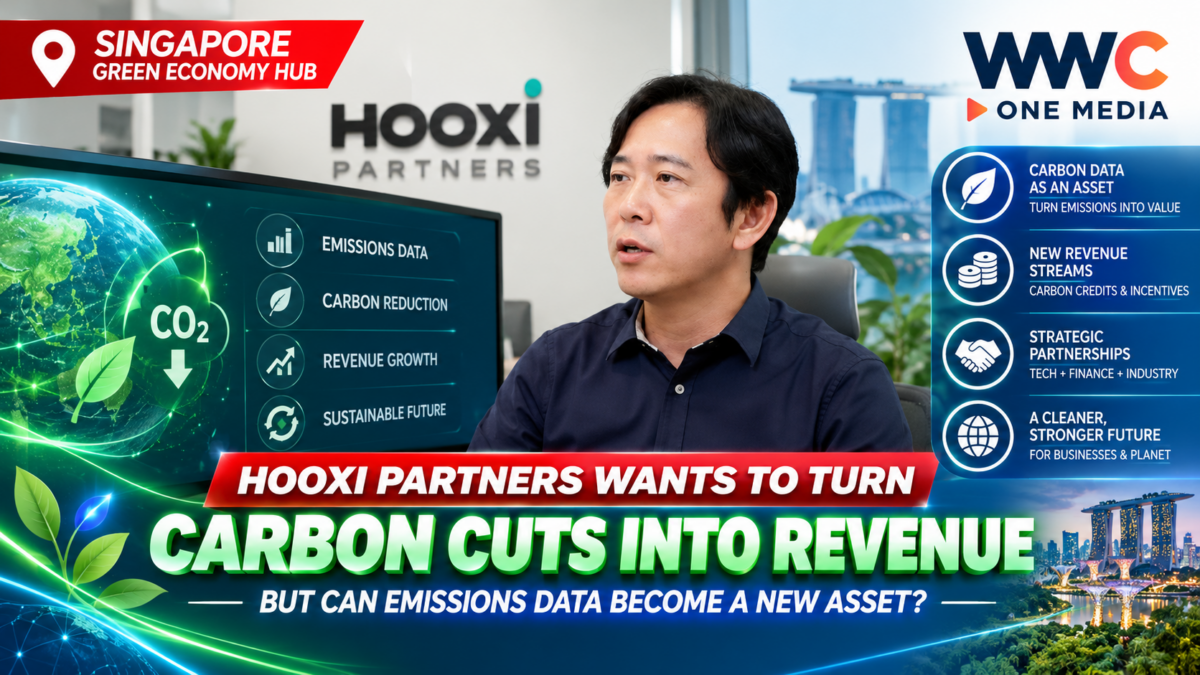
SEOUL — Cutting greenhouse-gas emissions can help companies meet environmental targets, but Hooxi Partners is pursuing a bigger idea: turning verified emissions reductions into an asset that can generate financial value.
The South Korean climate-fintech startup is building its business around a simple premise — emissions reductions only become commercially meaningful when companies can accurately measure, report and verify them, then connect those verified results to the carbon-credit market.
From Cutting Emissions to Creating Value
Reducing emissions does not automatically produce a tradable carbon credit.
Companies first need reliable emissions data, an appropriate methodology and verification that establishes whether the claimed reduction meets the relevant requirements.
Hooxi Partners is attempting to connect those steps through its Carbon AI platform, which is designed to help companies manage greenhouse-gas data, carbon-reduction projects and the processes needed to turn verified reductions into carbon assets.
That puts the company at the intersection of climate technology, carbon markets and financial services.
Why Verification Matters
The difference between an emissions reduction and a carbon credit is critical.
A company might install solar panels, replace older equipment, switch vehicles to electric models or improve energy efficiency and reduce its emissions. But those reductions cannot simply be counted as credits without meeting applicable rules and verification requirements.
Hooxi Partners’ model focuses on helping companies navigate that process, including measurement, reporting, verification and credit issuance.
The company’s approach reflects a growing business challenge: companies are increasingly expected to provide credible emissions data while also responding to carbon-market regulations and supply-chain requirements.
Carbon AI Targets the Full Process
Hooxi Partners describes Carbon AI as an integrated platform covering four major areas: regulatory response, carbon credits, supply-chain emissions management and carbon-credit trading.
Its services include Scope 1 and Scope 2 emissions management, support for Korea’s emissions-trading system, Scope 3 and product-carbon-footprint calculations, and assistance with carbon-credit transactions.
The objective is to reduce the fragmentation that can occur when companies measure emissions, manage regulatory requirements and pursue carbon credits through separate systems.
Small Emissions Cuts Can Also Matter
One of the company’s recent projects illustrates the broader opportunity.
Hooxi Partners has worked with the Seoul Energy Corporation on a program designed to aggregate emissions reductions from small, self-consumption solar installations.
The concept is to combine reductions from individual installations, register them as a larger emissions-reduction project and pursue certification so that the verified reductions can potentially become carbon credits.
That approach could address a practical problem: individual small-scale projects may not have enough resources to handle the methodology, registration, monitoring and verification process themselves.
Companies Are Looking Beyond Compliance
The business opportunity extends beyond simply helping companies meet environmental requirements.
In August, Hooxi Partners said it had certified 39,477 tonnes of CO2-equivalent internal emissions reductions across six customers in transportation, manufacturing and paper-related industries. The company said those projects helped protect 50,084 tonnes of emissions allowances from cancellation under the applicable system.
The company has argued that recognizing emissions reductions as financial assets could influence future corporate investment decisions.
But certification is not automatic. Hooxi Partners itself has emphasized that companies still need to demonstrate when equipment was introduced and maintain appropriate monitoring and quality-control records.
A Larger Carbon-Market Opportunity
The startup is also expanding through partnerships.
In July, Hooxi Partners and energy-technology company GridWiz announced plans to develop an integrated solution linking distributed-energy resources such as solar power, energy-storage systems, demand response and electric-vehicle charging with carbon-reduction projects.
The companies said the goal is to connect energy operations with verified emissions reductions and potential carbon assets.
That model could give companies a way to look at energy investments from two angles at once: reducing operating costs and potentially creating recognized carbon value.
The Bigger Question: Can Carbon Become Revenue?
The carbon market is built around a difficult requirement — environmental claims must be credible enough to be measured and verified.
That makes data increasingly important.
For Hooxi Partners, the opportunity lies in connecting emissions data → verified reductions → carbon credits → financial value.
Whether that model can scale will depend on regulation, verification standards, carbon-market demand and the ability of companies to generate reductions that qualify under applicable rules.
For businesses facing rising pressure to measure and reduce emissions, however, the message is becoming increasingly clear:
Carbon reduction may not only be something companies spend money to achieve. If the reductions can be properly measured and verified, they could also become an asset with economic value.
WWC ONE MEDIA G,A