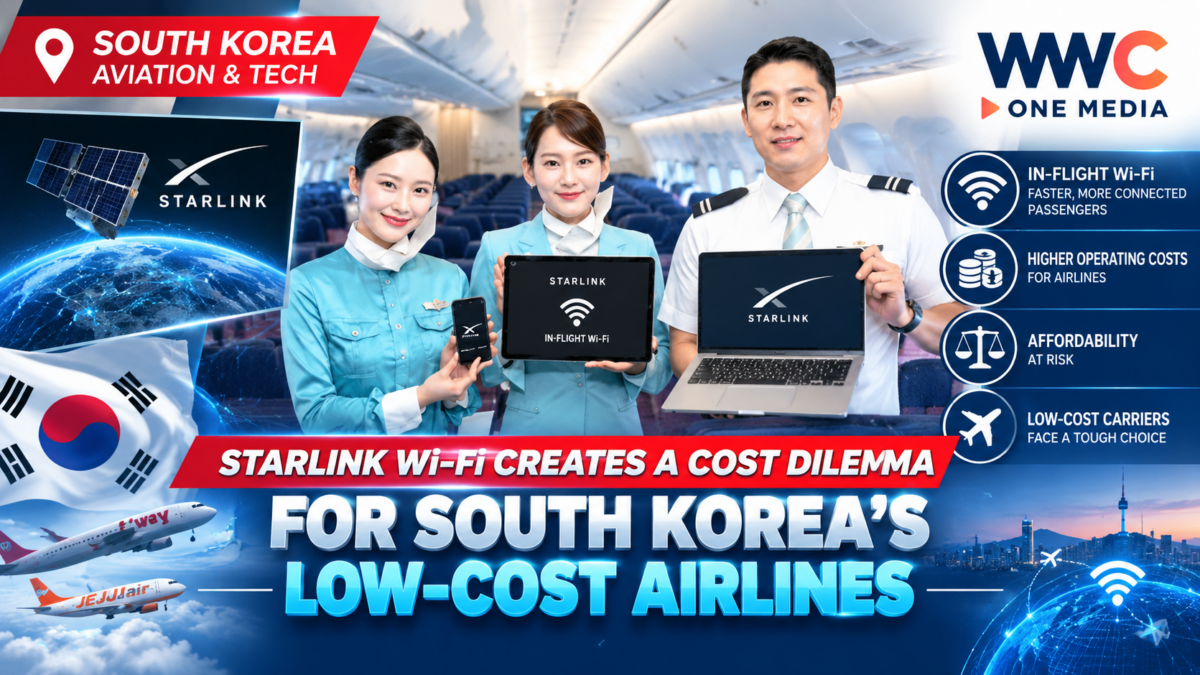
SEOUL — High-speed Starlink Wi-Fi is rapidly changing expectations for in-flight connectivity, but South Korea’s low-cost carriers (LCCs) face a difficult financial question: Can they afford to bring satellite internet onboard without undermining the low fares their passengers expect?
The issue has become more pressing since Korean Air began introducing Starlink-powered Wi-Fi in September, putting pressure on other Korean airlines to consider similar upgrades.
For major carriers with greater financial resources, the technology represents a fleet-modernization opportunity. For smaller LCCs, however, the economics are considerably more complicated.
Starlink Installation Comes With a Heavy Price Tag
Installing Starlink equipment on a single aircraft is estimated to cost around $500,000, or approximately 677 million won.
Airlines must also pay separate service fees, meaning the initial installation is only part of the expense.
That creates a significant hurdle for budget airlines already operating under tight margins.
The challenge is particularly relevant as several Korean LCCs recorded operating losses in the second quarter, with the strong U.S. dollar and unstable oil prices adding pressure to their finances.
Korean Air Has Already Started the Transition
Korean Air began introducing Starlink connectivity in mid-September, initially concentrating on long-haul services.
The airline plans to expand free Starlink Wi-Fi across most of its fleet by the end of 2027, following its integration with Asiana Airlines.
Asiana is also preparing to introduce the satellite-based service across its fleet. Korean Air’s stronger financial position makes the investment easier to absorb compared with smaller competitors.
The move also raises expectations among passengers for fast, reliable internet while flying.
LCCs Are Taking Different Approaches
Some budget carriers are already considering the technology.
Jin Air plans to begin installing Starlink on its Boeing 737-8 aircraft, while Air Busan and Air Seoul are reviewing which aircraft could receive the system.
Those three airlines are expected to be consolidated under Jin Air following the Korean Air-Asiana integration.
Other LCCs controlled by smaller parent companies face a more difficult calculation.
Their heavy reliance on short-haul routes is another consideration because passengers have less time in the air to use onboard internet, potentially reducing the financial return from the investment.
The Low-Fare Business Model Creates a Catch-22
For budget airlines, the central problem is straightforward.
Installing Starlink costs hundreds of thousands of dollars per aircraft, but raising ticket prices to recover that investment could undermine the price advantage that attracts LCC passengers in the first place.
Industry officials cited by The Korea Times said many LCCs could struggle to recover the cost without increasing fares, while higher fares could make it harder to compete.
That leaves airlines facing a difficult choice: invest in a technology passengers increasingly want, or preserve the low-cost model that defines their business.
Starlink Could Reshape the In-Flight Experience
The technology offers considerably more than basic messaging.
Starlink uses low-Earth-orbit satellites to provide high-speed connectivity capable of supporting data-intensive activities such as video streaming. Korean Air has said voice and video calls will remain restricted to maintain cabin comfort.
For passengers, that could make long flights feel more connected and productive.
For airlines, however, the question is whether passengers will value the service enough to justify the additional investment.
The Next Battle Could Be Over Cost
South Korea’s aviation market is therefore approaching a new divide.
Full-service carriers with greater financial resources can move ahead with satellite connectivity, while LCCs must weigh installation and operating costs against their customers’ expectations and already-tight margins.
As Starlink becomes more visible in Korean skies, the technology could become less of a luxury and more of a competitive expectation.
But for budget airlines, the biggest question may not be whether they can install Starlink — it may be whether they can afford what comes after installation.
WWC ONE MEDIA G,A