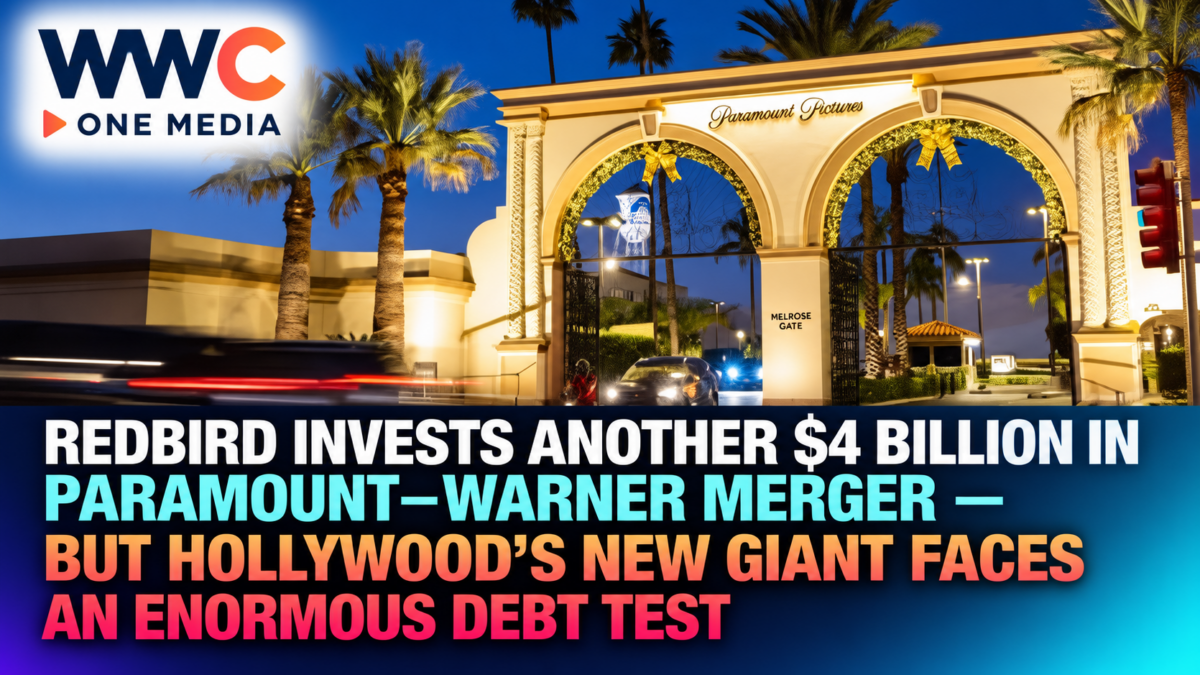
NEW YORK — Gerry Cardinale’s RedBird Capital Partners has increased its financial bet on Hollywood’s future, investing another $4 billion in the merger of Paramount and Warner Bros. Discovery as the newly combined entertainment empire prepares for a fierce battle against streaming giants and a mountain of debt.
The additional investment brings RedBird’s total commitment to approximately $6 billion, making the private investment firm one of the most important financial backers of David Ellison’s expanding media business.
The announcement coincided with the official completion of Paramount’s acquisition of Warner Bros. Discovery on October 6, 2026.
The transaction, valued at approximately $110 billion including debt, combines some of the world’s most recognizable film studios, television networks and streaming platforms under one corporate structure.
The newly merged company is operating as Skydance Corporation, with shares trading on the New York Stock Exchange under the ticker SKYD.
But the size of the deal creates an equally large financial challenge.
RedBird and the Ellison family have helped assemble one of the biggest entertainment companies in the world. Now they must prove that its extraordinary collection of Hollywood franchises can generate enough growth and cash flow to justify the investment.
RedBird’s Hollywood Investment Has Tripled to $6 Billion
RedBird’s relationship with David Ellison did not begin with the Warner Bros. acquisition.
The firm first invested approximately $275 million in Skydance Media in 2019.
Its commitment subsequently grew as Cardinale backed Ellison’s ambition to transform Skydance from a film and television production company into a major global media group.
RedBird eventually invested about $2 billion in the transactions that enabled Skydance to acquire control of Paramount Global in August 2025.
The latest $4 billion commitment brings the firm’s cumulative backing of the Ellison-controlled media businesses to approximately $6 billion.
That scale is significant.
RedBird is no longer simply a financial investor supporting a promising Hollywood production company.
It is helping shape the ownership and future strategy of one of the industry’s largest media conglomerates.
The $110 Billion Merger Is Officially Complete
Paramount confirmed on October 6 that it had completed its acquisition of Warner Bros. Discovery following the necessary regulatory approvals and closing procedures.
Warner Bros. Discovery shareholders received approximately $31.0167 per share in cash, reflecting the agreed purchase price and an additional payment related to the closing date.
Warner Bros. Discovery shares ceased trading on Nasdaq.
The combined company’s Class B shares began trading on the New York Stock Exchange under the new ticker SKYD.
The transaction gives Skydance control of an extraordinary portfolio of entertainment assets.
These include Paramount Pictures, Warner Bros. Pictures, HBO, CBS, CNN and major cable television networks.
Its streaming operations include HBO Max and Paramount+, alongside additional services and digital brands.
The combined group also controls valuable intellectual property spanning movies, television, animation, news and live sports.
The acquisition dramatically increases Skydance’s scale.
But it also makes the organization much more complicated to manage.
Hollywood’s Biggest Franchises Are Now Under One Roof
The merger creates an entertainment portfolio that few competitors can match.
Skydance now brings together franchises associated with both Paramount and Warner Bros., including:
Harry Potter, Batman, Superman, Mission: Impossible, Top Gun, Star Trek and SpongeBob SquarePants.
It also controls major television properties, including Game of Thrones, Friends and an extensive library of classic programming.
Those franchises are valuable because they can generate revenue through multiple channels.
A successful entertainment property can produce theatrical releases, streaming subscriptions, television licensing, merchandise, consumer products and other commercial opportunities.
For RedBird, that collection of intellectual property is one of the central attractions of the investment.
The challenge is turning a large portfolio of famous brands into sustainable earnings growth.
Owning valuable franchises does not guarantee that every new film or television series will succeed.
Gerry Cardinale Says the Deal Is About Growth
RedBird founder Gerry Cardinale has argued that the merger should not be viewed simply as an exercise in cutting costs.
Speaking at Bloomberg’s Screentime conference in Los Angeles on October 1, Cardinale emphasized the opportunity to generate meaningful growth from the combined company’s assets.
He acknowledged that restructuring would occur but rejected the idea that the entire investment strategy depended on reducing Hollywood employment.
Cardinale has promoted RedBird’s owner-operator investment model, which emphasizes working closely with management to improve businesses over time.
For Skydance, that means seeking growth from content production, streaming, sports, licensing and technology.
The theory is straightforward.
Combining two major entertainment groups should create opportunities that neither could achieve as efficiently on its own.
But those opportunities must eventually appear in financial results.
Skydance Is Targeting at Least $6 Billion in Savings
The combined company has announced an ambitious cost-savings target.
Management wants to generate at least $6 billion in annual run-rate synergies within three years.
According to the company’s official announcement, those savings are expected to come primarily from technology, integration, procurement, marketing and real-estate efficiencies.
That could include combining overlapping systems, negotiating better supplier contracts and reducing duplicated corporate expenses.
But achieving such savings is difficult.
Paramount and Warner Bros. Discovery have separate corporate structures, production operations, distribution systems and technology platforms.
Integrating them will require extensive operational changes.
There are also concerns about employment.
Although Cardinale has argued that widespread layoffs are not the foundation of the strategy, combining businesses of this size creates the possibility of overlapping roles.
Hollywood workers and industry unions will therefore be watching the integration closely.
The Debt Burden Is a Major Financial Risk
The new company’s financial structure may be its biggest challenge.
The acquisition relies on a combination of substantial equity investment and debt financing.
The transaction’s initial financing plan included approximately $47 billion in new equity commitments, primarily backed by the Ellison family and RedBird-led arrangements.
It also included major debt commitments from lenders.
Following the merger, reporting has highlighted a very large consolidated debt burden.
That matters because the entertainment industry is undergoing structural change.
Traditional cable television revenues are under pressure.
Streaming remains highly competitive.
Movie production is expensive.
And audiences increasingly divide their attention among entertainment platforms, social media, video games and online creators.
A company carrying substantial debt has less room for operational mistakes.
If cash flow disappoints, management may face pressure to reduce spending, sell assets or accelerate cost-cutting.
This is why the debt question could become more important than the initial excitement surrounding the merger.
RedBird Is Betting on a Financial Turnaround
RedBird’s investment reflects confidence that the combined business can become more valuable through better management and a more integrated strategy.
But the firm is also accepting considerable execution risk.
The company must generate enough cash flow to support financing costs while continuing to invest in movies, television programming and streaming technology.
That is a difficult balance.
Reducing content spending too aggressively could weaken the very franchises that make the company valuable.
Investing heavily without producing sufficient returns could worsen its financial position.
Management therefore needs to find a way to improve operating efficiency without damaging the creative businesses that attract audiences.
The Ellison Family Still Controls the Company
One of the most important aspects of the merger is its ownership structure.
Although the financing involves several major outside investors, voting control remains concentrated.
The Ellison family and RedBird hold the company’s Class A voting shares.
Those shares represent 100% of the company’s voting control.
Other equity participants are participating through securities that do not provide equivalent governance rights.
This distinction matters because the financing includes large international investors, but that does not mean they control Skydance’s corporate decisions.
David Ellison remains chairman and chief executive officer.
Former Mattel chief executive Ynon Kreiz has joined as co-chief executive, with an important role in managing integration and operations.
Cardinale serves on the board.
The arrangement gives the Ellison-RedBird partnership considerable authority over the company’s strategic direction.
Middle Eastern Investors Helped Finance the Transaction
The acquisition also attracted substantial investment commitments from the Middle East.
The financing structure includes participation from investment vehicles associated with Saudi Arabia’s Public Investment Fund, Qatar Investment Authority and Abu Dhabi’s L’imad Holding.
The involvement of sovereign wealth funds reflects a broader trend in global entertainment finance.
Large international investors increasingly view media franchises, streaming platforms and sports rights as long-term strategic assets.
The attraction comes from the possibility of monetizing valuable intellectual property across global markets.
However, foreign investment in a company controlling major American news organizations has also generated scrutiny.
The ownership arrangements, governance rights and protections for editorial independence have therefore attracted attention beyond ordinary financial-market considerations.
CNN and CBS Are Now Part of the Same Corporate Empire
The merger has important consequences for the news industry.
Skydance now owns both CNN and CBS News.
These are among the most influential news organizations in the United States.
The combination raises questions about how the company’s leadership will manage editorial independence, financial pressure and potential political influence.
The transaction faced legal and political opposition before closing.
As part of the process, Skydance agreed to measures intended to protect editorial independence.
The company has also announced an editorial oversight structure.
But the effectiveness of those safeguards will depend on how they operate in practice.
For audiences and journalists, the central issue is whether financial and corporate decisions will remain separate from editorial judgment.
Paramount+ and HBO Max Are Heading Toward One Service
Streaming is another major part of the strategy.
Skydance plans to combine HBO Max and Paramount+ into a unified streaming offering over time.
The potential benefits are significant.
A combined platform could offer a much larger programming library, stronger international distribution and more opportunities to sell advertising or subscription packages.
It could also reduce duplicated technology and marketing costs.
However, the transition carries risks.
Customers may be concerned about subscription pricing.
Existing subscribers may prefer the identity or features of their current platforms.
Content licensing agreements could complicate distribution.
And combining two technology systems is rarely straightforward.
The company must improve its streaming economics without alienating customers.
Netflix and YouTube Remain Formidable Competitors
The acquisition creates scale, but it does not automatically create market leadership.
Netflix remains one of the world’s most established subscription streaming platforms.
Disney controls powerful film and television franchises alongside Disney+.
Amazon has the financial resources to support major entertainment investments through Prime Video.
YouTube, meanwhile, competes for enormous amounts of audience attention without relying on the same traditional Hollywood production model.
That makes Skydance’s position challenging.
It must defend established television businesses while growing digital platforms in a market where viewers have more entertainment choices than ever.
The company’s size may help.
But size alone is not enough.
The combined business still needs successful content, efficient distribution and sustainable subscriber economics.
Hollywood Could See More Than 30 Films a Year
Skydance has committed to producing at least 30 theatrical films annually across its combined studio operations.
The company also expects to produce more than 180 television shows and series.
These commitments are important because the merger has raised concerns about further consolidation in Hollywood.
Combining two major studios could reduce competition for projects, talent and distribution opportunities.
A substantial theatrical production commitment may help reassure cinema operators and creative professionals that the new company intends to remain an active producer.
But releasing more films is not the same as making more money.
Each movie requires investment in production and marketing.
Some will succeed.
Others will disappoint.
Management will need to balance output targets with financial discipline.
The Merger Has Already Faced Legal Resistance
The transaction did not close without opposition.
A coalition of U.S. state attorneys general challenged aspects of the acquisition.
The concerns included potential effects on competition, employment and the concentration of entertainment assets.
The dispute was resolved before closing.
As part of the settlement arrangements, Skydance made commitments involving domestic production investment and editorial protections.
The company also received the required regulatory approvals to complete the transaction.
That means the legal hurdles preventing the merger’s completion have been cleared.
But public scrutiny of the combined company’s market power will likely continue.
The $4 Billion Investment Gives RedBird More Than Financial Exposure
RedBird’s additional commitment reinforces its role as a key partner in the new company.
It also increases the financial consequences of the merger’s performance.
A successful turnaround could make the firm’s investment substantially more valuable.
But disappointing earnings, weak streaming performance or problems reducing debt could weigh on that value.
Private-equity firms typically seek returns through a combination of operating improvements, growth and eventual investment exits.
For an investment of this size, achieving those returns may take years.
That means RedBird is making a long-term bet on Hollywood’s ability to reinvent itself.
What Investors Will Watch Next
The merger is complete, but the integration has only begun.
The first major tests will be operational and financial.
Investors will closely examine whether Skydance can deliver its planned cost savings, reduce leverage and improve cash flow.
They will also assess whether the combination of HBO Max and Paramount+ produces stronger streaming economics.
Another question is whether the company’s film studios can consistently generate profitable releases.
Hollywood has experienced several years of uncertainty as traditional television declines and streaming platforms compete for audiences.
The merged company must navigate both challenges simultaneously.
Success will require more than reducing costs.
It will require generating enough new revenue to support one of the largest entertainment portfolios ever assembled.
RedBird Has Made Its Biggest Hollywood Bet—Now Comes the Hard Part
For Gerry Cardinale, the additional $4 billion investment represents a major vote of confidence in David Ellison’s vision.
The financial backing has helped bring together Paramount and Warner Bros. Discovery.
The resulting company owns a remarkable collection of films, television networks, streaming platforms and iconic entertainment franchises.
Its leadership has promised ambitious production commitments and at least $6 billion in annual cost savings.
But the merger also creates substantial debt, complex integration challenges and serious questions about the future of traditional media.
RedBird has now committed approximately $6 billion to help build David Ellison’s entertainment empire.
The bigger challenge is proving that bringing Hollywood’s most famous brands together will create a stronger business—rather than simply a much larger company with much larger financial obligations.