PANGLAO, BOHOL, Philippines — November 3, 2026
Bohol is taking a new approach to tourism by turning its international airport into a gateway for discovering lesser-known destinations, local restaurants and community experiences that travelers might otherwise overlook.
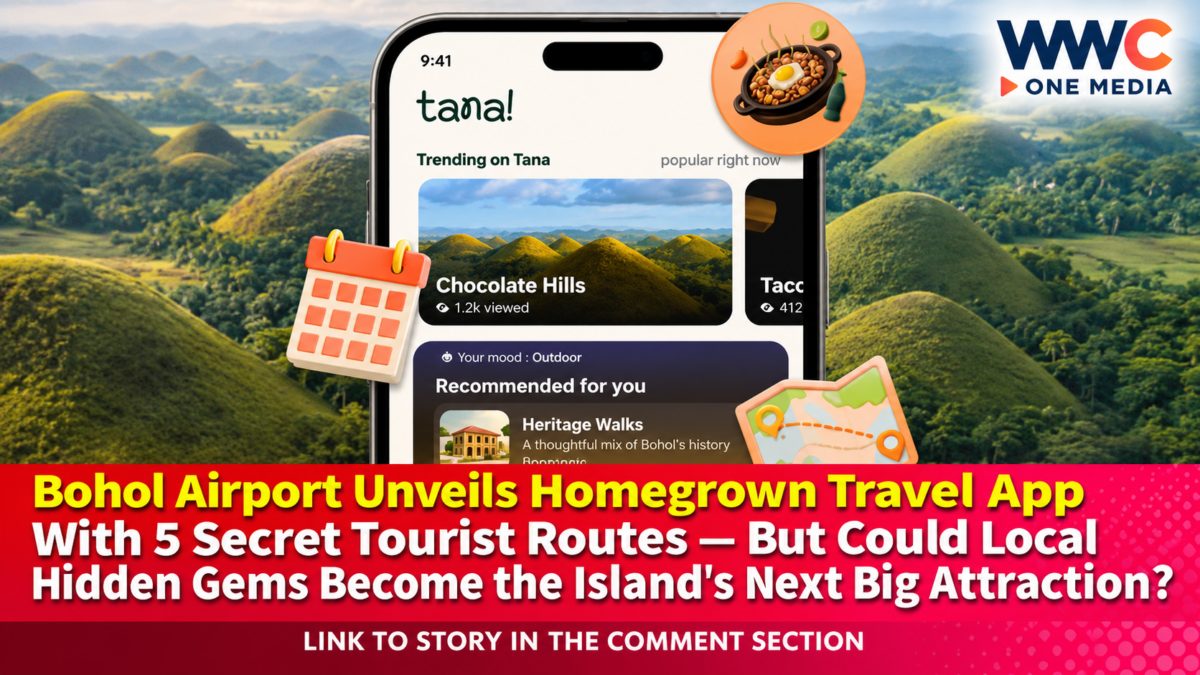
Bohol-Panglao International Airport (BPIA) has partnered with tana!, a locally developed travel-discovery application, to introduce curated itineraries and practical visitor guides designed around recommendations from people who actually live on the island.
The initiative goes beyond promoting Bohol’s familiar attractions, such as the Chocolate Hills, Panglao’s beaches and the Philippine tarsier.
Instead, it aims to connect arriving passengers with local eateries, heritage sites, agricultural communities, coastal destinations and experiences that are not always featured in conventional travel packages.
At the center of the collaboration is Bohol Maxxing, a collection of five specially curated travel routes designed to help visitors explore the province from a different perspective.
The airport will also introduce scannable QR-code guides, printed mini-magazines and a dedicated section within the tana! application.
For local businesses, the partnership could create new opportunities to reach travelers at one of the most important moments of their visit: immediately after arriving in Bohol.
But there is a bigger question behind the initiative.
Can a homegrown travel app encourage tourists to explore beyond the usual destinations and help smaller communities benefit from Bohol’s tourism industry—or will the province’s most famous attractions continue dominating visitor spending?
Bohol Airport Partners With Homegrown App tana!
The partnership brings together Bohol-Panglao International Airport and tana!, a travel platform developed in Bohol.
The airport is operated by Aboitiz InfraCapital Bohol Airport Corporation.
Unlike conventional travel directories that organize destinations primarily through general listings, tana! focuses on experiences selected by people familiar with the island.
The app offers themed collections, recommended routes and practical information designed to help travelers make informed decisions about where to go.
According to its Apple App Store listing, the application was developed by Paniel Nycole Dumdum.
It describes its recommendations as reviewed and selected by a local curation team.
The listing also identifies the app as a travel platform offering curated routes and locally recommended destinations.
The partnership’s objective is to make those recommendations easier for arriving passengers to discover.
Rather than expecting visitors to research every destination independently, airport guides will introduce them to options early in their journey.
What Is the Bohol Maxxing Initiative?
One of the collaboration’s major features is Bohol Maxxing, which offers five curated itineraries.
The initiative is designed to help different types of travelers explore the province according to their available time and interests.
Among the featured experiences are a redesigned countryside tour, a half-day exploration of Tagbilaran City and a coastal-and-farm itinerary.
The countryside experience includes firefly watching.
The Tagbilaran route introduces visitors to local urban attractions and community experiences.
The coastal-and-farm itinerary is designed particularly for returning travelers seeking quieter activities.
It includes opportunities involving permaculture farming and cacao roasting.
These activities can give visitors a better understanding of local agriculture, food production and community traditions.
However, the available reports describe only some of the five routes in detail.
It would be inaccurate to invent the complete list of itineraries or claim that every attraction is newly opened.
Travelers should consult the app for the current routes and participating destinations.
Discover Bohol Beyond the Chocolate Hills and Famous Beaches
Bohol is internationally recognized for its natural beauty and cultural attractions.
The Chocolate Hills remain among the province’s most recognizable landmarks.
Panglao continues attracting visitors through its beaches, accommodation options and marine activities.
But the airport’s latest initiative is built around a different proposition: visitors can experience more of Bohol by exploring places that do not receive the same national and international attention.
These may include neighborhood restaurants, local food producers, small community spaces and less-visited natural attractions.
For returning tourists, the approach could make repeat visits more interesting.
Someone who has already visited the Chocolate Hills or spent several days at a beach resort may be looking for different experiences.
Locally curated routes could introduce activities involving agriculture, food, heritage and everyday community life.
The platform’s usefulness will ultimately depend on the accuracy of its information, the quality of its recommendations and how well participating establishments serve visitors.
Airport QR Codes Make Travel Planning Easier
Under the partnership, arriving passengers will be able to access visitor information through QR-code-based discovery guides.
Printed mini-zines will also provide a compact introduction to selected destinations.
The tana! application will include a dedicated airport section featuring travel routes and practical advice.
The airport guides are expected to provide details about useful facilities and services.
These include information about 24-hour tourist SIM card kiosks, the Grab booking booth, last-minute shopping at Nomad Express and selected viewing areas within the terminal.
The goal is to reduce the amount of time travelers spend searching for basic information after arrival.
A visitor unfamiliar with the province may need help deciding where to eat, which activities to consider and how to arrange transportation.
By providing a starting point, the airport hopes to improve the transition between arrival and exploration.
However, the partnership does not establish that every transport option or business mentioned is available at all hours.
Travelers should still confirm schedules, service availability and prices.
Aboitiz InfraCapital Wants the Visitor Experience to Begin at the Airport
Aldwin Uy, general manager of Bohol-Panglao International Airport under Aboitiz InfraCapital Bohol Airport Corporation, said the collaboration aims to create a stronger connection between travelers and the province.
He emphasized that visitors should begin discovering Bohol as soon as they arrive.
The concept positions the airport as more than a transportation facility.
It becomes a point where travelers receive information about culture, food, communities and local experiences.
For airport operators, this is increasingly important.
Passenger satisfaction depends on more than flight schedules, terminals and baggage handling.
Convenient ground transportation, destination information and access to local services can influence how visitors evaluate their overall travel experience.
For Bohol, the initiative also creates an opportunity to direct tourists toward businesses and attractions outside the usual tourism circuit.
Smaller Businesses Could Benefit From Wider Tourist Exposure
One of the most important potential benefits involves local entrepreneurs.
Tourism spending often concentrates around well-known attractions, major resorts and established transportation routes.
Smaller businesses may have difficulty reaching visitors who are unfamiliar with their location or services.
A locally curated travel platform could help address that problem.
For example, a visitor who discovers a small café, farm experience or locally operated activity through tana! may spend money in a community they would otherwise have missed.
That spending could support jobs, suppliers and family-owned enterprises.
However, these benefits are still potential outcomes.
The airport partnership has not released verified figures showing how many additional customers or how much revenue participating businesses will receive.
The actual impact will depend on app usage, visitor interest, transportation access and the ability of businesses to accommodate demand.
Bohol’s Growing Air Connectivity Creates Opportunities
The launch comes shortly after another important development at Bohol-Panglao International Airport.
Philippine Airlines introduced an Airbus A330 wide-body aircraft on the Manila–Bohol route in October.
WWC ONE MEDIA reported the milestone in Philippine Airlines Deploys 309-Seat Airbus A330 on Manila–Bohol Route — But Can Bigger Flights Transform the Island’s Tourism Industry?.
The aircraft deployment demonstrates the airport’s ability to accommodate larger passenger aircraft.
More airline seat capacity may create opportunities to attract additional visitors during periods of strong demand.
But it does not automatically guarantee higher tourism arrivals.
The new tana! partnership addresses a different part of the visitor experience.
While airline connectivity helps travelers reach Bohol, locally curated information may encourage them to explore more of the province after arrival.
Together, these developments reflect an effort to improve both access and destination discovery.
Can Panglao’s Local Economy Capture More Visitor Spending?
Tourism-related investment is also continuing in Panglao.
In September, Robinsons Supermarket opened its first Bohol branch at Bellemar Lifestyle Center in Tawala.
WWC ONE MEDIA covered the development in Robinsons Makes Its Big Bohol Bet: First Panglao Supermarket Opens — And Tourism Is the Real Prize.
The expansion reflects business interest in a market serving both local residents and travelers.
But major retail investments are only one part of Bohol’s economy.
Smaller restaurants, food producers, transport operators and community tourism providers also depend on visitor spending.
The tana! partnership could provide another promotional channel for those smaller establishments.
For the initiative to achieve its objectives, however, recommendations will need to remain relevant, accurate and useful to travelers.
Sustainable Tourism Remains Essential
Encouraging visitors to explore more destinations also creates environmental responsibilities.
Bohol’s coastal areas, wildlife habitats and natural attractions require careful management.
Tourism growth can support livelihoods, but poorly managed visitor activity may damage sensitive ecosystems.
WWC ONE MEDIA recently covered this challenge in Bohol Whale Shark Watching Returns This November — But Tourists Must Follow These Strict New Rules.
That article examined the province’s stricter framework for marine wildlife interactions.
It emphasized that operators must meet environmental and regulatory requirements before conducting activities.
The relevance to tana! is broader.
Locally recommended experiences should encourage travelers to respect communities, wildlife and natural habitats.
Promoting lesser-known destinations may help diversify tourism, but it should not result in uncontrolled visitor pressure on sensitive locations.
Responsible tourism involves balancing economic opportunities with conservation and community welfare.
Bohol’s Hospitality Industry Is Already Gaining International Attention
Bohol’s tourism appeal extends beyond its famous landmarks.
Local design, hospitality services and cultural influences are attracting recognition.
WWC ONE MEDIA reported on the province’s international hospitality achievements in Bohol Design Goes Global: South Palms Wins Two Major Asia Awards — What Makes This Resort Stand Out?.
The report explored how a Panglao resort incorporated local materials, craftsmanship and environmental design principles.
The connection to tana! lies in the growing importance of destination identity.
Modern tourism is not always driven exclusively by famous landmarks.
Food, architecture, craftsmanship, agriculture and community experiences can also shape how travelers remember a destination.
A locally developed discovery platform may help communicate those elements to visitors more effectively.
The Department of Tourism Is Strengthening Regional Standards
The partnership also comes as government agencies work to improve tourism services across Central Visayas.
WWC ONE MEDIA reported that the number of Department of Tourism-accredited tourism enterprises in the region increased to approximately 3,500 as of September 30, 2026.
The development was covered in Central Visayas Tourism Accreditations Jump 25% to 3,500 as DOT Waives Fees — But Thousands of Tourists Still Face a Critical Safety Question.
Accreditation helps establish standards and provides travelers with information about participating tourism businesses.
However, a recommendation appearing in a travel app does not automatically establish that an operator holds the required tourism accreditation or permits.
Travelers should verify the credentials of service providers where applicable, especially for organized tours, transport and other regulated activities.
Digital discovery and tourism regulation serve different purposes, but both contribute to a better visitor experience.
Bohol Is Also Developing Other Digital Tourism Tools
The airport’s partnership is part of a wider trend toward technology-assisted tourism.
In July 2026, the Department of Science and Technology and Bohol Island State University launched a separate platform called the Laag Bohol Web-App.
The project aims to connect tourists, tour guides, transport providers, operators and tourism authorities.
Its objectives include improving access to tourism services, visitor feedback and destination planning.
Laag Bohol and tana! are separate initiatives.
The former is a university-linked project supported by government research funding, while tana! is a locally developed discovery platform entering into a partnership with the airport.
There is no verified announcement that the two applications have merged or are operated by the same organization.
Their development nevertheless reflects growing interest in using digital tools to improve Bohol’s tourism experience.
What Travelers Should Know Before Using tana!
The tana! application is listed on Apple’s App Store under developer Paniel Nycole Dumdum.
Its publicly described features include themed collections, locally curated routes and information about selected destinations.
Travelers can explore recommendations and use them as a starting point when planning their trip.
But practical details can change.
Opening hours, entrance fees, transport availability and operating conditions should be confirmed before visiting a destination.
Those planning agricultural or community-based activities may need to coordinate with local operators in advance.
Travelers should also respect private property and local community rules.
The partnership announcement does not establish that every itinerary includes transportation, paid admission or a complete tour package.
A curated route is principally a travel-planning guide, not necessarily a booking confirmation.
What Will Determine Whether the Project Succeeds?
The partnership is promising, but its long-term success will depend on measurable outcomes.
One important indicator will be whether arriving passengers actually access the QR guides and use tana! to plan their activities.
Another will be whether smaller establishments receive additional visitors.
The quality of the curated information will also matter.
Inaccurate opening hours, outdated recommendations or inaccessible destinations could reduce user confidence.
The platform will need to maintain its content and adapt to changes in the local tourism environment.
Airport staff, tourism operators and participating communities may also have roles in ensuring that passengers can easily access the information.
No verified public data currently establish how many travelers have used the airport-specific guides or how much spending the partnership has generated.
For now, the project is best understood as a new effort to make Bohol’s tourism opportunities more visible.
The Bottom Line
Bohol-Panglao International Airport has partnered with the locally developed tana! travel app to introduce QR-code visitor guides, printed mini-zines and an airport-specific digital discovery section.
The partnership features five Bohol Maxxing itineraries, including countryside activities, Tagbilaran exploration and coastal-and-farm experiences.
Airport operator Aboitiz InfraCapital Bohol Airport Corporation hopes the initiative will encourage visitors to explore lesser-known destinations while giving local businesses greater exposure.
Independent coverage from InsiderPH, SunStar Cebu, Daily Tribune and Context.ph confirms the collaboration and its announced features.
However, its actual effect on visitor numbers, community income and tourism spending has not yet been measured publicly.
As Bohol prepares to welcome more travelers and promote its attractions beyond the conventional tourism circuit, one question could define the next chapter of the province’s tourism industry: Can a locally created travel app turn overlooked communities into must-visit destinations—or will the promise of a more inclusive tourism boom remain unfulfilled?