Seven people, including three children, died in a road collision near Khavda in Gujarat’s Kutch district on the night of Nov. 21, after a passenger car collided with a trailer on the Bhuj-Khavda National Highway. The Indian government has confirmed financial assistance for the families of those killed, while police investigate the circumstances surrounding the crash.
The incident has two distinct public-record developments: the reported recovery and investigation of the victims, and the national government’s decision to provide financial relief. But the most important unanswered question remains the cause of the collision. The available public information does not establish a final finding of fault or explain all the factors that led to the impact.
What is confirmed about the Kutch crash?
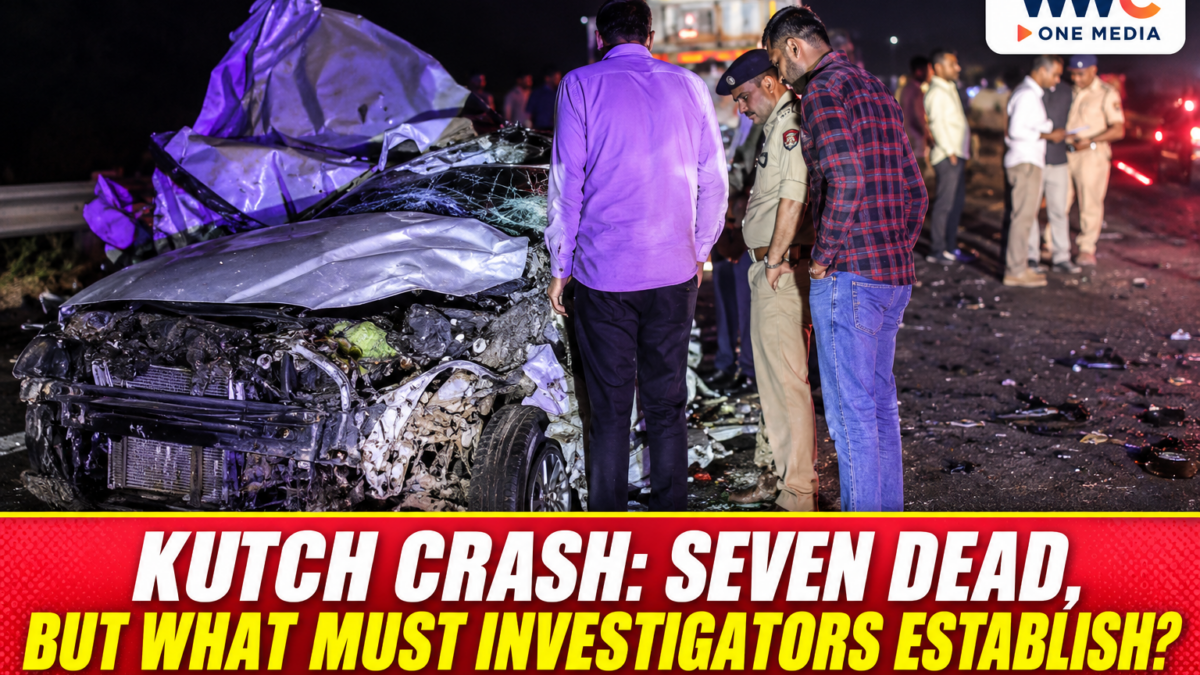
The government-operated Akashvani news service reported that the collision happened near Khavda in Kutch district late on Nov. 21. Its report identified the vehicles as a car and a trailer travelling on the Bhuj-Khavda National Highway.
Seven people died, including three children. The car was described as severely damaged, and the bodies were sent to a hospital for post-mortem examination.
Local police and emergency rescue teams responded after receiving information about the incident. Akashvani also reported that police registered a case to investigate the exact cause of the accident.
Those details establish the scale of the loss and confirm that an investigation was under way. They do not, however, provide a final reconstruction of the collision or a judicial determination of responsibility.
The distinction is important in a serious road incident. The number of fatalities establishes the human consequences, but it does not by itself explain whether vehicle movement, road conditions, mechanical factors or other circumstances contributed.
Government announces financial assistance
The Prime Minister’s Office issued a formal statement on Nov. 22 confirming that Prime Minister Narendra Modi had expressed condolences over the loss of lives in Kutch.
The statement announced ex-gratia assistance from the Prime Minister’s National Relief Fund (PMNRF): ₹2 lakh for the next of kin of each deceased person and ₹50,000 for each injured person.
The announcement provides a defined amount of central government assistance. It is separate from any insurance settlement, compensation claim or other assistance that may be available under applicable rules.
For families dealing with the consequences of a fatal collision, financial assistance can help address immediate expenses. However, the PMNRF announcement does not resolve questions about liability, insurance coverage or any legal claims arising from the accident.
It is also important not to confuse the two categories of assistance. The ₹2 lakh amount applies to the next of kin of each person who died, while the ₹50,000 amount is intended for injured people.
The cause of the collision remains the central question
Akashvani reported that police registered a case to investigate the exact cause of the accident. That means the available public account should not be treated as a final technical or legal conclusion.
Investigators may need to establish the direction and movement of both vehicles, the point of impact, road conditions and the physical evidence left at the scene. Vehicle inspections and witness accounts can also help reconstruct the sequence of events.
The distinction between a collision description and a confirmed cause is especially important when a heavy vehicle is involved. A trailer’s size and mass can make the consequences of an impact severe, but the scale of the damage alone does not prove speeding, negligence or mechanical failure.
WWC has examined similar questions in its coverage of a Cotabato truck crash involving reported brake failure. That Philippine incident is unrelated to the Kutch collision, but it illustrates why a mechanical explanation should be supported by an investigation rather than assumed from the damage.
Why highway investigations need more than an early account
A preliminary description can help the public understand where a collision occurred and which vehicles were involved. It cannot necessarily answer every question about how the event unfolded.
A complete investigation may consider vehicle condition, road layout, visibility, traffic movements and other physical evidence. Investigators may also compare witness accounts with the damage patterns and findings from the scene.
These questions matter because a conclusion about responsibility can have consequences beyond the immediate investigation. It may affect criminal proceedings, insurance claims and any civil action brought by affected families.
In a separate Philippine incident, WWC reported on a truck that struck a store and eatery in Southern Leyte. That case raised a related reporting issue: describing what a vehicle struck is not the same as establishing why the driver lost control.
The same principle applies in Gujarat. Until investigators publish more detail, the cause should remain an open question rather than a conclusion.
The wider road-safety concern
The Kutch collision adds to the continuing public concern over serious highway crashes involving passenger vehicles and heavy transport. The deaths of three children make the consequences particularly grave for the affected families, but the public-interest questions extend to the safety of everyone using the road.
Heavy vehicles and smaller passenger cars share highway space, often under different operating conditions. A collision between them can have severe consequences, which makes reliable vehicle inspections, safe driving practices and sound road design important parts of any road-safety discussion.
WWC’s recent Antipolo truck-crash analysis explains why investigators need to distinguish an initial description of a crash from evidence that establishes its cause. The article also discusses the importance of technical inspection and documented findings.
That is not evidence of a shared cause between the incidents. It is a reminder that road-safety conclusions should be based on the facts of each case.
What happens next
The next important development is a fuller account from the investigating authorities. The public record should clarify the registered case, the evidence collected at the scene and any findings that emerge from vehicle inspections or other investigative work.
The post-mortem examinations may provide official medical findings relating to the deaths. Those findings should not be anticipated or described as confirmed until the relevant authorities release them.
The government has already announced PMNRF assistance, but the public statement does not provide a detailed breakdown of the victims, the investigation’s progress or any determination of responsibility.
For now, the confirmed public account is that seven people died in a car-trailer collision near Khavda, police registered a case to establish the cause, and the central government announced financial assistance for the deceased’s next of kin and injured people.
Frequently asked questions
1. How many people died in the Kutch road accident?
Seven people died, including three children, in the collision near Khavda in Gujarat’s Kutch district.
2. Where did the collision happen?
The collision was reported near Khavda on the Bhuj-Khavda National Highway in Kutch district, Gujarat, India.
3. What vehicles were involved?
The government broadcaster’s report described a collision involving a car and a trailer.
4. Has police confirmed the cause of the accident?
The available report says police registered a case to investigate the exact cause. It does not provide a final finding establishing responsibility.
5. What financial assistance did the Indian government announce?
The Prime Minister’s Office announced ₹2 lakh from the Prime Minister’s National Relief Fund for the next of kin of each deceased person and ₹50,000 for each injured person.