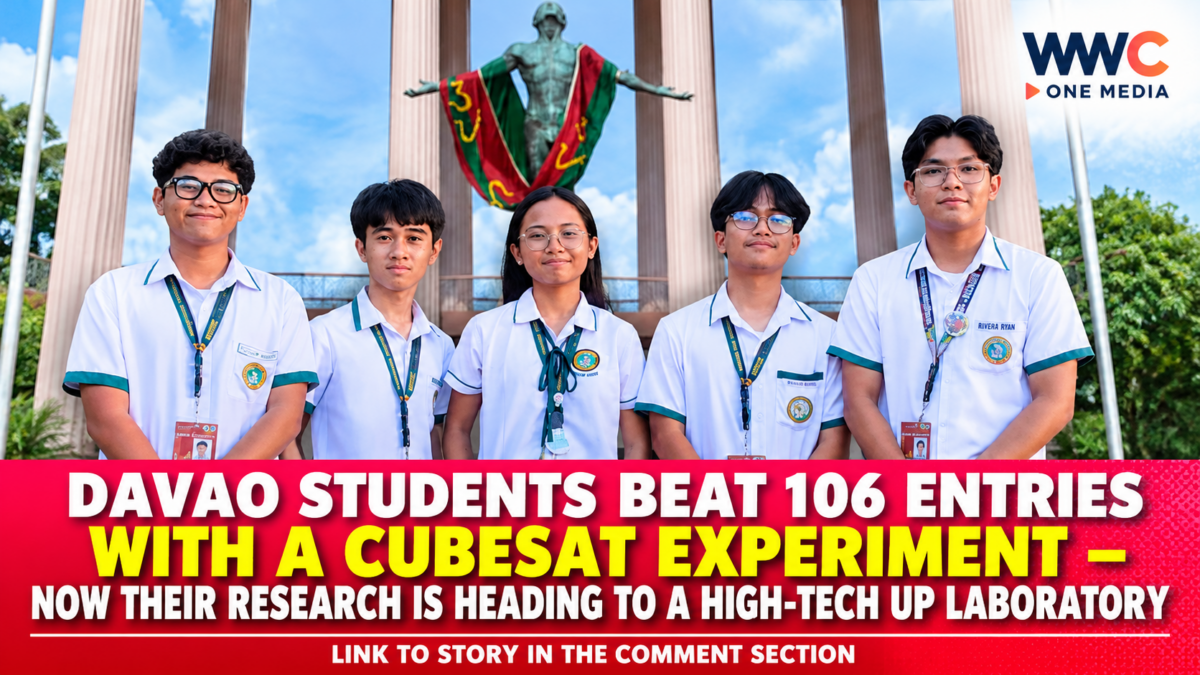
DAVAO CITY, Philippines — Five senior high school students from Davao City are taking their satellite research beyond the classroom after winning the senior high school category of a nationwide space science competition, earning an opportunity to test their experiment at the University of the Philippines Diliman.
The winning students belong to Team APOGEE of Davao City National High School (DCNHS), under its STEM-Earth and Space program. Their research proposal stood out among 106 submissions from across the Philippines in the Philippine Space Agency’s (PhilSA) 2026 Patalasan sa #YamangKalawakan: The Full Anechoic Chamber Experiment Challenge.
Their study, titled “Characterizing Telemetry Degradation Caused by Simulated CubeSat Rotation and Antenna Polarization Mismatch,” examines how satellite movement and antenna alignment can affect the quality of communication signals.
The victory gives the Davao students an opportunity to bring their research into a professional engineering environment, where they are scheduled to conduct hands-on testing at the Full Anechoic Chamber of the University of the Philippines Diliman’s Electrical and Electronics Engineering Institute (UP-EEEI).
For a team of high school researchers, the opportunity represents more than a competition victory. It is a chance to examine a technical problem that matters to the operation of small satellites and the communication systems that connect them to Earth.
Five Davao students earn national recognition
Team APOGEE is composed of five senior high school students:
- Daniel Dave A. Garcia
- Basha Therese J. Martinez
- Ben Angelo S. Manla
- Julian Chris I. Giducos
- Rain Elmo C. Catapang
The team is led by coach Charis Faith D. Acquiadan, who highlighted the importance of giving students access to professional-grade research facilities.
Acquiadan described the opportunity to conduct testing at UP-EEEI as a significant milestone, explaining that exposure to specialized equipment can help bridge the gap between high school STEM education and advanced university research.
The achievement also demonstrates how secondary school students can participate in scientific work that goes beyond classroom demonstrations, particularly when they are given opportunities to develop original research proposals and engage with established research institutions.
What exactly are the students trying to discover?
The team’s research focuses on two technical factors that could affect satellite communication: CubeSat rotation and antenna polarization mismatch.
A CubeSat is a small, standardized satellite commonly used for educational, research and technology-demonstration missions. Despite its compact size, it must still communicate with ground stations to transmit information and receive instructions.
That communication depends partly on the performance and orientation of its antennas.
When a satellite changes its orientation, its antenna may no longer be positioned in the most favorable direction for communicating with a receiving station. The alignment between transmitting and receiving antennas can also influence how efficiently signals are transferred.
This is where polarization becomes important.
Polarization describes the orientation of an electromagnetic wave’s electric field. When transmitting and receiving antennas have mismatched polarization, the received signal can become weaker.
Team APOGEE wants to examine how these factors interact and how much they can contribute to telemetry degradation under simulated conditions.
Telemetry refers to the information transmitted by a spacecraft or satellite to a ground station. It can include operational information and measurements that help operators monitor the spacecraft.
In practical terms, the team’s research is examining a question that satellite engineers must consider: How can changes in a small satellite’s orientation and antenna alignment affect the strength and reliability of its communication signals?
The study is not being presented as a complete solution to satellite communication problems. Rather, it aims to generate useful experimental findings that could help inform decisions involving antenna selection and small-satellite communication design.
Why UP Diliman’s Full Anechoic Chamber matters
The next stage will take the students to UP Diliman’s Electrical and Electronics Engineering Institute, where they are expected to calibrate their equipment and conduct their CubeSat rotation experiment inside the Full Anechoic Chamber.
The facility is designed for specialized antenna measurements.
According to the University of the Philippines, the chamber is electromagnetically shielded and equipped with specially treated interior surfaces that absorb electromagnetic waves, reducing unwanted reflections during measurements.
This creates an environment suitable for examining antenna radiation patterns and evaluating antenna performance under controlled conditions.
The chamber is particularly important because satellite communication depends on antennas that can transmit and receive signals effectively.
The UP facility forms part of the university’s broader research infrastructure for small satellites and space engineering. Its laboratories support work involving satellite components, antenna testing and other space technology applications.
For Team APOGEE, access to this facility means their proposed experiment can move beyond theoretical discussion and into a more specialized testing environment.
The students’ upcoming work will involve equipment calibration and hands-on experimentation, as reported by SunStar Davao.
PhilSA’s competition gives high school students access to space research
The 2026 Patalasan sa #YamangKalawakan challenge was organized to encourage Filipino high school students to develop original experiments involving space science, satellite engineering and related technologies.
According to PhilSA’s published competition guidelines, participating teams were required to consist of two to five students and a teacher-coach. Entries were divided into junior high school and senior high school categories.
The winning proposals were intended to be carried out using the Full Anechoic Chamber at UP Diliman.
PhilSA’s published schedule listed November 10–12, 2026, for the study tour. The agency also stated that first-place teams in each category would receive an all-expenses-paid study tour and a ₱50,000 cash prize.
The competition therefore offers more than recognition. It provides students with an opportunity to engage with specialized facilities and experience how scientific proposals are evaluated and tested.
The programme also reflects the importance of introducing young Filipinos to research fields that require engineering knowledge, analytical thinking and practical experimentation.
Filipino students have already brought experiments to the International Space Station
Team APOGEE’s achievement comes amid a wider effort to expand Filipino participation in international space science programmes.
In a separate development reported by the Philippine News Agency in May 2026, an experiment designed by students from Rizal Technological University was successfully performed aboard the International Space Station’s Kibo module.
The experiment, called Double Gyroscope, was designed by Christopher Tumamac, Ryan Andrew Doña and Rose Ann Cezar. NASA astronaut Christopher Williams conducted the experiment on March 24, 2026, as part of the Asian Try Zero-G programme.
BusinessMirror also reported on the achievement, explaining how the experiment examined the movement of gyroscopes in a microgravity environment.
These students are not part of Team APOGEE, and their experiment is separate from the Davao team’s CubeSat research. However, their achievement demonstrates that Filipino students can contribute to scientific activities extending beyond conventional school laboratories.
PhilSA has also documented previous Filipino student experiments selected for the Asian Try Zero-G programme, including research conducted in earlier years.
The growing number of opportunities for young researchers highlights the importance of developing local scientific talent and connecting schools with universities, government agencies and international research initiatives.
Davao’s achievement adds to the country’s growing technology ambitions
The team’s success also connects with a broader conversation about the Philippines’ ability to develop its own scientific and technological capabilities.
Space technology depends on several interconnected fields, including electronics, telecommunications, software, materials science and engineering. Developing these capabilities requires not only funding and specialized facilities but also a steady pipeline of students who can eventually become researchers and technical professionals.
WWC ONE MEDIA previously examined the challenges facing local governments in adopting emerging technology in Philippine LGUs Lag in AI Readiness as Skills, Internet and Funding Gaps Hold Back Adoption. The report highlights how limited technical skills, infrastructure and institutional support can slow technology development, reinforcing why opportunities for students to gain practical research experience matter.
The importance of building those skills also extends into the education sector. In AI Is Transforming Philippine Classrooms — But Working Students Risk Being Left Behind as Schools Struggle to Keep Up, WWC ONE MEDIA explored the growing need to ensure that students receive meaningful access to technology education and institutional support.
Davao’s Team APOGEE offers a positive example of what can happen when students are encouraged to pursue technical research and are given opportunities to work with institutions beyond their own school.
The region’s wider technology ecosystem is also developing. WWC ONE MEDIA’s report, A Koronadal IT Student Has Found a New Way to Preserve Local Heritage — Here’s How Technology Could Bring the City’s Stories to Life, explored another example of a young Filipino using technology to address a local challenge.
Meanwhile, the country’s digital infrastructure is becoming increasingly important as advanced technology and data-intensive applications expand. Converge Builds a Digital Fortress for Philippine Data as AI and Cloud Demand Accelerate examines the infrastructure investments supporting the country’s growing digital economy.
These developments involve different technologies and research areas, but they point to a common issue: the Philippines needs both capable people and reliable infrastructure to participate more meaningfully in advanced technology industries.
The next test begins at UP Diliman
For Team APOGEE, winning the national competition is an important achievement, but the next stage may prove even more valuable.
The upcoming testing will give the students an opportunity to work with specialized equipment, calibrate their experimental setup and examine the behavior of their proposed satellite communication experiment under controlled conditions.
The results could provide useful information about how satellite rotation and antenna polarization mismatch influence telemetry performance.
The team has also expressed hope that its findings can help satellite designers better understand polarization-related signal loss when selecting antennas for small satellites.
That is a practical research objective in a field where reliable communication is essential.
The students are not claiming to have solved every challenge facing satellite engineers. Their contribution is more focused: to investigate a specific communication problem and produce findings that could support further research.
But for five students from Davao City National High School, the opportunity to conduct an experiment inside a specialized university facility is already a major step.
Their victory began with a research proposal competing against 105 other entries. Now the bigger question is what their experiment will reveal once it reaches the laboratory.