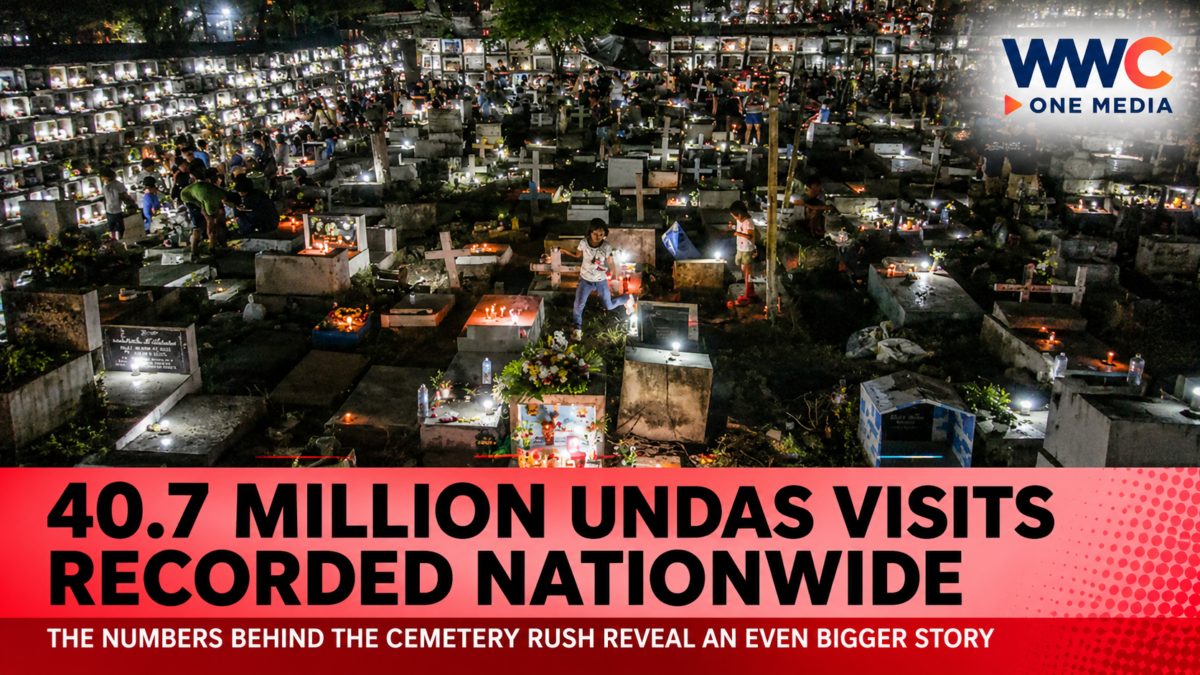
MANILA, Philippines — More than 40.7 million visits to cemeteries, memorial parks and columbaria were recorded across the Philippines during the opening days of Undas 2026, reflecting the extraordinary scale of the country’s annual tradition of remembering departed loved ones.
The Philippine National Police (PNP) reported that 40,740,246 visitors were recorded across 5,311 cemeteries, memorial parks and columbaria nationwide from October 30 until 6 a.m. on November 2.
The figures were announced by PNP chief Police General Jose Melencio Nartatez Jr. on Monday, November 2, as police continued security operations during the observance of All Saints’ Day and All Souls’ Day.
Alongside the large number of recorded visits, authorities reported confiscating 6,499 prohibited items during inspections and security operations at cemetery grounds nationwide.
The figures highlight the logistical challenge of managing one of the Philippines’ most significant annual observances, when families travel to burial grounds to pray, offer flowers and candles, clean graves and spend time remembering relatives who have passed away.
But the nationwide total is only part of the story. Metro Manila’s cemetery figures, the scale of the police deployment and the volume of prohibited items seized provide a closer look at how authorities managed the Undas 2026 crowds.
PNP records more than 40.7 million cemetery visits
According to the PNP’s nationwide monitoring report, 40,740,246 visits were recorded across 5,311 cemeteries, memorial parks and columbaria between October 30 and 6 a.m. on November 2.
The reporting period covered the days leading into All Saints’ Day on November 1 and All Souls’ Day on November 2.
The figure represents the number of recorded visits reported by police monitoring operations. It should not automatically be interpreted as 40.7 million unique individuals, since the published report does not establish whether repeat visits by the same person were excluded.
The distinction matters when interpreting the scale of the holiday movement.
Nevertheless, the recorded total demonstrates the enormous volume of activity that authorities monitored during the Undas period.
The Philippine National Police said personnel would continue providing security and assistance, particularly around major roads, transport terminals and other areas experiencing increased passenger and vehicle movement.
Police operations also shifted toward helping travelers return to their homes safely after spending the holiday with their families.
6,499 prohibited items confiscated during Undas operations
The PNP also reported that 6,499 prohibited items were confiscated during nationwide security operations.
The listed items included:
- 879 pointed or bladed objects
- 62 alcoholic drinks
- 2,817 lighters
- 1,739 cigarette and vape products
- 180 cooking materials
- 397 flammable substances
- Other restricted items
The confiscations formed part of security measures intended to prevent disturbances and reduce potential hazards inside crowded cemetery grounds.
Restrictions on certain objects and activities vary depending on cemetery regulations and local government rules. Visitors are therefore expected to follow posted restrictions and instructions from cemetery administrators and security personnel.
The PNP said police officers would remain available to assist visitors, respond to emergencies and help maintain order as the holiday period concluded.
Metro Manila records millions of cemetery visits
Metro Manila also experienced substantial crowds during the observance.
According to reporting by The Philippine Star, the National Capital Region Police Office (NCRPO) recorded 2,522,841 visits to cemeteries, memorial parks and columbaria in Metro Manila on November 1.
The figures covered several police districts and cemetery locations across the capital region.
Manila North Cemetery accounted for a significant share of the recorded activity.
The Philippine Star reported that the cemetery’s director, Daniel Tan, recorded 660,000 visitors on November 1, in addition to 1,434,800 recorded from October 30 to November 1.
Meanwhile, Manila South Cemetery registered 74,194 visitors on November 1, bringing its reported total to 404,433.
The figures illustrate how major burial grounds in the capital continue to attract large numbers of families during the annual observance.
The NCRPO also reported that another 954,680 visits were recorded in Metro Manila cemeteries by 6 p.m. on November 2.
Police personnel remained deployed to assist with crowd management, traffic conditions and public safety.
Manila North Cemetery draws more than 1.3 million visitors in one day
Manila North Cemetery, considered the country’s largest cemetery, was among the busiest locations during Undas 2026.
GMA News reported that cemetery director Daniel Tan recorded 1,342,000 visitors on November 1 alone.
Despite the heavy influx, Tan said the cemetery did not experience major untoward incidents during the day’s observance.
Some children were reportedly separated from their companions, but they were located with assistance from the cemetery’s paging system.
The cemetery also implemented restrictions on certain items brought inside its grounds.
The scale of the crowd reflects the importance of Manila North Cemetery as a major destination for families visiting the graves of relatives.
Earlier reports from GMA News documented how the cemetery’s internal roads became difficult to navigate as the number of visitors increased, prompting management to stop its free ride service.
The experience highlights why crowd management, accessible pathways and emergency assistance remain important during peak visiting hours.
More than 111,000 police personnel deployed nationwide
The large number of visitors required extensive security preparations.
GMA News reported before the holiday that approximately 141,000 personnel from the PNP and augmentation forces would be deployed nationwide for Undas 2026.
The deployment covered cemeteries, major roads, transport terminals and other locations expected to experience increased public activity.
The PNP also placed units nationwide under full alert status beginning October 30, with operations scheduled to continue through the holiday period.
In Metro Manila, police personnel were assigned to cemetery entrances, surrounding roads, transport hubs and other strategic locations.
The NCRPO also shifted part of its focus toward helping residents return safely to the capital after traveling to their home provinces.
Authorities monitored traffic and passenger movements at major entry points and transport terminals as people returned after the long weekend.
The operation was not limited to cemetery security. Police also monitored residential areas and commercial establishments to help prevent crimes while families were away.
MMDA deploys more than 2,000 personnel for traffic management
Traffic management was another major part of the government’s Undas preparations.
The Metropolitan Manila Development Authority (MMDA) deployed more than 2,000 personnel across Metro Manila to help manage traffic and pedestrian movement around cemeteries, memorial parks, churches and other crowded areas.
According to the Presidential Communications Office, the deployment included traffic management, rerouting measures, medical assistance and emergency response arrangements.
Major cemeteries covered by the preparations included Manila North Cemetery, Manila South Cemetery, Bagbag Public Cemetery in Quezon City, Loyola Memorial Park in Marikina City and San Juan Public Cemetery.
The measures were intended to reduce congestion and help ensure that emergency vehicles could reach areas where assistance was needed.
The large number of cemetery visitors also meant that traffic management had to account for pedestrians, public transportation, private vehicles and families traveling between different parts of Metro Manila.
Philippine Red Cross deploys emergency teams for the holiday rush
Public safety preparations also involved humanitarian and emergency response organizations.
The Philippine Information Agency reported that the Philippine Red Cross deployed 1,890 staff members and trained volunteers for its Undas 2026 operations.
The organization established 322 first aid stations across strategic locations nationwide, including cemeteries, transport terminals, seaports and major travel routes.
Its deployment also included ambulances, welfare desks, mobile units and on-foot patrol teams.
The Red Cross provided assistance to visitors and travelers who needed first aid, medical attention or welfare support.
The organization encouraged families to prepare for their journeys, remain hydrated and keep important medical and emergency contact information accessible.
These preparations were particularly relevant during a holiday period involving extensive travel and large gatherings.
Undas remains one of the Philippines’ most important family traditions
Beyond the security figures, Undas remains a deeply meaningful occasion for many Filipino families.
Observed around All Saints’ Day on November 1 and All Souls’ Day on November 2, the tradition brings relatives together to remember loved ones who have died.
Families commonly visit cemeteries to clean and decorate graves, offer flowers and candles, pray and share memories.
The Associated Press reported that the tradition combines Catholic observances with older Filipino practices of honoring ancestors.
Anthropologist Nestor Castro of the University of the Philippines Diliman explained that ancestral veneration existed in the Philippines before Spanish colonization, with earlier traditions involving offerings to ancestral spirits known as anito.
Over time, these practices became intertwined with Catholic religious observances.
For many families, the annual cemetery visit is also an opportunity to reconnect with relatives who may live far apart.
The observance therefore carries significance beyond the number of visitors recorded by authorities. It is also a continuing expression of family ties, cultural identity and remembrance.
WWC ONE MEDIA’s earlier Undas reports provide additional context
The 40.7-million figure follows several preparations and public advisories published ahead of the holiday.
In UNDAS 2026 ALERT: Manila North Cemetery Announces Strict Entry Rules, Vehicle Ban and October 27 Deadline — But Are Thousands of Visitors Ready for the Restrictions?, WWC ONE MEDIA detailed Manila North Cemetery’s visiting schedule, vehicle restrictions and prohibited-item rules. Those measures help explain the preparations behind the large crowds recorded during the observance.
Police enforcement was another important part of the preparations. UNDAS 2026 CRACKDOWN: 18 Caught Drinking on Manila Streets as Police Intensify Oplan Galugad Near Major Cemeteries — But Is a Bigger Security Sweep Coming? examined police operations around Manila cemeteries before the busiest visiting days.
For families traveling to their home provinces, highway safety was also a concern. HPG Deploys 761 Personnel and 586 Force Multipliers for Undas 2026 — What Motorists Need to Know Before Travelling reported on the Highway Patrol Group’s preparations and its efforts to assist motorists during the holiday travel rush.
The transportation challenge extended to major expressways. In SMC Prepares Five Luzon Expressways for 10% Undas Traffic Surge — But Can Its Roadwork Ban Prevent Holiday Gridlock?, WWC ONE MEDIA examined the expected increase in vehicle traffic and the measures planned by the expressway operator.
Meanwhile, Globe Braces for Massive Undas 2026 Mobile Traffic Surge as Millions Travel — But Will Its Network Hold Up When Filipinos Need It Most? explored the importance of reliable mobile connectivity during the holiday, particularly for families coordinating travel and staying in contact during crowded events.
Together, these reports show that managing Undas requires coordination across several sectors—not only police and cemetery administrators, but also traffic authorities, emergency responders, transportation operators and telecommunications providers.
The bigger question: What do the 40.7 million visits reveal?
The PNP’s nationwide figure provides a striking snapshot of the scale of Undas 2026.
More than 40.7 million visits were recorded across thousands of burial grounds in just a few days, while authorities confiscated thousands of prohibited items and deployed personnel to manage crowds, traffic and public safety.
However, the number should be understood within its reporting limits. It covers recorded visits from October 30 to 6 a.m. on November 2, not necessarily the final total for the entire holiday period. Nor does it establish that every recorded visit represented a different person.
The figures also raise broader questions about how local governments and cemetery administrators can continue improving crowd management, sanitation, emergency access and visitor assistance during future observances.
For now, the 2026 monitoring report underscores the scale of a tradition that continues to bring millions of Filipino families together.
More than 40 million visits were recorded—but behind every visit was a family remembering someone who remains part of its story.