
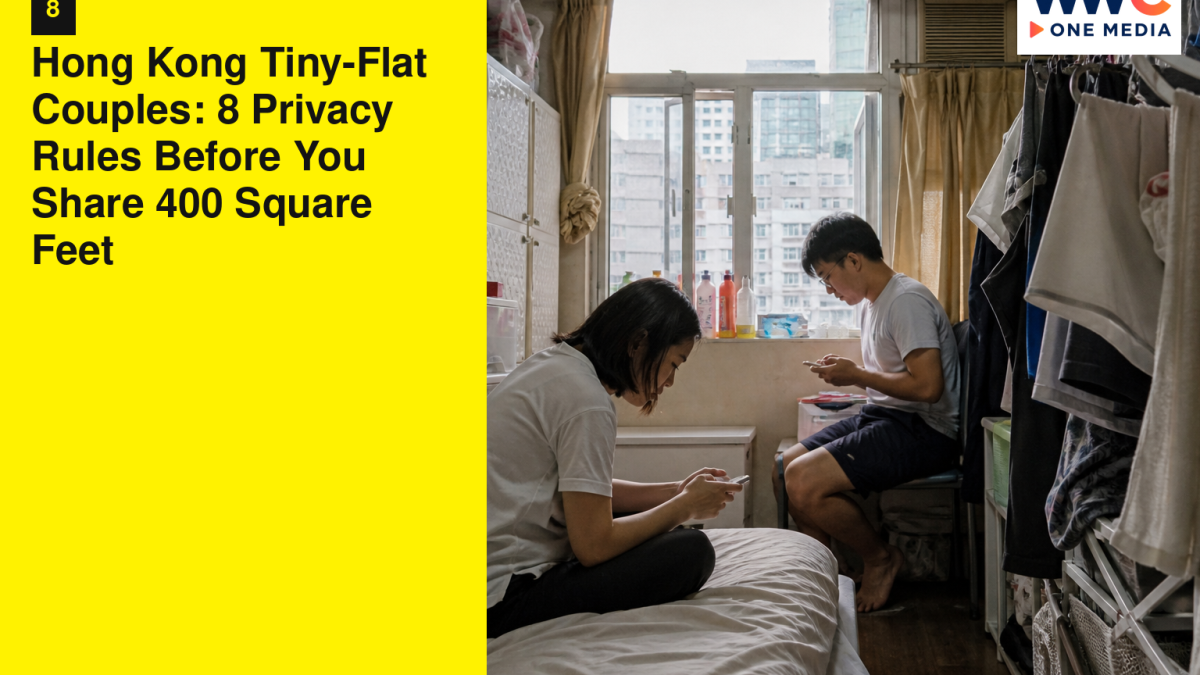
HONG KONG — A Hong Kong tiny-flat couple can love each other and still lose the plot in 400 square feet. That number is not a market statistic. It is the premise of this flat: one room that is living room and bedroom, a kitchen that is a corridor, a bathroom that has heard every call. Kowloon walk-up, Island shoebox, a subdivided unit with a door that is more idea than door — the photos will lie. The privacy will not.
Write eight privacy rules before you share the keys. Zoom walls, hanging laundry, whose parents visit, the last MTR, headphones, the bathroom, packages, and an hour that is only yours. If you wait until week six, you will negotiate in a voice the neighbour already knows.
1. Name the walls you actually have — walk-up, shoebox, or subdivided
A newer Island shoebox in a managed tower still has thin nights, but it has a lobby, a camera, and a set of house rules taped by the lifts. A Kowloon walk-up from another decade has staircases that smell like everyone’s dinner and neighbours who have opinions about your drying rack. A subdivided unit — partitions, a shared corridor, a kitchen you do not fully control — is a different contract. Privacy rules that ignore the building type will sound like mood boards.
Walk the space together once with the lights on and once at night. Where does the bed sit relative to the door. Where will a laptop face during a video call. Where does sound go when someone laughs. If the only “office” is the edge of the mattress, say that before one of you accepts a job that needs camera-on meetings from nine to six.
Do not romanticise the subdivided partition. A foam panel is not a wall. If you can hear a stranger’s phone alarm through it, you will hear each other’s fights. Couples who pretend otherwise perform intimacy for an audience they never agreed to.
If the 400 square feet is a managed shoebox, read the deed of mutual covenant summaries the building actually enforces: guests, noise hours, drying clothes at windows, rubbish. Those are privacy-adjacent. A security guard who calls up every time a parent visits is part of your relationship whether you like it or not.
Write one sentence in Notes: building type, who is on the lease, who has a copy of the keys, whether a landlord can enter with notice or with a culture of “just dropping by.” Hong Kong tiny-flat couples split up over access as often as they split up over money. Access is privacy.
2. The Zoom wall is a privacy rule, not a furniture flex
Two people, 400 square feet, at least one job that still believes in cameras. You need a wall, a corner, or a lie that you both consent to. A hanging rack with a sheet. A curtain on a tension rod. The bathroom, which is a terrible studio and a real last resort. Agree which backdrop is allowed on work days and which hours the camera-on person gets the quiet half of the room.
Headphones are not optional. They are how your partner’s stand-up does not become your personality. Buy a decent pair each. Agree a mug, a sticky note, or a closed laptop lid that means do not boil water, do not start a fight, do not ask about dinner. In a small flat the kettle is a public event.
If both of you need camera-on at the same hour, the flat cannot do it. That is not a failure of love. That is geometry. Budget a co-working day, a mall corner that is actually usable, a library, a friend’s office on a Saturday. Or stagger. One takes 8 to 12 out of the house. The other takes 1 to 5. Write it like a shift. Hong Kong tiny-flat couples who “figure it out each morning” figure it out as resentment.
Never film or photograph the other person in the background of a call without a standing yes. Colleagues do not need your partner in pyjamas. Family group calls on speaker are a Zoom-wall cousin. Speaker in 400 square feet is a broadcast. Earphones, or a warning, or take it at the stairwell if the stairwell is safer than the mattress.
If one of you does client work that cannot leak — finance, law, medicine, anything with a face and a file — the privacy rule gets stricter. The other person leaves, or wears earphones in the bathroom, or you admit the unit is the wrong unit. Do not shame that admission. Shame is how people start taking calls from the toilet and calling it fine.
3. Hanging laundry is public even when it is your underwear
Hong Kong dries clothes where it can: bamboo pole, rack at the window, a drying machine if the shoebox has one and the electric bill will tolerate it. Laundry in 400 square feet is not a chore chart only. It is a display. Neighbours across the airshaft can see. A parent who visits will see. A Zoom camera will see if you are careless.
Agree what can hang at the window and what stays on an indoor rack. Agree whose shirts can occupy the only shower rail. Agree a wash day so the room is not a permanent damp forest. Damp is a health nuisance and a mood. It is also how two people start snapping about towels that “never dry.”
If you are in a walk-up, the corridor rack may be a building habit. It is not automatically your habit. Stolen clothes happen. So does a neighbour’s commentary. If either of you is private about bodies — scars, undergarments, religious clothing — the window pole is a boundary, not a quaint postcard.
A script:
“Window is for jeans and tees. Anything I would not wear to a 7-Eleven stays inside. If your mother is coming, we take the rack down before the doorbell.”
That last clause matters. Laundry as a first impression is a fight you can skip.
Do not keep score of who folded. Do keep a hamper that is not the chair. In 400 square feet the chair will become a second wardrobe and then a third person.
4. The bathroom is a timetable, not a vibe
One toilet. That is the whole policy. Morning work starts, evening showers, a stomach that does not care you are in a meeting. Write the ugly version: who showers first on weekdays, how long is a reasonable shower, whether the door locks, whether the other person may enter for a charger. In a tiny flat, “just grabbing something” is how privacy dies of a thousand polite intrusions.
If one of you needs longer in the morning — hair, medication, prayer, a panic the city does not need to see — give them the bathroom block and take the kettle to the other end of the 400 square feet. If there is no other end, leave. A walk to a cha chaan teng is cheaper than a daily collision.
Smell, bins, period products, medication boxes: decide what stays visible. A partner who grew up in a house with two bathrooms will treat visibility as nothing. A partner who did not may feel exposed. Neither is dramatic. Put a small closed box in the only cabinet and stop narrating each other’s bodies.
If the unit is subdivided and you share a toilet with people who are not your partner, the couple privacy rule has a second layer. Knock. Shoes. A time you will not linger. And a plan for guests, because your overnight visitor is also their corridor.
5. Whose parents visit — and what 400 square feet can actually host
Parents in Hong Kong, as in Manila, as in a lot of this region, will treat a child’s flat as an extension of family space unless you draw a line. In 400 square feet that line has to be practical. There is no spare room. A parent on the sofa is a parent in the bedroom. A parent overnight is a redesign of the whole night.
Write: which parents, how much notice, how many nights, whether they get a key, whether they may arrive from the airport unannounced because “the flight landed early.” A mother from Tuen Mun for dim sum is not the same as a father from the Mainland staying a week because medical appointments are in Kowloon. Name both.
If one family is local and the other is overseas — Philippines, Canada, the UK, Australia — the overseas visit will be longer and heavier. The local family may feel they have a right to drop by because they are close. Both pressures need a sentence you can say without looking at your partner for permission in the doorway.
“We love you. This flat is 400 square feet. We can do dinner. We cannot do three nights. We’ll book you a guesthouse in [neighbourhood] and come every day.”
If that sentence is unsayable, you do not have a privacy rule. You have a fear. Fear will not get smaller when the suitcase appears.
Agree what gets tidied for parents and what is none of their business: mail, medication, a pride flag, a crucifix, a rental contract with one name. You can honour a parent and still put a document in a drawer. That is not deceit. That is a lock on a life they do not live.
Do not use a parent visit as a sneak family introduction if the other person thought it was a casual Sunday. That ambush is a privacy violation even if everyone smiles over pineapple buns.
6. Sound: the fight, the video, the neighbour who already knows your name
Walk-ups conduct arguments. Shoebox towers conduct bass. Subdivided units conduct everything. Your privacy rule for sound is two-layered: what the neighbour hears, and what you refuse to process in a space that cannot hold a storm.
Agree a pause gesture. A walk to the 24-hour convenience store. A circuit around the block in Sham Shui Po, or down to the harbour if you are on the Island and the weather is not a signal 8. You cannot slam a door you do not have. You should not perform a breakup for the airshaft.
Headphones for drama, for games, for the late YouTube spiral. Quiet hours exist in many buildings even if they are unevenly enforced. Read the notice by the lift. Then write yours: after 11, voices drop, calls move to earphones, the gaming mic dies.
Sex is a sound rule too. Adults can say this without a smirk. Neighbours, parents on a video call in the next hour, a roommate on the other side of a partition if the unit is not truly yours. If you cannot have a private life in the room, the room is the wrong room. That is a housing problem with a relationship attached.
If a neighbour bangs, do not escalate through the wall. Building management, a note, a time change. Tiny-flat couples who start a war with the unit next door add a third relationship they did not budget.
7. Phones, mail, packages, and the last MTR as a gate
Physical privacy in 400 square feet includes the pile at the door. Bank letters, Octopus-related mail, a parcel with a pharmacy label, a package from a family that still thinks you live alone. Agree who may open what. A “we have nothing to hide” speech is not a policy. A policy is: mine unless I ask, shared if it is addressed to both, landlord letters photographed and sent to the group of two.
Phones: no going through the other person’s photos because the phone is charging on the only stool. Passwords for utilities can be shared. Passwords for private chat are not a loyalty test. If trust is already gone, a passcode will not save you. If trust is intact, do not break it for sport.
Overnight absence: the last MTR is a real hinge in this city. If one of you will miss it, say so before the last train, not in a voice note at 1 a.m. from Mong Kok. The person in the 400 square feet deserves to know whether to chain the door, leave a light, or stop waiting. This is not control. This is fire safety plus nerves.
If you go out separately — office drinks in Central, a church group in Kowloon Tong, a family dinner in Tin Shui Wai — the tiny flat still needs a return window. “I’ll miss last MTR and I’ll take a taxi” is a complete sentence. “Don’t wait up” without a plan is how people sit on a mattress refreshing a chat.
Guests who miss last MTR become overnight guests. In 400 square feet that is a privacy event for the person who did not invite them. The rule belongs in writing: no surprise sleepovers. Friends book a hostel. Cousins get a warning. The friend who always “just crashes” is a third roommate you did not screen.
8. An hour that is only yours — leaving the 400 square feet without a trial
You will want to leave. Not forever. For an hour. A walk, a mall wander in Tsim Sha Tsui, a church pew, a gym that is really a door between you and the kettle. If leaving always becomes “are you mad at me,” the flat has no privacy because the relationship has no off switch.
Schedule it. Tuesday after dinner, one of you takes a loop. Sunday morning, the other takes a café with earphones. You do not have to earn it with good behaviour. You are not children. Hong Kong tiny-flat couples burn out when every outing is interpreted as a verdict.
Solo time inside the flat is harder, but possible: a headset and a face that means I am not available. A 25-minute nap that the other person does not fill with questions. Reading on the toilet is a cliché because the toilet is the only room with a door. Try to build a second door even if it is a curtain and a rule.
If one of you is an introvert who grew up with their own bedroom in a bigger city, 400 square feet will feel like an assault. Say that without blaming Hong Kong as a moral failure. Then keep the hour. The city is dense. Your nervous system is not a debate.
Scripts that fit in a Notes app before you move the rice cooker
Lease day:
“We have 400 square feet. Camera meetings: [corner / hours]. Bathroom: [weekday order]. Parents: dinner yes, overnight only with a date on the calendar. Packages: open only what’s yours. Last MTR: text if we’ll miss it. Solo hour: [day]. If this unit cannot take two Zoom jobs, we say so before month two.”
When a parent announces a visit:
“We can do Saturday yum cha and an afternoon here. We don’t have a spare bed. I’ll send two guesthouse links near the MTR.”
When a fight is getting loud:
“Walls. I’m going downstairs for twenty minutes. We pick this up walking, not from the mattress.”
When someone wants the password:
“Utilities yes. Chat no. If you’re worried about something, ask me the thing.”
What not to do in a Hong Kong tiny flat
Do not reorganise their side of the only wardrobe as a surprise act of love. That is a search.
Do not put the relationship on speaker so a mother can “just listen.”
Do not invite colleagues for drinks in a 400-square-foot shoebox because the view looks good on a listing. There is nowhere for coats, nowhere for a second conversation, nowhere to hide if it goes wrong.
Do not dry shoes on the only table and then host a video family call over the smell.
Do not use typhoon days as an excuse to skip every privacy rule because you are both stuck. Signal 8 is when you need the mug-on-laptop rule most.
Do not threaten to move back to a parent’s flat in Tsuen Wan or to a sister in Manila every time you lose an argument. Exit is a plan. It is not a weapon.
Do not assume a maid or a part-time helper, if you ever have one, is invisible. If another person has keys, that is a privacy conversation, a trust conversation, and a class conversation. Skip none of them.
Subdivided versus newer shoebox: logistics you should walk before you sign
Subdivided: check fire escape, window, whether the landlord’s family still uses the other side, water pressure at 8 a.m., whether your name can even be on a bill. If you cannot receive mail securely, you do not have privacy from the building, let alone from each other.
Walk-up: count the floors with groceries. Meet a neighbour if you can. Listen at 11 p.m. on a weekday, not only at the Saturday viewing.
Shoebox tower: rubbish rooms, package lockers, whether the management will let two people live in a unit registered as one, visitor QR, the swimming pool that you will never use but still pay for. Privacy from management is a real axis. Some buildings are nosy. Some are blessedly indifferent.
Island versus Kowloon is not a personality. It is a commute and a parent-visit pattern. If both families are in the New Territories and you pick a romantic Island box, you will spend your privacy budget on MTR time. That can be the right trade. Write it as a trade.
Objections
“If we need this many rules we shouldn’t live together.”
If you need none, you have not lived in 400 square feet. Rules are how small rooms stay kind.
“We’ll be flexible.”
Flexible is how the person with the louder job always wins the Zoom wall.
“It’s Hong Kong, nobody has privacy.”
People have less space. They still have drawers, earphones, and the right to a closed bathroom door. Density is not a permission slip.
“My mum will be insulted if she can’t stay.”
Then your mum needs a guesthouse and a full day of your time, not your partner’s side of the bed. Insult is cheaper than a week of no sleep.
If the 400 square feet is a trial
Put an end date on the trial. Ninety days, then a walk-through of the eight rules: which ones you kept, which ones the building made impossible, whether one of you needs a different unit or a different arrangement. A trial without a review becomes a fog.
Photograph meters and walls on day one. Privacy fights love a stain and a story about who “never cared.” Care is boring. Boring is the point.
If it does not work, leave like adults: notice, deposit, who stays with which family, who keeps the rice cooker. The tiny flat will rent again. You do not have to destroy each other on the way out for the neighbour to have a complete serial.
Bottom line
Hong Kong tiny-flat couples last in 400 square feet on eight privacy rules: the walls you actually have, a Zoom corner, laundry that is not a window confession, a bathroom timetable, parents who do not become roommates, sound that the airshaft does not get to keep, mail and last MTR as gates, and an hour that is only yours. The city is crowded. The flat is small. The relationship does not have to be a broadcast. Write the rules before you hang the first rack.




Leave a Reply