
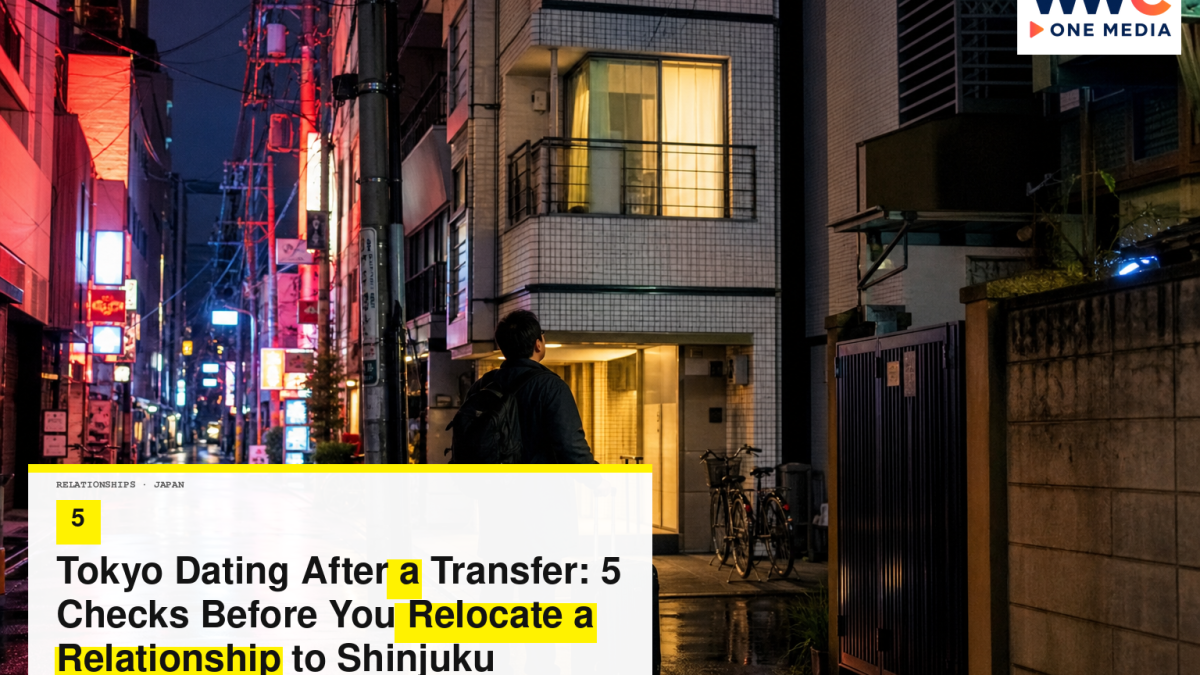
TOKYO, Japan — Tokyo dating after a transfer looks, from Manila or Singapore, like a plot twist with better trains. A posting to Shinjuku, a 1K that photographs like a capsule, a relationship that was working when both of you could still grab a late dinner in BGC or Tanjong Pagar. Then the offer letter arrives and the couple treats logistics as a vibe. Visa, last train, who follows whom, whose name is on a lease they cannot even view in English yet — these are not romance killers. They are the relationship, relocated.
Do five checks before you move the two of you toward Shinjuku. Not legal advice. Not a visa clinic. Couple logistics you have to name while you still have a table in the city you are leaving.
1. Who is actually being transferred — and who is following
One person has a job letter. The other has a decision that people will politely call love. Say the words. Who follows whom from Manila, from Singapore, from a university town in the Philippines that is not Manila. If both of you have offers, you have a different problem: two start dates, two HR departments, two possible neighbourhoods. If only one of you has an offer, the follower is taking a gap, a remote job that may not survive Japanese tax and time zones, a job hunt in a language they may not have, or a tourist-looking arrival that you should not pretend is a plan.
Write it without poetry:
Person A: transferred to [company], start date, expected hours, whether overtime is a culture or a rumour they have not tested.
Person B: follows / stays / tries a three-month visit / applies from outside / looks for work after arrival.
If Person B “will see,” you do not have a relocate-a-relationship plan. You have a holiday with a suitcase. Tokyo dating after a transfer dies in that fog around week six, when the transferred person is exhausted from onboarding and the follower is staring at a 1K that is empty at 9 p.m. and loud at 1 a.m. from the building’s pipes.
Families will have opinions. A Filipino parent who blessed an LDR to Singapore may not bless a move to Tokyo that they cannot picture. A Singaporean parent may ask about cost in a way that sounds like they are asking about character. Brief each other before the parents get on a group call. The follower should not hear the plan first from a tita.
If the relationship is new — under a year, still a maybe — relocating it to Shinjuku is a merger, not a cute adventure. You can still do it. You cannot do it on stickers and “we’ll figure it out at the airport.”
A check question that is allowed to be blunt:
“If I hate it in month four, do I have a ticket home that does not require your HR’s permission? If you hate the relationship in month four, do I still have a roof that is legal for me to occupy?”
If those answers are mush, stay in the city you are in, or go as a visitor with a return date. Visiting is a category. Following is a category. Mixing them is how people get stuck.
2. Visa and work as logistics the couple must name (not legal advice)
This is not a primer on which visa exists. Japan’s immigration categories change, company sponsorship practices differ, and a blog post is not your lawyer or your HR. What a couple must still name is the job each status does in the relationship.
If only one of you will have permission to work, money is not 50-50 in any honest sense. The working partner carries rent, national health insurance lines if they are on a company scheme, the mobile plan, the aircon in August. The other partner carries time, housework, isolation, and a job hunt that may be slow. Pretending that split is equal because you both “contribute emotionally” will rot. Write a monthly number each of you can live with, a buffer for a ticket, and what happens if the working partner loses the job that the visa hangs on.
If the follower’s plan is remote work for a Manila or Singapore employer, name whether that employer has agreed, whether the hours collide with JST, and what you will do if the employer later says no. A 1K in Shinjuku is a bad place to discover your boss thought you were still in Ortigas.
If the plan is language school plus a relationship, name the school’s attendance expectations and the evening the couple still gets. Language school is a schedule. So is a Shinjuku job. They will fight unless you put them on one calendar.
Documents the couple should photocopy into a shared folder you both can open: passports, the offer letter, the apartment contract if it exists, emergency contacts in Tokyo and back home, insurance cards when you have them. Not because you are cynical. Because a phone dies, a bag gets left on a Chuo line seat, and the other person should not be guessing.
Do not take immigration advice from a group chat of people who arrived under a different year and a different company. Do not threaten each other with “then your visa” during a fight. Status is a logistics stack. It is a cruel weapon. Couples who use it that way are already relocating a different relationship than the one they packed.
If you need professional advice, get it from the channels your company names or from a qualified person in Japan, not from a dating column. This check is only: have we named who can work, who pays, what happens if the job ends, and who holds copies of the paper.
3. The 1K, Shinjuku, and the version of closeness you have not tested
A 1K is a room plus a kitchen the size of a decision. Shinjuku as a base can mean a walk to a tower office, or it can mean a box above a street that does not sleep, or it can mean “Shinjuku” as a brand while the actual unit is a few stops out on the Odakyu or Keio because the rent in the postcard did not fit. Walk the real address at night. Weekend viewings lie. Tuesday at 11 p.m. does not.
Tokyo dating after a transfer often collapses the LDR into sudden 24-hour proximity. You used to miss each other across a two-hour time gap or a Friday flight. Now you can hear them wash a cup. If you have never lived together, do not let the transfer be the first experiment in a 1K you cannot easily leave. Try a long stay in one city first if you can: two weeks in one apartment, not a hotel, with grocery runs and a night one of you is late.
Name the furniture of privacy. Where does a video call to family in Manila go. Where do shoes live. Who gets the futon closet. Is there a building rule about rubbish night that will become a character judgment. Convenience-store dinners are fine. They are not a personality. If one of you needs to cook because of money or culture or control, the 1K kitchen will become a stage. Agree a rotation before the first week of overtime.
Guests: a 1K cannot host a visiting parent in any dignified way for a week. Budget a business hotel near Shinjuku Station, or a weekly mansion, or a visit that is shorter. Do not promise your mother the floor because you feel guilty about leaving. Guilt plus a 1K is how everyone sleeps badly and someone says something about “this country.”
If one of you already lives in Tokyo and the other is arriving, the resident should not treat the 1K as a finished nest the newcomer must not touch. Unpacking is a joint act. So is a drawer that stays only theirs. People who move for love still need a side of the room that is not a shared aesthetic.
Noise and neighbours: Japanese apartment life can be strict in ways that feel personal when you are already raw. If you fight, take it outside. A konbini walk, a circuit around Shinjuku Gyoen when it is open, a late meal in a place that can absorb a low voice. The 1K is a bad courtroom.
4. Last train, overtime, and the calendar you will actually live
Tokyo’s last train is a social law. Miss it and you are in a taxi you did not budget, a hotel, or an all-night wait that sounds cinematic and feels like fluorescent punishment. If the transferred job is in Nishi-Shinjuku towers, “just one more drink” with a team is not a maybe. It is a culture you have to treat as a schedule.
The follower waiting in a 1K with a cooked meal and a story about last train will start to hate Shinjuku. The transferred person, crushed between a boss and a partner, will start to lie about which train they could have caught. Write a rule that is kinder than surveillance: if you will miss last train, you text before last train, not after. If nomikai nights are weekly, they go on the calendar like a shift. The couple gets a protected night that is not optional just because a senpai appeared.
Weekends are not automatically yours. The transferred person may sleep. The follower may be lonely in a language they are still learning. Alternate: one Saturday is errands and ward office and SIM cards. One Saturday is actually a date that is not Shinjuku Station. Yoyogi, a bathhouse, a cheap museum, a walk that is not shopping in Kabukicho because you live next to it and think that counts as seeing Tokyo.
Time difference with family back home will eat mornings or nights. A mother in Quezon City who wants a video call at her 8 p.m. is asking for your 9 p.m. or later, depending on the season of clocks, and that may be when the transferred person finally gets home. Or a Singapore morning call that hits the follower while the other is already in an office. Put family calls in a slot. Do not let every relative become a third roommate.
Money calendar: rent, commuter pass, phone, the national health insurance payment if it lands on you, the aircon month, the cost of going home at Christmas or Chinese New Year or a funeral. Tokyo dating after a transfer is expensive at the hinges — arrival, first winter, first emergency flight. A couple who only budgeted rent will fight at Haneda over a ticket.
If one of you still has a lease in Manila or an HDB room that is not yet ended, name the overlap months. Paying two cities is a choice. Paying two cities by accident is how the follower feels like a secret and the transferred person feels hunted by numbers.
5. The exit, the visit, and who you are if the posting ends
Postings end. Contracts end. A three-year Shinjuku plan can become a fourteen-month plan because a team restructures. Relocating a relationship means agreeing what happens when Tokyo stops being the job.
Do you both return to the city you left. Does the transferred person accept the next posting and expect another follow. Does the follower stay in Japan on a basis you have actually researched with professionals, not hope. Does the relationship return to LDR on purpose, with a schedule, instead of decaying into “when I have leave.”
Write a visit plan even if you both go. Families in Manila and Singapore will want the person who “disappeared to Tokyo.” Birthdays, funerals, a sibling’s wedding in Cebu that is not optional. The couple needs a policy: how many trips a year, who pays, whether the transferred person’s leave is for the relationship or for their own parents. These trips are where Tokyo dating after a transfer either looks adult or looks like one family was abandoned.
If it does not work — the 1K, the hours, the homesickness that does not lift — you need a no-fault sentence. “We tried the transfer as a couple. We are not doing the next year.” Then tickets, deposits, whose furniture was never yours. Do not trap someone in Shinjuku with shame. Do not trap someone in a relationship because their visa paperwork is sitting on a microwave.
A check you can do before anyone resigns back home:
Live for two weeks as if you already moved. Last-train texts. A budget in JPY as well as PHP or SGD. A night one of you is socially stuck. A morning of silence. If that already feels like punishment, a 1K will not heal it with vending-machine coffee.
Scripts for the week the offer letter lands
To the partner:
“I want you with me in Shinjuku. I also want us to name five things: who is employed, what status we think we are using (we will confirm with HR/professionals, not with a thread), 1K versus a slightly bigger unit further out, last-train rules, and what we do if the posting ends. If you would rather visit first for a month, say that. Visiting is not a lesser love.”
To a parent:
“This is a job transfer and a relationship decision. We are not announcing a marriage. We are announcing a city. I will send the address when we have one. I will send a way to reach both of us.”
To yourself, privately:
“If I am only going so they will not be angry, I am not going. If they are only taking me so they will not feel guilty, I am not going.”
What not to do when you relocate a relationship to Shinjuku
Do not quit a stable job in Manila or Singapore in a rush to match their start date if your own landing is still a shrug.
Do not arrive as a surprise at Haneda to “support them.” Surprises at immigration and at a 1K are not support.
Do not use Shinjuku nightlife as the relationship. Kabukicho is a neighbour, not a personality. A couple that only exists after 9 p.m. in that neighbourhood will not know each other at 8 a.m. on a rubbish day.
Do not mock how they bow, how they apologise at a konbini, how they go quiet on the train. Adaptation is not a betrayal of home. Mockery is a cheap way to feel loyal to Manila while standing in Takadanobaba.
Do not hide the relationship from HR if the company needs to know about a cohabitant for an apartment or an emergency contact — and do not announce the relationship to a whole team as content. Ask the transferred person what their workplace can know. Japanese offices vary. Gossip does not.
Do not skip the ward-office days because they are unromantic. Resident procedures, health insurance, a phone, a bank — these are the bones. A partner who refuses to sit through them is not too spontaneous. They are leaving the boring love to you.
Do not compare every meal to food court food from home as a sport. Homesickness is real. A running scoreboard is a way of refusing the city while living in it.
City logistics the first month will actually use
Shinjuku Station is a city under a city. Agree a meeting point that is a named exit or a specific department store corner, not “Shinjuku.” You will lose each other. It will be unfunny.
IC card — Suica or Pasmo, phone or plastic — before the first Monday. Last train on the line you actually ride, checked the same day, not remembered from a trip in 2019.
A 1K viewing: measure the space for two people with two suitcases, not one person with a backpack. Open the bathroom. Listen. Ask who else lives on the floor if you can. Ask about rubbish, bicycle, and whether two names can be associated with the contract. If the landlord wants one name only, the unnamed person needs to know they are legally a guest in their own life.
SIM / Wi-Fi: the follower should not be dependent on the transferred person’s hotspot to message home. That dependency becomes a leash even if nobody meant it.
Clinics: know where you would go after hours. A couple without a night-time plan will fight in a corridor of a station they cannot exit.
Earthquake kit is not a meme. One bag, water, a meeting point if phones die. Put it next to the shoes. This is a Tokyo fact, not a personality.
Objections
“If you loved me you’d just come.”
Love is not a visa. Love is not a 1K. Love that refuses logistics is a speech.
“We’ll be in Shinjuku, it’s exciting.”
Shinjuku is also overtime, tourists, and a station that can take twenty minutes to cross with a suitcase. Excitement is week one.
“Other couples did it.”
Other couples are not paying your rent or sitting in your ward office. Use them as a lunch, not as a policy.
“My company will handle everything.”
Companies handle employees. They handle partners unevenly, sometimes not at all. Ask, in writing, what “everything” includes: housing size, cohabitant, flights, language support. Then believe the email, not the dinner toast.
“We can always come back.”
Coming back costs a lease break, a job explanation, and face with families. Possible. Not free. Price it.
A three-month review you should calendar before you fly
Month one: survival. Ward office, sleep, food, whether last-train texts are happening.
Month two: work is real now. Is the follower still a person with a day, or an unpaid concierge.
Month three: decide. Stay as planned, change the unit, change the arrangement to visits, or end the Tokyo chapter without killing the whole relationship if that is still honest.
Put the review on a calendar with a location that is not the 1K — a park, a chain café, somewhere you can leave.
If you skip the review, the 1K will review you anyway, usually on a wet Wednesday.
Who follows whom from Manila or Singapore — the family version
If the transferred person is the one whose family expected them to stay close — a youngest daughter, a son who sends money, a caregiver for a parent — the follow is not only a couple issue. Write what money still goes home, who picks up the hospital runs, whether a sibling is being dumped with a job they did not vote for. Tokyo dating after a transfer that ignores the household back in Quezon City or Jurong will look like escape from one end and abandonment from the other.
If the follower is the one with the heavier family load, they may arrive late, or not at all, or only after a wedding that has not been discussed. Do not punish that delay as insufficient romance. Name a date. If the date keeps sliding, believe the slide.
A couple can choose each other and still refuse to relocate this year. That sentence should be available without a breakup. Transfer season makes people confuse timing with destiny. Destiny is a weak planner.
Bottom line
Tokyo dating after a transfer survives five checks: who is employed and who is following from Manila or Singapore, visa and work named as couple logistics rather than a vibe, a 1K in Shinjuku that you have treated as a real room, last train and overtime on a calendar, and an exit if the posting or the relationship ends. The trains will be on time. The relationship will not be, unless you write the boring parts before you pack. Shinjuku will take the person who has a desk. It will only keep the couple if they arrived as a plan.

Leave a Reply