
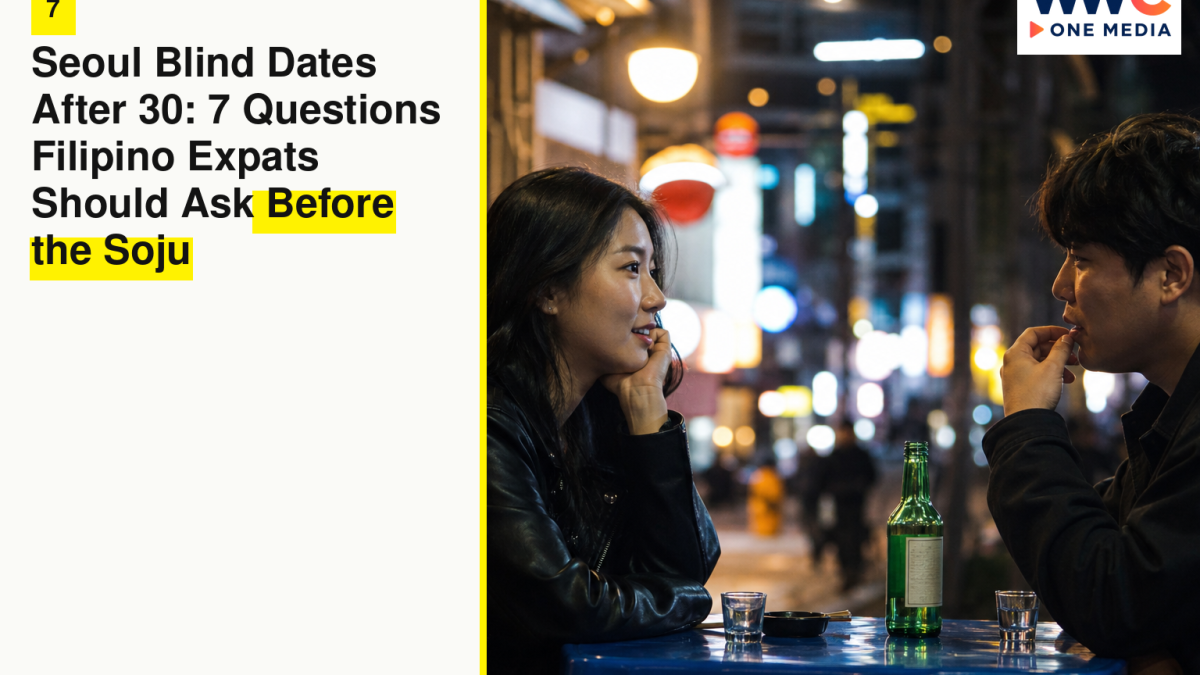
SEOUL, South Korea — A Seoul blind date after 30 can look like a simple Tuesday: a church intro, a coworker’s cousin, an app match that a friend swore was “serious,” a table that will eventually host soju whether you asked for it or not. For Filipino expats it is rarely simple. Visa, a job that can end, family back in the Philippines, a church group that talks, Hongdae versus Gangnam as two different nights — none of this is a drinking guide. Soju here is a setting. The questions belong before the first glass, not after the third when everyone is braver and less precise.
Ask seven. Work and time in Korea, what they think this meeting is, family and faith, money without a salary interrogation, how they date (apps, church, introductions), what leaving would do, and how you get home. Write the ones you cannot say out loud in a note on your phone. You can still steer a conversation without turning a barbecue house into an intake form.
1. What is your actual life in Seoul right now — job, hours, neighbourhood
After 30, a blind date that skips work is skipping the spine. You are not asking for a payslip. You are asking whether this person has a Tuesday. Office in Gangnam with late teams, a school, a hospital shift, a freelance life that is really unemployment with better coffee, a family business, a military-adjacent schedule you should not pry into like a tourist. Filipino expats know contract life. Ask how stable their week is, not how impressive their title sounds in English.
Neighbourhood is a tell. Hongdae at night is one temperature: younger streets, music, a walk that can still feel like a student city even when you are not. Gangnam is another: spend, polish, a taxi reflex. Itaewon and Hannam have their own mix of foreigners and locals who are used to foreigners. Jamsil, Seongsu, a quiet place in Mapo — different bedtimes. If they will only meet in one district and refuse to name where they live even roughly (a station is enough), you are not being mysterious. You are being unplaceable.
Hours matter because soju culture and overtime culture can occupy the same evening. A person who can only meet at 9:30 p.m. is offering you leftover nervous system. That can still be a kind person. It is a bad first setting for a serious conversation. Suggest an earlier meal. If they cannot do earlier for a month, believe the month.
A clean ask:
“Where do you usually finish work, and which station is home? I’m in [area] / I live near [station]. I do better with dinner than with a 10 p.m. first meeting.”
If they mock you for being old, you are on a Seoul blind date after 30 with someone who wants a younger night. That is useful. Leave before the soju.
Do not invent a law about how Koreans must date. There isn’t a single script you can quote. There are families, churches, companies, and apps. There is also your own contract. If your E-7 or teaching year or company secondment has an end date, say there is an end date. You do not need to lecture immigration. You need to not pretend you are a permanent feature of Seoul when you are not.
2. What is this meeting, in their words — intro, app, church, or “my mum asked”
Filipino expats get dropped into several funnels. A church in Seoul or a Filipino mass community that still uses auntie networks. A Korean colleague who thinks you would like their friend. An app that hides age until it does not. A family introduction that someone translated as coffee.
Ask who arranged it and what they were told about you. If the story you were given — “just a friendly dinner” — does not match the story they were given — “she’s ready to settle” — you are in a play. You can still eat. You should not perform a future.
Church intros can be warm and also fast. Communities talk. A date on Friday can be a prayer request on Sunday if you are not careful. Agree, even on a first meeting, that you will not become content. No tagging. No introducing you to five people at the next gathering as a couple because you shared pork belly once.
App-to-offline after 30 often carries a fatigue that younger dating does not. People want to know if you want children, if you will stay in Korea, if you date Koreans only, if you date Filipinos only. You can answer a subset. You cannot answer a life exam over kimchi-jjigae.
Script:
“My friend said this was casual. If you’ve been told this is a parent-level introduction, tell me now so I don’t joke my way through the wrong night.”
If they cannot say what it is, it is casual for them and possibly a screening for someone else. Proceed as if you owe nothing beyond the bill you agreed.
3. Family — theirs in Korea, yours in the Philippines — without a soap opera
After 30, family is already in the room. Korean parents who want a timeline. Filipino parents who want to know if this is a foreigner situation they should worry about, a Catholic situation, a visa situation, a “when are you coming home” situation. You do not have to produce both sets of parents on night one. You do have to know whether parents are a veto, a background noise, or a partner in the plan.
Ask whether they live with family. Many people in Seoul still do, or they live independently and still spend every Sunday in a specific house. A person who must be home, or who must video-call a parent at a fixed hour, is describing a calendar. Mocking that calendar as “too close to mum” is a fast way to fail a decent person and a faster way to misunderstand the city.
Tell the truth about yours. A mother in Batangas who expects you home in two years. A family that is fine with you staying. A sibling you send money to. None of this is shameful. Hiding it until someone is already attached is how Seoul blind dates after 30 become ambushes at Christmas.
Religion belongs here if it belongs in your actual life. If Friday mass or Sunday service is non-negotiable for you, say so before you are in a bar in Hongdae that will run past midnight. If they need a partner who will attend church with family in a specific denomination, they should say so. Do not invent a rule about what Korean families require. Ask this family. Families differ. Your job is this table, not a documentary.
If either of you is divorced, widowed, already a parent — after 30 this is not rare, and a blind date that treats it as a scandal is the wrong date. Share what you need to share to be decent. You do not need to hand over a whole history to a stranger with chopsticks.
4. Money, soju, and the bill — without a salary quiz
Soju as a setting means a table that can get expensive by accident: meat, sides that keep coming, drinks you did not strictly order, a second place that “everyone goes to.” Filipino expats on a Seoul wage or a Manila-linked contract should not perform a richer person. Suggest a place with a clear menu. Offer to split. Notice whether they flinch, insist, or keep adding bottles to test you.
A person who pushes drink after drink is not being cultural. They are removing your judgment. You can decline. You can order food and a non-drink and still be at the table. “I don’t drink on first meetings” is a complete sentence. So is “I’ll have one and then I’m on water, I have work.” This is not a guide to how to drink. It is a guide to staying able to leave.
Salary talk: after 30, some introductions want numbers. You can talk in bands and in lifestyle. “I can do meals like this, I cannot do designer-as-default, I send money home” is honest. “How much do you make in won” from a stranger is a red flag unless you are both explicitly in a matchmaking process that you consented to. Even then, you can defer.
If they want to know whether you will work after marriage, or whether you expect to be provided for, that is a values question. Answer it as values. Do not let it become a trap about Filipino stereotypes — the gold-digger joke, the “you only want a visa” joke. You can shut that down once, calmly. If it continues, the date is over. You are not a punchline with a passport.
Who pays: first Seoul blind dates often involve a small fight over the bill that is actually etiquette. Have cash or a working card. If they pay, say thank you and do not narrate a gender theory. If you pay, do not make a speech about modern people. If a third person arranged the intro and appears at the end, do not let the third person turn the bill into theatre.
5. How they date — apps, church, introductions — and whether you are one of several
After 30 in Seoul, people stack methods. An app, a church, a friend, a parent’s friend. That is not automatically immoral. It is a market. Ask whether they are meeting other people this month. You can handle a yes. You cannot handle a performance of exclusivity that is false.
Filipino expats sometimes get treated as a category: easygoing, English-speaking, likely to leave, likely to want something “real,” likely to be less demanding than a local timeline. You are not a category. If you feel yourself being fitted into one, say you are a person with a contract and a parish or a lack of one, not a type.
Ask how they ended the last thing. You do not need names. You need whether they are still in it. A person whose “ex” still messages every night, or whose wife is “complicated,” is not a blind date. That is a situation. Leave it on the sidewalk.
KakaoTalk will take over after the meal if it went well. A new chat, a plus friend, a delay. If they want your Kakao immediately and also want to keep you off any trail that looks like dating, notice the split. Privacy is fine. Secrecy that only applies to you is not.
Script:
“I’m not asking you to be exclusive after pork belly. I am asking whether you are already in something that would make this a problem on Friday.”
If they laugh too long, it is a problem.
6. What happens if one of you leaves Korea — visa, job, family back in PH
This is the question Filipino expats should not skip because it feels heavy for a first soju. You can keep it light and still land it.
“My job is here until [season/year if you know]. If this became real, we’d have to talk about countries. Have you ever dated someone who might not stay?”
You are not proposing. You are refusing to waste a year. Seoul blind dates after 30 go wrong when one person is shopping for a spouse who will slot into a Korean life with no remainder, and the other person is shopping for a companion until the contract ends. Both are legitimate. They are not the same product.
Do not invent Korean legal claims about marriage, visas, or what a foreigner is “owed.” You are not their immigration officer. If the relationship gets that far, you use real professionals and real documents. On night one you only need to know if leaving is unthinkable to them, or thinkable, or a fantasy where you simply quit your life.
Family back in PH includes the possibility that you will go home for a funeral at the wrong time, or that you will be expected to send a ticket to a sibling. If they cannot tolerate a partner who still has a household elsewhere, better to hear it while you can still split a taxi.
If you would not leave Korea for anyone, say that too. Expats lie about flexibility to seem easy. After 30, easy is expensive.
7. How does this night end — last train, taxi, a second place you did not agree to
Seoul has a last subway. Missing it is a different night: taxis that surge, a long wait, a “come to mine” that was not on the menu. Filipino expats, especially women and anyone who has done this in a second language, should decide the end before the soju. Tell a friend the district. Keep your own way home. Your T-money or card should work. Your phone should have battery.
A second place — karaoke, a bar, a “nice view” — needs a new yes. Blind dates after 30 go sloppy when the intro person disappears and the remaining person upgrades the itinerary. You can like them and still go home from the first table.
If they insist on dropping you off, pick a station, not your building, until you have a reason to trust them. If you are the one who would insist, notice whether they look trapped. Courtesy is not a chase.
Safety is not a personality. It is a plan. Meet in a busy restaurant, not a private room as the first move. Eat. Talk. End. Kakao later if you want.
If they get angry that you will not drink more, or that you have a curfew that is actually a train, you have your answer without question seven’s poetry.
Scripts you can send the introducer and the date
To the friend who set it up:
“Thank you. I can do dinner in [Hongdae / Gangnam / near [station]] before 8. I don’t want a surprise extra person. If this is a parent introduction, I need that in the message, not at the table.”
To the date, day before:
“Looking forward to [place]. I don’t drink much on first meetings. If you want soju as the whole plan, let’s pick a meal-first spot or reschedule.”
After, if you will not continue:
“I appreciated dinner. I don’t think we’re a match for what I want this year. Wishing you well.”
After, if you will:
“I had a good time. I can do coffee this Sunday in Seongsu or a walk along the river if the wind isn’t stupid. Weeknight soju as a second date is harder for me.”
Short. No essay. Seoul will fill silence with stickers if you let it; you do not have to.
What not to do on a Seoul blind date after 30
Do not use soju as courage to say the seven questions in a slurred stack. Ask two well. Save the rest for a daylight meal.
Do not compare them to an ex in Manila as entertainment.
Do not perform the perfect Filipino — endlessly accommodating, always smiling, always free on weekends. Your rest is part of the truth.
Do not let a church community interrogate you in a hallway because someone saw you in Gangnam. You can be a person of faith and still have a private Tuesday.
Do not out someone as your date on Instagram. Korean workplaces and families vary in nosiness. Ask.
Do not offer to help with English homework as a personality. You can help later if you want. As a first-date move it can feel like a transaction.
Do not stay because the bill was large and you feel indebted. Pay your share back on the app if you must. Then leave.
Do not make Korea the villain or the Philippines a punchline. People hear what you will someday say about them.
Hongdae versus Gangnam versus the river: picking a room that matches the questions
Hongdae: loud, easy to escape, easy to be anonymous, easy to drink past the point of questions. Good for a low-stakes second meeting. Imperfect for a first serious conversation after 30.
Gangnam: easier to get a table that behaves, easier to overspend, easier to feel ranked. Fine if you both live south of the river and have a workday tomorrow.
Yeouido or a Han River path: romantic in photos, windy in real life, public. Better as a walk after a meal than as the whole date. Bring a layer. The river does not care about your outfit.
A chain restaurant near a station you both know: underrated. Fluorescent light is a friend of judgment.
If the introducer insists on a room with a closed door and a bottle already on the table, you can decline the venue without declining the person. Venue is information.
Objections
“Just see how you feel.”
Feeling is better when you still have a last train and a sentence.
“Koreans don’t talk like this on a first date.”
Some do not. Some families talk faster than this before the meat is cooked. You are allowed to need a few facts. You are a foreigner with a life that can be moved. That is not an interrogation. That is adult.
“You’re too intense for soju.”
Then we agree: soju is the wrong container. Coffee exists.
“My parents would never accept a Filipino.”
Thank them for saying it early. Do not audition to change a household that has already voted. You can be sad on the way to the station. You do not have to campaign.
“Visa is just paperwork.”
Paperwork is how people live. If they minimise it, they may also minimise your job.
City logistics Filipino expats actually use that night
T-money or a phone wallet that taps. A screenshot of the restaurant name in Korean so a taxi driver is not guessing. A backup bus or taxi plan after last subway — check the same day.
KakaoTalk installed if you are going to use it; some people will not stay on Instagram DMs. That is not a moral test. It is the local pipe.
A friend who knows the neighbourhood you went to and who will call if you do not text by a time. Not because Seoul is a movie. Because blind dates anywhere get safer with a check-in.
Cashless is common; a card that actually works is not optional. If your Manila-issued card is moody, know that before the bill.
Language: you can date in English, in Korean, in a mix, with a phone. Do not pretend a fluency you do not have. Do not use their English mistakes as cute content later.
If you need to leave, you leave. A polite bow, a thank you, a taxi. You do not owe a speech in two languages.
If the soju already started and you skipped the questions
You can still go home. You can still message the next day with one or two of the seven. You are not required to convert a foggy night into a relationship because the meat was good.
If you said too much — visa anxiety, family money, a lonely winter — do not panic-delete. People after 30 have heard loneliness. If they use it against you, that is the filter working.
If they said too much and you feel like a counsellor, you can decline the role. Blind dates are not clinics.
Bottom line
Seoul blind dates after 30, for Filipino expats, are seven questions before the soju: the actual week they live (job, hours, station), what the meeting is (church, app, mum), family here and in the Philippines, money without a quiz, whether you are one of several, what leaving Korea would do, and how the night ends on the last train. Hongdae and Gangnam will both serve a bottle. Neither will ask for you. Soju is a setting, not a plan. Ask while you can still hear the answer, then take the subway you meant to take.



Leave a Reply