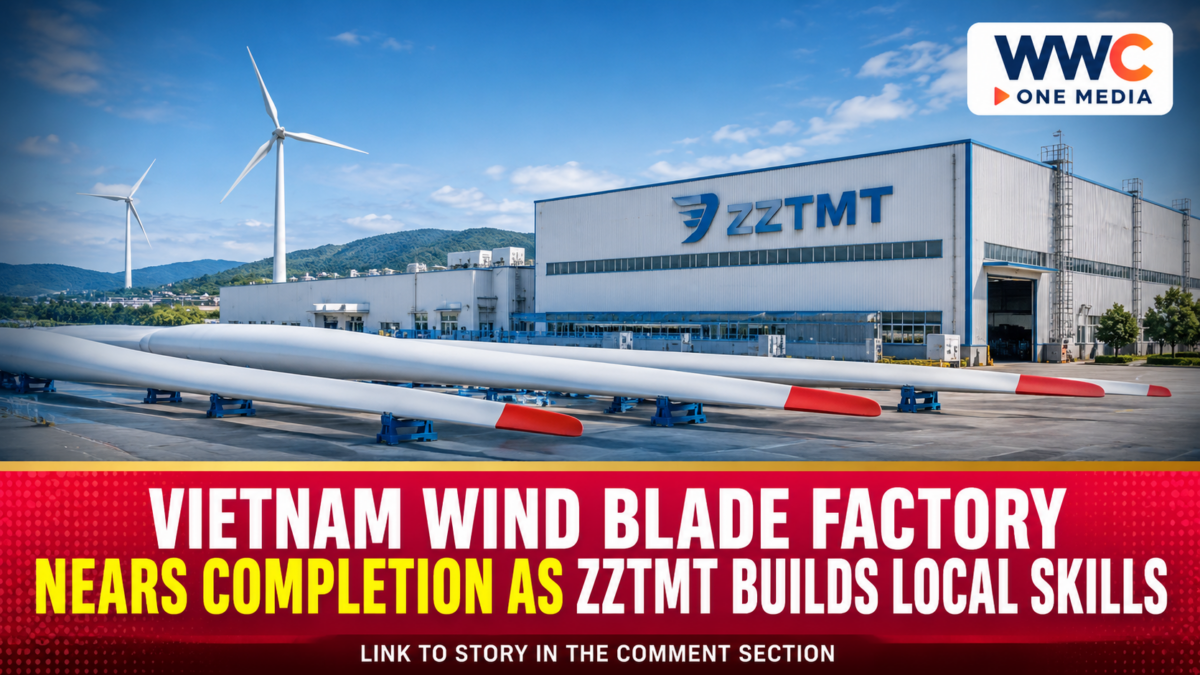
A Vietnamese wind turbine blade factory backed by Chinese manufacturer Zhuzhou Times New Material Technology Co., Ltd. (ZZTMT) has reached a major construction milestone, with the company reporting that its main production complex was 88.4% complete as of November 23, 2026. The project in Khanh Hoa Province is also being paired with technical training for Vietnamese participants as the company prepares the facility for future operations.
The development matters beyond the progress of one industrial site. Vietnam is seeking to strengthen its domestic renewable-energy supply chain, while large wind turbine blades present manufacturing and transport challenges that make regional production capacity commercially relevant. The project offers a test of whether foreign-backed investment can translate into local industrial capability, skilled jobs and a functioning manufacturing operation.
Vietnam wind blade factory is a strategic overseas investment
The facility is located in Phuoc Nam Industrial Park in Khanh Hoa Province. ZZTMT describes it as its first overseas greenfield project independently invested in, constructed and operated by the company.
The corporate structure is important. CRRC Corporation’s project description identifies Zhuzhou Times New Material Technology as a subsidiary of CRRC and says the Vietnamese operation, Vietnam Wind Turbine Blade Engineering Co., Ltd., was established as a wholly owned subsidiary of ZZTMT.
That makes the Vietnam facility part of an established industrial group rather than a standalone local venture. ZZTMT is listed on the Shanghai Stock Exchange under stock code 600458, according to the company’s corporate disclosures.
CRRC’s September project description says the factory is intended to produce blades in the 100-metre class and serve Vietnam and other international markets in Southeast Asia. It also identifies oversized component logistics and transport as issues the project is intended to address.
For wind developers, manufacturing location can affect the cost and complexity of moving very large blades from production sites to wind farms. A facility closer to regional customers could improve delivery options, although the commercial benefit will depend on customer orders, production capability and logistics arrangements once the plant is operating.
Construction progress is substantial, but commissioning remains a separate milestone
ZZTMT’s November 23 company-issued release put completion of the main production complex at 88.4%. It said the steel structure, roof and exterior wall panel installations had been completed, while work on supporting facilities was continuing.
That percentage should be read carefully. It refers to the main production complex, not necessarily every part of the wider project, nor does it mean the factory has started commercial production.
The company release does not provide a confirmed date for commissioning, first production or full-capacity operation. Those milestones will matter more to customers and the regional supply chain than a construction percentage alone.
CRRC’s September description also outlines design features intended for the local coastal environment. It says the factory plans to monitor and regulate temperature and humidity across storage, production and testing processes, taking account of high temperatures, humidity and salt exposure in south-central Vietnam.
The parent company’s description also refers to plans for rooftop distributed solar generation, an energy-storage system and provision for direct green-power supply. These are design and planning details; they should not be mistaken for proof that the systems are already installed or generating electricity.
Training 50 Vietnamese participants before operations
ZZTMT’s November release says the company worked with Ho Chi Minh City University of Transport during 2026 to organise three training sessions in Zhuzhou, China. It said 50 Vietnamese participants took part, including factory employees, students and practical training instructors, and that all passed their final assessments.
The training programme is relevant because a manufacturing facility needs more than buildings and equipment. Production quality, workplace safety, maintenance and technical troubleshooting depend on workers who can operate and support the manufacturing process.
The company has not publicly detailed in the release the full curriculum, the number of participants who will be employed at the factory, or the positions they may fill. The reported training therefore demonstrates an effort to prepare local participants, but it does not yet establish the size of the eventual Vietnamese workforce.
The company also highlighted technical engagement at the APAC Wind Energy Summit 2026 in Hanoi. It said Jiang Dong delivered a presentation on typical blade failure cases, covering subjects including lightning protection, pultruded plate fatigue, lifting points and leading- and trailing-edge issues.
That technical focus is commercially relevant. Blade performance is not only a question of manufacturing volume: inspection, repair and reliability affect the long-term operating costs of wind farms.
The parent-company guarantee provides a view of the corporate backing
A CRRC shareholder circular published in May 2026 lists Vietnam Wind Turbine Blade Engineering Co., Ltd. as a wholly owned subsidiary of Zhuzhou Times New Material Technology. It also lists a guarantee amount of RMB20.6 million for the Vietnamese subsidiary.
The same circular gives the subsidiary’s financial position at December 31, 2025: total assets of RMB7.0288 million, total liabilities of zero and net assets of RMB7.0288 million. Those figures are a historical snapshot from before the latest reported construction progress and should not be treated as the project’s current cost or value.
The guarantee amount is also not the same as proof that the parent has paid that amount into the project. It is a disclosed guarantee figure in the circular. The document does not, by itself, establish how much financing the factory has drawn or how much additional capital will be required before operations begin.
For readers following regional clean-energy investment, WWC has examined how Vietnam’s green-finance ambitions depend on grid capacity and project delivery. A manufacturing facility is one part of the renewable-energy chain; it does not replace the need for viable wind projects, grid connections and dependable demand.
Why local blade production matters to the wider energy supply chain
A domestic manufacturing base can potentially support shorter delivery routes, technical service capacity and local industrial employment. It can also give suppliers and training institutions an opportunity to develop skills connected to wind-energy equipment.
But the factory’s eventual contribution will depend on whether it secures customers and achieves consistent production. Construction progress and training activity are important inputs, not proof of market demand or commercial success.
Vietnam’s renewable-energy ambitions also involve cross-border partnerships and different technologies. WWC’s coverage of Vietnam-Russia energy cooperation and its proposed wind-power links illustrates how announcements and cooperation frameworks need to be distinguished from projects that have reached construction or operation.
The same discipline applies to the ZZTMT facility. Its ownership structure, construction update and training programme are documented. Its future output, customer base, production schedule and contribution to Vietnam’s total blade supply remain matters to be demonstrated.
For a Philippine perspective on how wind projects move through development, WWC has also reported on a proposed wind project developer’s decision to relinquish two project rights after site assessments. The comparison is not about the companies being alike; it highlights that renewable-energy growth depends on practical execution as well as investment announcements.
What happens next
The next milestones to watch are completion of the supporting facilities, installation and testing of production equipment, commissioning, and confirmation of the factory’s first commercial output. Public disclosure of customer contracts, production capacity actually brought online and the number of local employees would help establish the project’s operating contribution.
For now, ZZTMT has reported that the main production complex is close to completion and that training has involved 50 Vietnamese participants. Whether those preparations become a reliable manufacturing operation will be determined by the next phase: moving from construction and training to production and delivery.
Frequently asked questions
Where is ZZTMT’s Vietnam wind blade factory located?
The facility is located in Phuoc Nam Industrial Park in Khanh Hoa Province, Vietnam.
How complete is the factory?
ZZTMT’s November 23, 2026 company release said the main production complex was 88.4% complete. Supporting-facility work was still continuing.
Which company owns the Vietnamese operation?
Vietnam Wind Turbine Blade Engineering Co., Ltd. is identified in CRRC’s project description and shareholder disclosures as a wholly owned subsidiary of Zhuzhou Times New Material Technology Co., Ltd.
How many Vietnamese participants received training?
ZZTMT said 50 Vietnamese participants took part in three training sessions organised with Ho Chi Minh City University of Transport during 2026.
Has the factory started commercial production?
The company release reviewed for this report describes construction progress and training but does not confirm commercial production or a commissioning date.