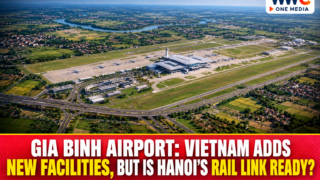
Vietnam is reviewing changes to the detailed development plan for Gia Binh International Airport, including additional aircraft-maintenance facilities, catering infrastructure and a proposed metro connection. But as of Nov. 23, 2026, the railway component remains part of a planning process rather than a confirmed construction project, with Hanoi and Bac Ninh facing a Nov. 25 deadline to submit transport proposals.
The distinction matters because an airport’s capacity is only one part of its ability to serve a major urban region. Passengers, cargo operators, airport workers and airlines also need dependable connections to the surrounding cities. Vietnam’s latest government instructions show that officials are still working on how those connections should fit together.
The airport is being developed with long-term ambitions, including a role in regional aviation and aircraft maintenance. Whether those ambitions translate into an efficient gateway will depend partly on infrastructure beyond the airport boundary.
Gia Binh Airport’s revised plan is still under review
Vietnam’s Ministry of Construction is collecting comments on the proposed adjustment to Gia Binh International Airport’s detailed plan for 2021–2030, with a vision to 2050.
The Civil Aviation Authority of Vietnam says the adjustment was proposed by Masterise Aviation Infrastructure Joint Stock Company, identified as the airport project investor. The aviation authority worked with the company to complete the adjustment dossier, after which the ministry directed the authority and investor to review feedback, explain how comments were addressed and complete the documents for submission.
That process is important. It means the proposed additions should not be treated as final approved changes simply because they appear in the revised planning materials.
The proposed updates include changes to the aircraft parking apron, the ground-transport centre and locations for government agencies. The plan also identifies additional operational facilities on the airport’s western side, including an aircraft-maintenance area, an energy-storage facility and a catering building.
A metro route and station locations are also proposed for inclusion in the updated airport plan. The public announcement, however, does not establish a final route, station list or construction timetable.
The airport has ambitious capacity targets
Gia Binh’s existing planning framework sets out a large-scale development target. The airport is planned as a 4F facility under the International Civil Aviation Organization classification system.
The published planning figures envisage capacity of around 30 million passengers and 1.6 million tonnes of cargo annually by 2030. The longer-term vision raises those figures to around 50 million passengers and 2.5 million tonnes of cargo a year by 2050.
Those are planning targets, not evidence that the airport has already reached those operating levels.
The development is being implemented in stages. The aviation authority says Masterise Aviation Infrastructure has been carrying out phase 1.1, focusing on facilities needed for the 2027 Asia-Pacific Economic Cooperation summit.
A separate government announcement on preparations for the airport’s future operation also describes work on the organisational, staffing, airline-network, service and infrastructure requirements needed before commercial operations can begin.
For comparison, Vietnam’s development of Long Thanh International Airport shows how much coordination is involved in bringing a major new airport into service. WWC has examined Long Thanh’s planned opening and the operational preparations facing airlines. Gia Binh’s own timetable and operating requirements will have to be assessed on their own terms.
Hanoi’s rail connection is a separate challenge
The railway question received separate attention in a government meeting chaired by Standing Deputy Prime Minister Pham Gia Tuc on Oct. 29. The resulting Government Office notice, issued on Nov. 6, addressed transport links for Gia Binh, including urban railway connections.
The notice acknowledged that road and rail connection projects involving Hanoi, Bac Ninh, Hai Phong and Quang Ninh were already being implemented. But it also recorded that a comprehensive study of the wider transport network had not yet been completed.
That is the gap officials are now being asked to address.
Hanoi was instructed to lead a review of its urban railway network and coordinate with the relevant ministries and local governments. The notice specifically calls for study and prioritisation of direct urban rail connections between Gia Binh, Noi Bai International Airport and central Hanoi.
It also asks Hanoi to work with Bac Ninh, Hai Phong and Quang Ninh on regional transport connections. The goal is to align local plans, identify priority projects and match their implementation schedules with the airport’s development.
Bac Ninh was separately instructed to review transport and infrastructure plans serving the airport’s passenger terminal, cargo area and transfer facilities. Both Hanoi and Bac Ninh were told to send their reviews and proposals to the Ministry of Construction before Nov. 25.
Why the wider transport plan matters
An airport can have a large terminal and extensive cargo facilities yet still face practical limits if access roads, rail services and transfer points are poorly coordinated.
For passengers, the issue is the time and reliability of journeys between the airport and major destinations. For cargo operators, it is the ability to move goods between aircraft, warehouses, roads and regional distribution centres without unnecessary delays.
The proposed maintenance and catering facilities also point to a broader operating model than passenger travel alone. Aircraft maintenance requires specialised space, equipment, technical staff and reliable access to supporting services. Catering and energy infrastructure are part of the airport’s day-to-day operating system.
That makes transport planning more than a question of drawing a metro line on a map. The railway, road network, airport terminals and cargo facilities need to work as a connected system.
The Philippines has faced similar questions about how airport investments connect with wider logistics networks. WWC’s coverage of the proposed Sangley airport project and the challenges of developing another major aviation gateway offers a regional comparison. Meanwhile, Clark’s expanding air-cargo infrastructure illustrates why airport access and cargo handling matter alongside runway and terminal capacity.
What happens next
The immediate milestone is Nov. 25, when Hanoi and Bac Ninh are due to submit their transport reviews and proposals to the Ministry of Construction.
The ministry is then expected to coordinate the local submissions, identify an overall connectivity approach, set out priority infrastructure projects and assess resource requirements, implementation schedules and the responsibilities of the agencies involved. The government notice directs the ministry to report its proposed overall plan to the Prime Minister during November.
Those steps may clarify which rail and road projects should take priority. They do not, by themselves, mean that a specific metro route has received final approval, funding or a construction start date.
For now, Gia Binh’s revised airport plan and the government’s wider transport review are related but distinct processes. The airport’s proposed facilities are being assessed through the planning dossier, while the regional transport system still requires coordination between national ministries and local authorities.
The next set of official decisions will show whether the proposed rail connection can move from a planning objective to a defined project.
Frequently asked questions
Is the metro link to Gia Binh Airport approved?
The airport planning update proposes adding metro route and station information. A separate government notice directs Hanoi to study and prioritise direct rail connections. The records reviewed do not establish a final approved route or construction schedule.
When must Hanoi and Bac Ninh submit their transport proposals?
The Government Office notice sets Nov. 25, 2026, as the deadline for both local governments to submit their reviews and proposals to the Ministry of Construction.
What new facilities are proposed for Gia Binh Airport?
The proposed planning updates include an aircraft-maintenance area, an energy-storage facility, a catering building, changes to the aircraft parking apron and ground-transport centre, and updated locations for government agencies.
How large is Gia Binh Airport planned to become?
The planning targets are around 30 million passengers and 1.6 million tonnes of cargo annually by 2030. The vision for 2050 is around 50 million passengers and 2.5 million tonnes of cargo a year.
Is Gia Binh Airport already operating commercially?
The official records reviewed describe construction and preparations for future operations. They do not establish that the airport has begun commercial passenger operations.