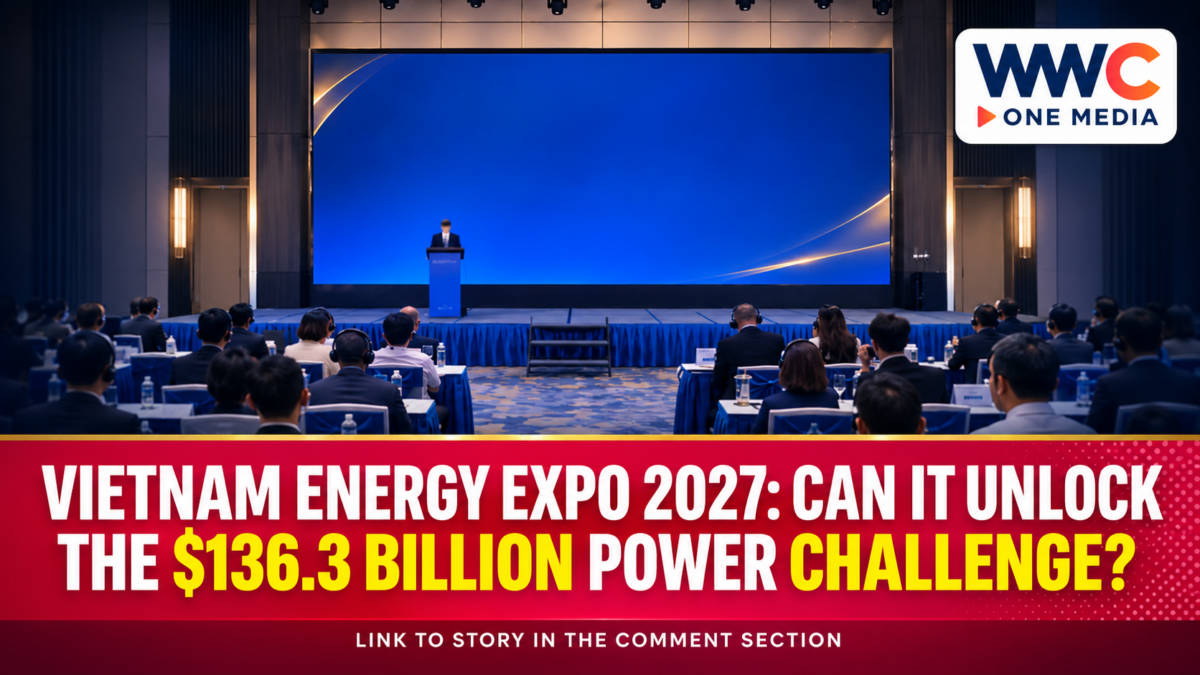
HANOI, Vietnam — Nov. 22, 2026. Vietnam has announced the Global Energy Exhibition & Congress Vietnam 2027, scheduled for May 26–28, 2027, at the Vietnam Exposition Center in Hanoi. The Vietnam Energy Expo initiative comes as the country’s revised power development programme estimates US$136.3 billion in investment requirements for electricity generation and transmission between 2026 and 2030.
The figure describes a nationwide financing requirement, not money promised to the exhibition or investment already raised. The significant question is whether meetings between policymakers, project developers, technology suppliers and financiers will eventually produce bankable projects, signed agreements and operating power infrastructure.
Vietnam Energy Expo: What Has Actually Been Announced?
The Vietnam Exposition Center and international events company dmg events announced the exhibition and congress on Nov. 17. Organisers are planning more than 800 exhibitors, about 30,000 visitors, 450 speakers and 120 conference sessions. These are forecasts for an event that has not yet taken place, rather than confirmed participation totals.
The inaugural gathering is designed to cover conventional and emerging energy systems. Its proposed exhibition areas include electricity generation, transmission networks, gas and liquefied natural gas, renewable power, batteries, electric mobility and industrial digitalisation.
Deputy Minister of Industry and Trade Truong Thanh Hoai attended the announcement. Organiser material identifies Vietnam Electricity, Petrovietnam and Petrolimex as participating partners, illustrating the intended range of electricity and fuel-sector interests. Their involvement in the launch does not itself establish financing for new projects.
Where the $136.3 Billion Requirement Comes From
Vietnam’s revised Power Development Plan VIII puts the capital requirement for power plants and transmission infrastructure in 2026–2030 at US$136.3 billion. This is a planning estimate for a multi-year national development programme. It is neither the expo’s budget nor a fundraising result.
The distinction matters because investment requirements, investor interest and completed spending are separate measures. A company can attend a trade event, discuss a proposed power station and still have substantial work to do before reaching a final investment decision.
Vietnam’s government approved revisions to its national electricity plan in April 2025. The revised plan anticipates commercial electricity demand of approximately 500.4 billion to 557.8 billion kilowatt-hours by 2030, reflecting the scale of the infrastructure task. These are planning projections, not actual consumption figures for 2030.
For a wider view of Vietnam’s search for partners in different technologies, WWC ONE MEDIA has also covered Vietnam–Russia energy cooperation involving nuclear, wind and gas-fired power. That diplomatic track is distinct from the 2027 exhibition.
Why Transmission and Storage Matter as Much as Power Plants
Adding generation capacity is only one part of an electricity expansion. Power must also move from producing regions to factories, homes and businesses, while system operators manage changes in supply and demand.
Vietnam’s October 2026 government directions put particular emphasis on rooftop solar, battery energy storage systems and grid infrastructure. The government called for electricity savings of at least 3% annually and measures to reduce peak demand by at least 3,000 megawatts. These are policy instructions and targets, not proof they have already been delivered.
The same directions called on Vietnam Electricity to study and invest in batteries at substations and other suitable locations, with systems scheduled to begin operation in 2027. Successful implementation would depend on equipment, financing, grid connection and delivery schedules.
The engineering challenge has regional parallels. In the Philippines, WWC examined NGCP’s Project Airbag and the question of whether battery storage can lower electricity bills. Grid reliability and consumer cost are connected concerns, but developments in one country do not establish results in another.
What International Investors May Be Looking For
The congress programme is intended to connect energy businesses with financial institutions, developers, policymakers and equipment providers. Proposed strategic and technical sessions will cover both investment priorities and the practical work of constructing and operating energy assets.
Analysis: A useful exhibition can reduce the time needed to identify counterparties and compare technology. It cannot, by itself, resolve uncertainty over project economics, contractual obligations, approvals or construction risks. Those issues have to be addressed project by project.
The distinction between a conversation and a commitment should remain central to how the event is judged. An announced partnership is more meaningful when it is followed by disclosed financing, a specific project, an agreed timetable and evidence that work is advancing.
Regional cooperation may also widen the pool of technology and expertise. WWC’s coverage of the Philippines–Indonesia–Vietnam initiative for island solar power and battery storage shows another route through which countries are exploring energy solutions. That initiative is separate from the Hanoi congress and does not count towards its investment total.
What Happens Next
Organisers must turn their participation targets into an actual event on May 26–28, 2027. Governments, companies and investors will then have an opportunity to discuss specific electricity projects, equipment requirements and potential financing arrangements.
A stronger test will come after the exhibition: whether any discussions result in verified contracts, funded construction, completed grid links or operating generating and storage capacity. Public announcements should distinguish each of those stages instead of treating every proposed deal as delivered investment.
For now, the exhibition is a platform for possible cooperation against a very large national capital requirement. It is not evidence that US$136.3 billion has been secured. Vietnam’s power expansion will ultimately be measured by investments that reach construction and provide dependable electricity, not by the size of a conference.
Frequently Asked Questions
When and where will the Vietnam Energy Expo take place?
The Global Energy Exhibition & Congress Vietnam 2027 is scheduled for May 26–28, 2027, at the Vietnam Exposition Center in Hanoi.
Has Vietnam secured US$136.3 billion through the expo?
No. US$136.3 billion is the estimated investment requirement for electricity generation and transmission in 2026–2030. It is not a confirmed expo financing package.
How many exhibitors are expected at GEEC 2027?
Organisers project more than 800 exhibitors, around 30,000 visitors, 450 speakers and 120 conference sessions. Actual participation will be known later.
Why are batteries and transmission grids important?
Transmission carries electricity to users, while storage can help manage fluctuations in supply and demand. Both can support reliability as the generation mix changes.
What would show that the exhibition succeeded?
Evidence would include named projects advancing to binding agreements, financing, construction and operation. Attendance figures alone cannot prove that new power infrastructure has been delivered.