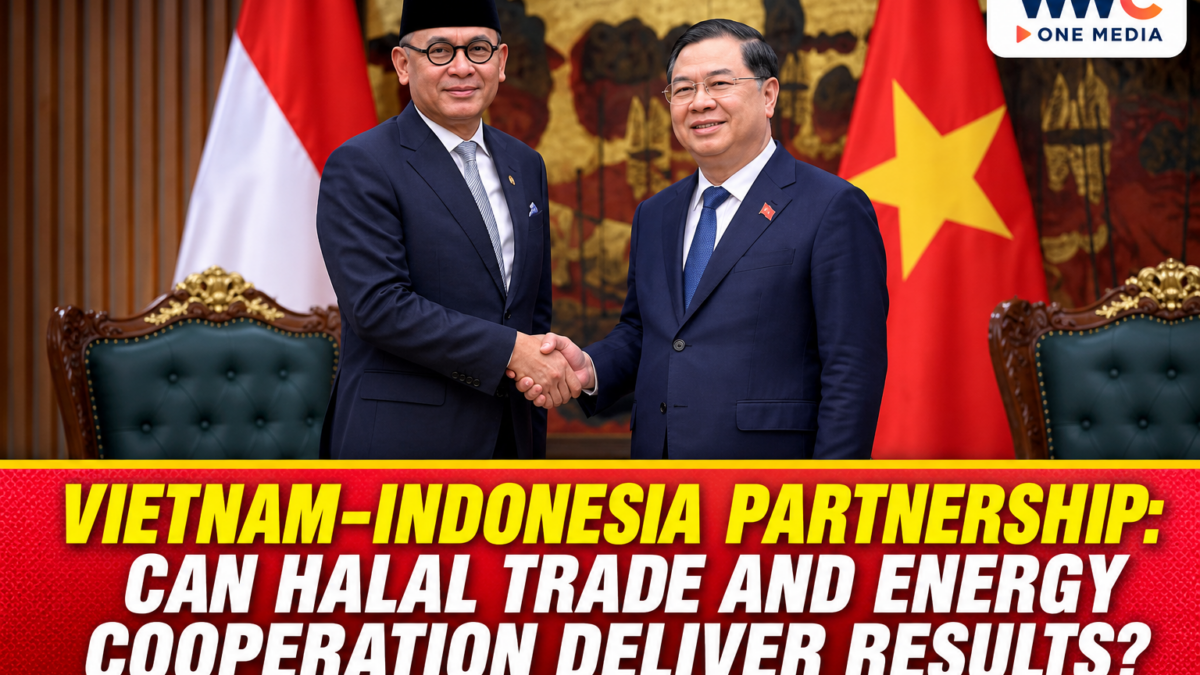
Vietnam and Indonesia are moving to deepen economic cooperation after senior officials from both countries met in Hanoi on Nov. 21, placing halal manufacturing, technology, digital development and energy security among their priorities. The meetings came as bilateral trade approached US$16.6 billion during the first 10 months of 2026, while Indonesian investment in Vietnam reached nearly US$1.75 billion.
The figures show that the relationship already has a substantial commercial base. The more important question now is whether the two governments can turn their diplomatic commitments into practical arrangements that help businesses enter new markets, secure recognised halal certification and develop more resilient energy and technology partnerships.
The agenda is also relevant to the wider ASEAN economy. Indonesia offers a large Muslim consumer market and significant industrial capacity, while Vietnam is seeking to expand manufacturing, technology and export opportunities. Cooperation could create opportunities for businesses in both countries, but the outcome will depend on implementation rather than declarations alone.
Vietnam–Indonesia partnership builds on growing trade
Vietnam’s Foreign Ministry recorded nearly US$16.6 billion in bilateral trade for the first 10 months of 2026, an increase of 17.5% compared with the same period in 2025.
The same official record put Indonesian investment in Vietnam at nearly US$1.75 billion in 2026, ranking Indonesia sixth among countries and territories investing in Vietnam for the year. It also reported more than 216,000 Indonesian tourist visits to Vietnam during the first 10 months, an increase of more than 27% year on year.
These figures provide a useful starting point for measuring the partnership. Trade growth indicates that commercial exchanges are expanding, while investment figures point to Indonesian business participation in Vietnam’s economy.
The two governments have already established a longer-term framework. Their Comprehensive Strategic Partnership was elevated in March 2025, and officials signed a 2026–2030 Plan of Action in Jakarta in July 2026 to guide cooperation across strategic sectors.
The plan identifies areas including food and agricultural security, high-technology industries, the digital economy, energy, healthcare, halal industries, science and technology, and education. The governments also set a bilateral trade target of US$18 billion by 2028.
That target is a policy objective, not a guarantee. Reaching it will require continued business activity, investment and the removal of practical obstacles to trade.
Halal certification could become a major commercial test
Halal manufacturing emerged as one of the clearest areas for more specific cooperation.
During the Nov. 21 meeting between Vietnamese Foreign Minister Le Hoai Trung and Indonesian Foreign Minister Arrmanatha Christiawan Nasir, Vietnam proposed that Indonesia expand technical support for Vietnamese companies producing halal goods and encourage investment in those businesses.
The ministers also discussed moving towards an agreement on mutual recognition of halal certification.
This matters because certification can affect whether a product is accepted in a market where halal requirements apply. Producers may need to understand the relevant standards, documentation and assessment procedures before their goods can reach buyers.
Mutual recognition could potentially reduce duplicated certification work if both sides agree on the standards, institutions and procedures covered. However, the Nov. 21 record describes an objective to conclude such an agreement; it does not establish that a final mutual-recognition arrangement has already been signed.
For Vietnamese manufacturers, technical assistance and investment could help develop production capacity and improve their ability to serve Indonesian buyers. For Indonesian companies, closer links with Vietnamese producers could create additional commercial opportunities.
The opportunity also fits into the wider regional halal economy. WWC has examined how halal certification and Muslim-friendly services are becoming part of Southeast Asia’s tourism and business competition. The broader lesson is that access to Muslim consumers involves more than marketing: product standards, supply chains and credible certification also matter.
Technology and innovation extend the agenda beyond traditional trade
The two governments also identified science and technology, innovation, digital transformation and the digital economy as areas where cooperation could expand.
These priorities reflect the growing importance of technology in manufacturing, services and cross-border business. Cooperation could include knowledge exchange, business partnerships and investment, although the public statements reviewed do not identify specific joint technology projects or committed funding.
Vietnam’s Foreign Ministry also recorded a proposal to convene the eighth meeting of the Joint Committee on Economic, Scientific and Technical Cooperation. Such a mechanism could provide a formal channel for reviewing projects and identifying obstacles that require government coordination.
The value of this work will depend on whether it produces measurable outcomes. Agreements to explore innovation are useful starting points, but businesses ultimately need clear programmes, responsible institutions, financing arrangements and implementation schedules.
WWC’s coverage of Southeast Asia’s electrification and technology infrastructure challenge examines a related regional issue: economic transformation requires systems and infrastructure capable of supporting new industries.
Energy security is part of the economic relationship
Energy cooperation was another major theme in the discussions.
Vietnam’s Foreign Ministry said the two sides explored opportunities involving energy transition, smart agriculture, food security and energy security, including coal supply. The Vietnamese side also called for closer coordination to sustain trade and investment growth.
The separate meeting between Standing Deputy Prime Minister Pham Gia Tuc and Foreign Minister Nasir on Nov. 21 placed energy security within a broader programme covering the halal industry, scientific research, innovation, the digital economy and green economic cooperation.
Energy security has direct implications for industry. Manufacturers need dependable electricity and fuel supplies to maintain production, while governments must balance supply reliability, costs and longer-term transition goals.
The inclusion of coal supply in the discussions shows that the immediate energy agenda is not limited to renewable sources. It reflects the practical need to maintain energy availability while countries pursue wider changes in their energy systems.
The discussions do not, however, establish a new coal-supply contract, a specific energy project or a committed investment amount. Those would require separate agreements and project disclosures.
For regional context, WWC has reported on ASEAN’s efforts to strengthen energy security through cooperation and fuel-access arrangements. The issue is relevant across Southeast Asia because energy disruptions can affect industrial output, transport and household costs.
The 2026–2030 plan needs measurable delivery
The July action plan gives both governments a framework for turning the Comprehensive Strategic Partnership into sector-level cooperation. The Nov. 21 meetings added political direction and identified areas where officials want more concrete progress.
The Vietnamese government has called for coordination among ministries, local authorities and businesses to implement the plan with clear objectives, assigned responsibilities, measurable results and deadlines.
That approach will be important if the partnership is to move beyond high-level diplomacy. Businesses need to know which agencies will handle certification questions, how investment proposals will be supported and what procedures will apply to cross-border projects.
The trade target of US$18 billion by 2028 provides one measurable benchmark. Other indicators could include the completion of a halal-certification recognition agreement, new investment commitments, operational technology partnerships and documented progress in energy cooperation.
These are possible measures of implementation, not achievements already confirmed by the latest meetings.
What happens next
The next steps include continued work on the 2026–2030 Plan of Action, closer coordination between the two countries’ ministries and the proposed eighth meeting of the Joint Committee on Economic, Scientific and Technical Cooperation.
The halal-certification issue will be particularly important to watch. A signed mutual-recognition agreement would be a more concrete development than a general commitment to support halal producers.
Businesses and investors will also need further details on specific projects, financing, regulatory arrangements and implementation schedules before the broader cooperation agenda can be assessed.
For now, Vietnam and Indonesia have a growing trade relationship, a long-term strategic framework and a defined list of sectors for closer cooperation. Whether those commitments deliver stronger market access, investment and energy resilience will depend on what the two governments and their businesses put into operation.
Frequently asked questions
1. What did Vietnam and Indonesia discuss in November 2026?
Their discussions covered trade and investment, halal manufacturing, science and technology, innovation, digital transformation, energy transition, food security and energy security.
2. How much was Vietnam–Indonesia trade in 2026?
The Vietnamese Foreign Ministry reported nearly US$16.6 billion in bilateral trade during the first 10 months of 2026, up 17.5% from the same period in 2025.
3. What is the halal-certification agreement being discussed?
The two sides are working towards mutual recognition of halal certificates. The aim is to improve cooperation on certification, but the November meeting record does not confirm that a final agreement has been signed.
4. What is the Vietnam–Indonesia trade target?
The two governments have set a bilateral trade target of US$18 billion by 2028.
5. Has Vietnam and Indonesia announced a new energy project?
The November discussions identified energy security and related cooperation priorities, including coal supply. The official records reviewed do not announce a specific new energy project or signed supply contract.