
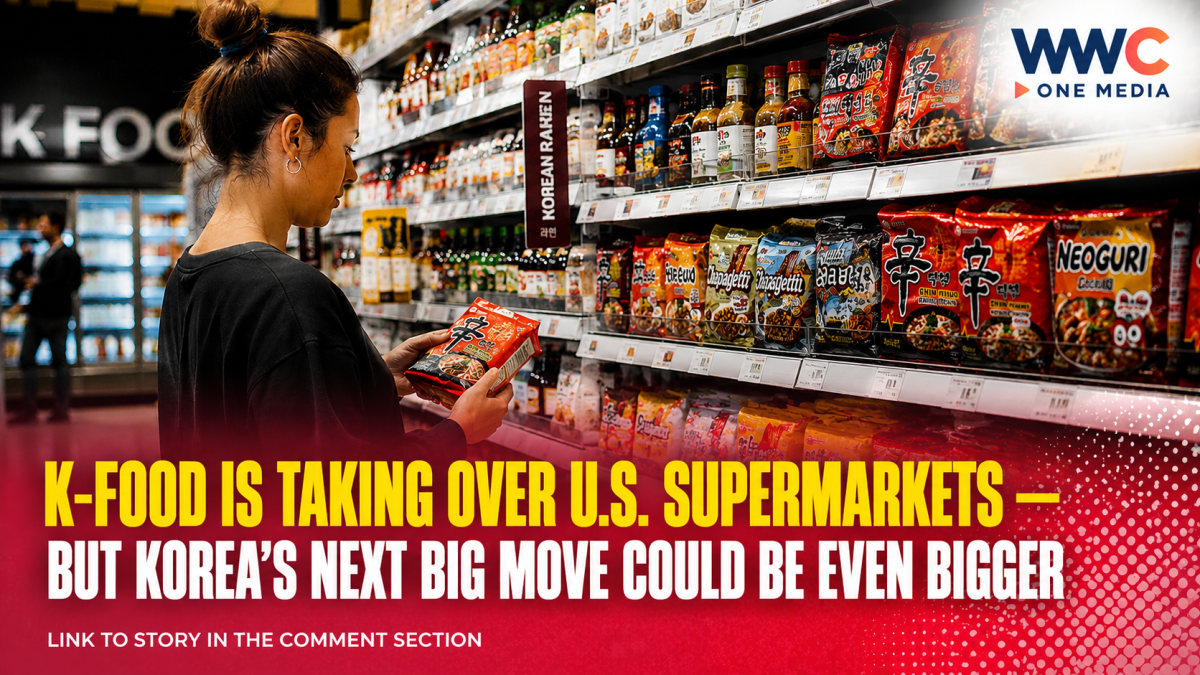
South Korea is making a major push to take K-food beyond Asian communities and into mainstream global grocery aisles as the country races toward a record $16 billion food-export target this year.
K-food exports reached $8.25 billion from January through July, up 4.8 percent from the same period last year, according to South Korea’s Ministry of Agriculture, Food and Rural Affairs. Instant noodles alone surpassed $1 billion in exports during the first seven months.
The United States has emerged as the biggest destination, with Korean food exports reaching $1.18 billion, a 9.8 percent increase. China followed with $940 million, up 6.7 percent.
Now, Seoul is changing its strategy: instead of relying primarily on specialty Asian supermarkets, Korean food companies are being encouraged to break into America’s mainstream retail giants, including H-E-B, Kroger and Target.
The government also said 67 Korean food products from 25 companies are expected to reach Costco warehouse shelves in the United States by the end of the year.
Why the U.S. is becoming K-food’s biggest battlefield
The shift reflects how dramatically Korean food has expanded in the American market.
Government data cited earlier this year showed that the United States had more than 1,100 Korean franchise outlets by the end of 2025, overtaking China, which had about 830. Korean franchise outlets in the U.S. more than doubled from 2020 to 2025.
American consumers are also encountering Korean flavors far beyond traditional Korean restaurants. Korean fried chicken, corn dogs, kimchi, sauces, noodles and other products have increasingly entered mainstream food culture.
Axios reported that the number of Korean restaurants in the U.S. increased 10 percent in 2024, while fast-food chains offering Korean fried chicken and corn dogs grew by roughly 15 percent. Korean corn dogs becoming available at Costco was highlighted as a sign that the cuisine had moved further into the American mainstream.
That growing familiarity is giving Korean manufacturers an opportunity to turn K-food from a cultural trend into a mass-market business.
China presents a very different opportunity
South Korea is taking a different approach in China, its second-largest food-export market.
Officials are watching the rise of China’s so-called “punk wellness” lifestyle — a phenomenon in which younger consumers attempt to offset unhealthy habits with wellness-oriented products and practices.
The trend has become visible in everything from herbal drinks and supplements to modernized traditional Chinese medicine experiences. Japanese and regional media have reported on TCM bars where young consumers combine traditional herbs with contemporary nightlife and drinks.
KOTRA has also identified a related “light wellness” trend among Chinese consumers, characterized by a preference for convenient products perceived as healthier while avoiding highly restrictive diets. The agency noted that this shift is influencing China’s snack and convenience-food market.
For Korean exporters, that creates an opening for instant foods, health-oriented products and snacks positioned around convenience and wellness.
The Korean government plans to use major Chinese e-commerce platforms including Tmall, JD, TikTok and Temu to expand sales.
Seoul is betting on a different K-food strategy for every region
The new export plan goes far beyond the U.S. and China.
In Southeast Asia, Korean exporters are expected to make greater use of Vietnam-based K-Market’s logistics infrastructure to distribute products throughout Vietnam and neighboring markets.
In Muslim-majority markets such as Indonesia and Malaysia, Korea plans to strengthen halal certification and promote Korean products through major halal events.
Singapore is being targeted for premium Korean meat, including Korean beef and Jeju pork.
Europe is another major focus. A record 89 Korean companies are expected to participate in SIAL Paris, with frozen dumplings and boneless fried chicken among the products being promoted.
Central Asia will see a stronger convenience-store strategy. CU has already expanded to more than 600 outlets in Mongolia and is also entering Kazakhstan, while GS25 continues expanding in Mongolia. These stores provide Korean companies with ready-made channels for products such as ramyeon, gimbap and prepared meals.
The Middle East is also being prioritized, with Korea planning a cold-chain pooling system through Khor Fakkan Port in the United Arab Emirates and targeting Saudi Arabia as another major growth market.
Meanwhile, Korean street food such as tteokbokki is being positioned as a strategic product for Central and South America, where younger consumers represent an important demographic.
The second half of 2026 could decide whether Korea hits $16 billion
South Korea’s $16 billion target is now within reach, but the government still faces a major challenge.
With $8.25 billion already recorded through July, Korea has achieved just over half of its annual goal. The government believes the final months of the year could be decisive because fresh agricultural exports typically accelerate while major shopping and consumption periods such as Thanksgiving and Black Friday drive demand in the United States.
The bigger story, however, is not simply the size of Korea’s food exports.
K-food is evolving from a niche cultural export into a global consumer industry.
Ramyeon helped open the door. Korean fried chicken, kimchi, sauces, snacks and street food pushed the trend further. Now Korean food companies are attempting something much bigger: putting K-food directly into the everyday shopping baskets of consumers who may have never considered themselves fans of Korean cuisine.
If that strategy succeeds, the next phase of the Korean Wave may not be driven by what people watch or listen to — but by what they put on the dinner table.
WWC ONE MEDIA G.A




Leave a Reply