
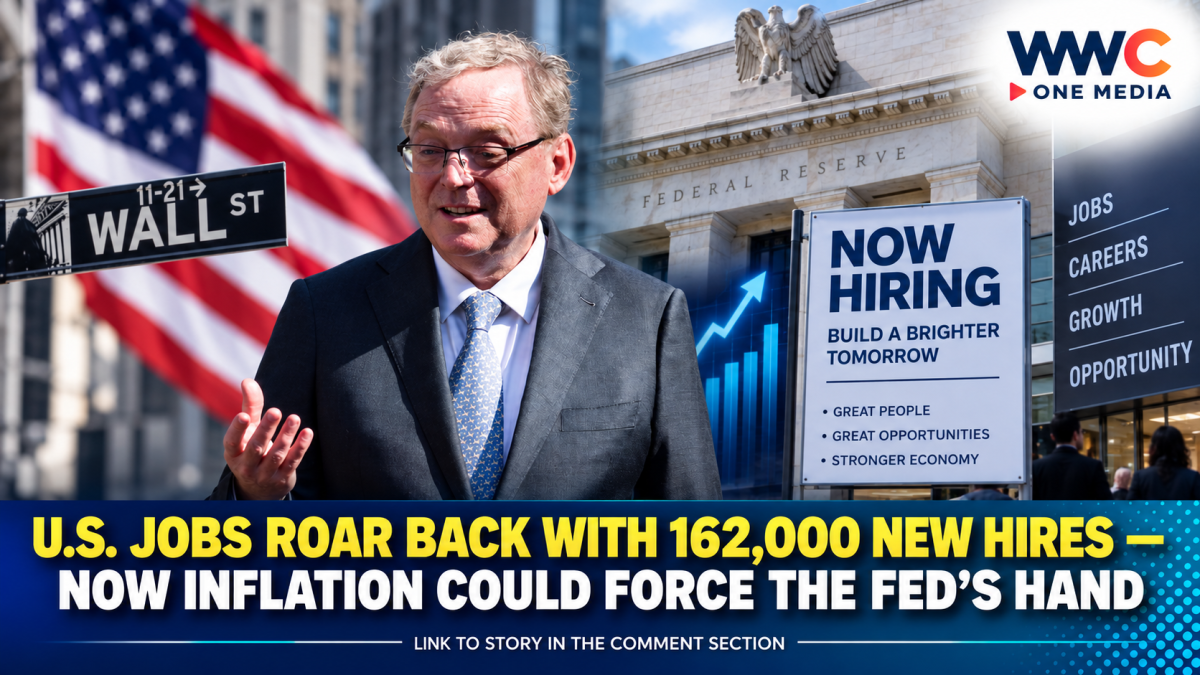
The U.S. labor market just delivered a surprise — and it could complicate the Federal Reserve’s next move.
American employers added 162,000 jobs in August, nearly three times the roughly 65,000 economists had expected, according to the latest Labor Department report. The unemployment rate remained at 4.1%.
At first glance, that’s excellent news for the economy.
But there’s a catch.
Inflation is still running well above the Federal Reserve’s 2% target.
And with hiring suddenly showing more strength than expected, the debate over whether the Fed should cut, hold or even raise interest rates is back in the spotlight.
The next major clue arrives September 11, when August’s consumer-price data is released — just days before the Fed’s September 15-16 meeting.
The jobs number shocked economists
The August increase was dramatically stronger than forecasts.
FactSet’s survey had economists expecting approximately 65,000 new jobs. Instead, payrolls increased by 162,000.
The Labor Department also revised earlier figures upward by a combined 55,000 jobs for June and July. July, which was initially reported as a loss of 23,000 jobs, was revised to a 21,000-job gain.
That changes the picture of the summer labor market.
Rather than showing an economy sliding rapidly toward a hiring freeze, the latest data indicate that employers were still capable of adding workers at a meaningful pace.
But that doesn’t mean the labor market is booming like it did during the post-pandemic hiring surge.
The average monthly gain so far in 2026 is more than 80,000 jobs, compared with just 9,700 in 2025 — but that remains substantially below the roughly 166,000 monthly pace seen in 2023 and 2024.
So the picture is complicated:
Hiring has recovered. But it hasn’t returned to the explosive levels of previous years.
Restaurants carried a huge part of the August rebound
One of the biggest contributors was the hospitality sector.
Food services and drinking places added 59,000 jobs in August, far above their recent average.
Local government education added another 42,000, while construction employment increased by 22,000 and manufacturing added 16,000.
Healthcare also continued to add jobs.
But there was an important weak spot:
The information sector lost 23,000 jobs.
According to the Labor Department, information employment has fallen by roughly 97,000 jobs since the beginning of 2026. Losses have occurred in areas including computing infrastructure, data processing, web hosting, publishing and broadcasting.
That is particularly notable as businesses rapidly adopt artificial intelligence and other automation technologies.
The jobs report therefore tells two stories at once:
Traditional service industries are hiring — while parts of the technology-driven economy are cutting positions.
The unemployment rate didn’t budge
Despite the surge in payrolls, the unemployment rate remained at 4.1%.
The labor force, however, expanded by approximately 683,000 people in August, while the participation rate rose to 61.6%.
That is important because a falling unemployment rate can sometimes look better simply because people stop looking for work.
In August, more Americans entered or re-entered the labor force.
Yet the broader picture remains unusual.
Economists have described the current environment as a “no-hire, no-fire” labor market: companies aren’t aggressively expanding their workforces, but they also aren’t laying off workers at historically high rates.
That can be particularly difficult for people entering the workforce or trying to switch jobs.
And here’s where the jobs report gets uncomfortable
Wages aren’t keeping pace with inflation.
Average hourly earnings increased 0.3% in August to $37.75, while annual wage growth slowed to 3.1%, according to the Bureau of Labor Statistics.
That was the weakest year-over-year wage increase since May 2021, according to reporting by The Korea Times/AP.
Meanwhile, the latest available U.S. inflation data showed consumer prices rising 3.4% over the year through July.
Core CPI, which excludes food and energy, rose 2.5%.
That creates a painful squeeze.
Prices are rising faster than average hourly wages on a year-over-year basis.
So while the headline jobs number looks strong, many households may not feel equally strong economically.
The Fed now has an even harder decision
The Federal Reserve has been trying to navigate two competing risks:
Inflation that remains too high — and a labor market that has shown signs of cooling.
The new jobs report reduces some of the urgency to support employment through lower rates.
If businesses are still hiring at a much stronger pace than expected, Fed policymakers have more room to concentrate on inflation.
Reuters reported that the stronger employment figures increased market expectations for a potential Fed rate hike at the September meeting.
But a hike isn’t guaranteed.
That’s because wage growth is relatively subdued and inflation has shown some recent moderation.
Federal Reserve Governor Christopher Waller said Thursday that he would lean toward leaving rates unchanged if the incoming inflation data shows continued cooling, but would consider a hike if inflation comes in hotter than expected.
That makes next week’s CPI report particularly important.
Inflation is still the elephant in the room
The latest official CPI report showed inflation at 3.4% in July, down from 3.5% in June.
But that remains well above the Fed’s 2% target.
More troubling for consumers, energy prices were up 14.7% over the year through July, while gasoline prices were up 24.6%.
Reuters noted that inflation remained high enough to keep the possibility of another rate increase on the table.
And energy could become even more important if oil prices remain elevated.
That creates a difficult chain reaction:
Higher oil prices → higher transportation costs → higher costs for businesses → pressure on consumer prices → greater pressure on the Fed.
Wall Street immediately felt the shock
Investors didn’t interpret the jobs report as simply good economic news.
U.S. stocks fell Friday as Treasury yields moved higher and traders reassessed the chances of another Fed rate increase.
The two-year Treasury yield — particularly sensitive to expectations about Federal Reserve policy — climbed to around 4.37%, while the 10-year yield was around 4.77%.
Market expectations for a September rate hike also increased after the jobs report.
That demonstrates the unusual situation facing investors:
A stronger economy can be bad news for markets if it means interest rates stay higher for longer.
The AI question is getting harder to ignore
Another emerging storyline is what happens to employment as companies increasingly use artificial intelligence.
The Labor Department’s information-sector data show significant employment declines in parts of the technology and communications economy.
The Korea Times/AP report also highlighted businesses turning toward technology and AI as they deal with worker shortages.
That’s creating an unusual paradox.
The U.S. economy can simultaneously experience:
worker shortages + weak hiring + low layoffs + rapid AI adoption.
For employers, AI can help compensate for a smaller available workforce.
For workers, however, it raises an increasingly important question:
Will technology fill jobs that companies can’t staff — or eventually replace jobs companies no longer want to hire for?
That debate is likely to become even more important as the labor market evolves.
What happens next?
The next major economic test is August CPI, due September 11.
That report will arrive just days before the Federal Reserve’s September 15-16 policy meeting.
The jobs report has strengthened the case for policymakers to remain focused on inflation.
But wage growth is cooling, some industries are losing jobs, and the broader labor market still isn’t generating employment at the pace seen in the strongest years of the post-pandemic recovery.
So the Fed faces a delicate balancing act.
Raise rates too aggressively and it could weaken hiring and economic growth.
Keep rates too low while inflation remains elevated and price pressures could become harder to extinguish.
That’s why one number could matter more than the 162,000 jobs headline.
The next inflation reading.
If inflation comes in hotter than expected, the August jobs surge could give the Fed another reason to tighten.
If inflation cools significantly, policymakers could have more justification for holding rates steady.
Either way, the September meeting is shaping up to be one of the most consequential economic decisions of the year.
The bottom line
The August jobs report is good news for employment — but not necessarily simple good news for the economy.
America added far more jobs than economists expected, unemployment remained low and more people entered the labor force.
But inflation is still above target, wage growth has weakened and some technology-related industries continue to shed jobs.
The result is an economy that looks stronger on the surface than many expected — while households and policymakers continue to wrestle with high prices.
The jobs crisis may be easing. The inflation problem isn’t finished.
And now the Federal Reserve has to decide which threat deserves more attention.




Leave a Reply