
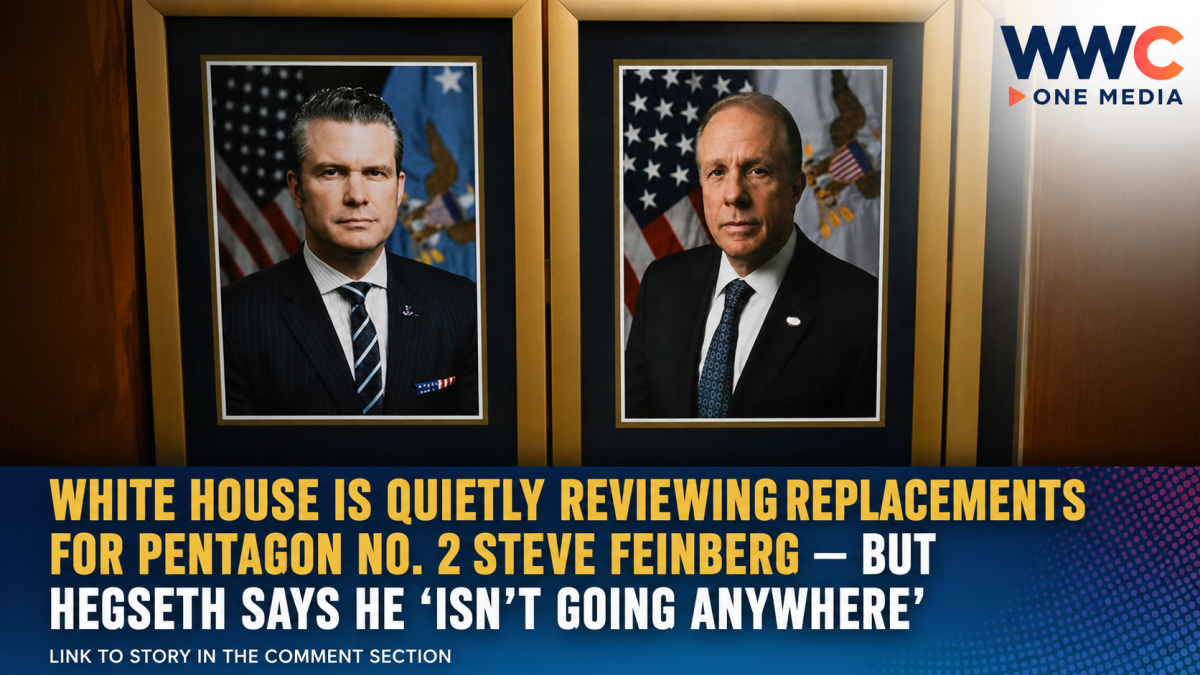
WASHINGTON — The White House has quietly examined possible replacements for the Pentagon’s second-highest civilian official, raising the possibility of another major shakeup inside a Defense Department already dealing with leadership turnover, an expensive Iran conflict and mounting questions about America’s ability to replenish critical weapons.
Three people familiar with the discussions told Reuters that the White House has reviewed potential candidates to replace Deputy Secretary of Defense Steve Feinberg, the billionaire private-equity executive who serves directly beneath Defense Secretary Pete Hegseth.
The discussions were underway by June and included conversations with senior senators about whether possible nominees could win enough votes for confirmation. One source said the review was still occurring as recently as late August.
But there is a crucial caveat:
No decision has been made to remove Feinberg.
The sources did not identify any potential replacements or explain definitively why the White House was considering alternatives.
And the administration is publicly pushing back hard against the story.
Hegseth Says Feinberg ‘Isn’t Going Anywhere’
White House spokeswoman Anna Kelly rejected the anonymous-source reporting and said President Donald Trump appreciates the work being done by Hegseth, Feinberg and the broader defense leadership.
The Pentagon went further.
Hegseth told Reuters that Feinberg has his full support and “isn’t going anywhere.” He praised his deputy for working to rebuild the U.S. defense industrial base and ensure the military has the weapons it needs.
That leaves Washington with two competing realities.
Behind the scenes, Reuters reports that potential successors have been examined.
In public, the administration says Feinberg remains secure.
Until Trump removes Feinberg, nominates a successor or the White House confirms that such a decision has been made, headlines declaring that Feinberg has been “fired” or is definitively being replaced would go beyond the available evidence.
Why Feinberg Matters More Than a Typical Deputy
Feinberg is not simply another political appointee.
The deputy defense secretary effectively acts as the Pentagon’s chief operating official, overseeing much of the department’s day-to-day management, budget execution and implementation of the defense secretary’s priorities.
The U.S. Senate confirmed him on March 14, 2025, by a 59-40 vote. Pentagon records say one of the major issues he emphasized during his confirmation process was strengthening the U.S. defense industrial base.
Before joining the administration, Feinberg co-founded and ran Cerberus Capital Management, one of America’s best-known private investment firms.
His business background was one reason supporters viewed him as a potentially important figure in reforming Pentagon procurement and pushing defense companies to manufacture weapons faster.
Now that mission has become considerably more urgent.
America Is Burning Through Weapons Faster Than Industry Can Replace Them
The deeper story behind the leadership speculation is the growing pressure on U.S. weapons inventories.
The continuing conflict with Iran has consumed large quantities of missiles and air-defense interceptors, adding to years of demand generated by military support for Ukraine and other global commitments.
Reuters reports that military leaders and lawmakers have become concerned about shortages in certain munitions. Analysts also say Feinberg’s promise to accelerate production has run into the fundamental reality that the American defense industrial base cannot dramatically increase output overnight.
Even when Washington provides billions of dollars, factories require time to expand production lines, hire specialized workers, obtain components and complete testing.
That means a funding announcement today may not produce usable missiles for months—or even years.
The problem is particularly acute for sophisticated missile-defense systems.
The U.S. Just Approved a Massive Patriot Missile Expansion
One sign of how seriously Washington is taking the issue came in July.
The U.S. Army awarded Lockheed Martin a contract worth up to $58.6 billion to dramatically expand production of PAC-3 Missile Segment Enhancement interceptors used in the Patriot air-defense system.
Reuters reported that the agreement could run through fiscal 2032, with Lockheed planning eventually to raise annual PAC-3 MSE production capacity to around 2,000 interceptors.
The company is investing billions of dollars in facilities and production capacity.
But those factories cannot solve today’s shortage immediately.
That time lag is at the heart of the challenge confronting Feinberg, Hegseth and Trump.
Trump Has Publicly Pressured Defense Contractors to Build Faster
The administration has been demanding a dramatic acceleration in weapons production for months.
In March, Trump met executives from major defense contractors including Lockheed Martin, RTX, Boeing, Northrop Grumman, BAE Systems and L3Harris as the administration sought to replenish weapons used in military operations.
Reuters reported that Trump said companies agreed to sharply increase production of precision-guided weapons.
But defense-industry executives have repeatedly pointed to another bottleneck: Congress must appropriate money and the Pentagon must turn that funding into finalized contracts before manufacturers can commit to major expansions.
Reuters reports that industry officials say slow appropriations have complicated Feinberg’s attempt to accelerate production.
That makes it difficult to assign responsibility for slow production to any single Pentagon official.
A Reported Trump-Hegseth Clash Put Feinberg in the Spotlight
The political pressure intensified after The Washington Post reported in August that Trump confronted Hegseth at Camp David over what sources described as severe shortages of long-range guided missiles and air-defense interceptors.
According to the Post’s sources, Hegseth blamed Feinberg for allowing inventories to deteriorate and for failing to ensure Trump fully understood the situation.
But this allegation is strongly disputed.
The White House called the report false, while Pentagon spokesman Sean Parnell said Hegseth neither misled Trump about weapons inventories nor blamed Feinberg.
That distinction needs to remain clear in any publication:
The alleged confrontation and attribution of blame come from anonymous-source reporting and are denied by the administration.
They are not established facts.
The Iran War Has Turned Production Capacity Into a Political Problem
The weapons issue is becoming harder to separate from the administration’s broader Iran strategy.
The Washington Post reported that the U.S. expended enormous quantities of precision weapons during the early stages of the conflict, including Tomahawk cruise missiles and Patriot and THAAD air-defense interceptors.
It also reported that replenishing some high-end interceptors can take years even after manufacturers receive orders.
Trump has publicly disputed suggestions that the United States is running dangerously short of weapons, saying the country has enormous inventories and is increasing production.
More recently, Reuters reported that Trump said Washington would prioritize rebuilding domestic stockpiles before some weapons sales abroad resume.
So the debate is no longer merely an accounting question inside the Pentagon.
It affects how many military options the president has during an active conflict.
Feinberg Has Been Trying to Change How the Pentagon Deals With Contractors
Feinberg’s response has included attempts to squeeze more information and faster performance from the defense industry.
Reuters reported that in an August 18 memo, he told contractors to accelerate production and provide greater transparency on costs and pricing.
Industry analysis of the memo says the new approach reaches deeper into supplier networks, seeking more visibility into costs at both prime contractors and subcontractors for large negotiations.
Feinberg has also championed a more investment-oriented Pentagon strategy.
Reuters says he has pushed the military to make direct investments and provide loans to defense companies through organizations including the Office of Strategic Capital and the newer Economic Defense Unit.
Pentagon historical records show the Economic Defense Unit was established through a Feinberg memorandum in February 2026 to coordinate economic competition and industrial-production initiatives.
In other words, the official whose future is now being questioned is also one of the architects of the administration’s effort to fundamentally change how Washington finances its military-industrial base.
Then There Are the Cerberus Questions
Feinberg’s previous career has created another source of scrutiny.
Democratic Senator Elizabeth Warren, a member of the Senate Armed Services Committee, has questioned whether Feinberg’s former relationship with Cerberus Capital Management could create conflicts involving Pentagon contracting—including the enormous Golden Dome missile-defense program.
Warren called on Feinberg to cut financial ties and maintain broad recusals involving Cerberus-related matters.
The Pentagon rejects the allegation that Feinberg has a conflict.
Chief Pentagon spokesman Sean Parnell told Reuters that Feinberg has fully divested from Cerberus and recuses himself from matters involving the firm and the executive branch.
Cerberus did not provide Reuters with a comment for its September 5 report.
So here again, the distinction matters: Warren has raised concerns, but the Pentagon says appropriate safeguards are already in place.
Feinberg Would Be the Biggest Departure Yet
What makes the replacement discussion particularly significant is the timing.
The Pentagon has already endured a series of senior departures.
Army Secretary Dan Driscoll stepped down this week after 18 months in the role. The White House did not publicly provide a reason for his departure, although reporting has described months of tension with Hegseth.
Former Navy Secretary John Phelan left earlier in the year after another abrupt Pentagon shakeup. Trump later said Phelan had been fired following disagreements over shipbuilding.
Trump has since announced plans to nominate Hung Cao, a Navy veteran who has been serving as acting Navy secretary, for the permanent position.
If Feinberg were ultimately removed, Reuters notes that he would represent the highest-ranking Pentagon departure yet under Hegseth.
That would transform the story from another personnel change into a shakeup at the very top of America’s defense establishment.
But This Is Not Yet a Feinberg Firing Story
That is the most important conclusion.
What has been established is that administration officials have reviewed potential candidates and even discussed confirmation prospects with senators.
What has not been established is that Trump has decided Feinberg must go.
The White House rejects the reporting.
Hegseth is publicly backing his deputy.
No successor has been named.
No nomination has been announced.
And Feinberg remains deputy defense secretary.
But the fact that potential replacements were reportedly being evaluated as recently as late August suggests that the administration has at least considered what the Pentagon might look like without him.
And that is happening at a particularly sensitive moment.
The United States is fighting an expensive conflict, weapons inventories are under intense scrutiny, Congress and defense contractors are wrestling with how quickly production can expand, and several senior Pentagon officials have already departed.
The biggest question may therefore be bigger than whether Steve Feinberg keeps his job.
If America’s defense factories cannot replenish weapons as fast as the military is using them, changing the Pentagon’s No. 2 official may be far easier than fixing the underlying problem.
WWC ONE MEDIA M.J.E




Leave a Reply