
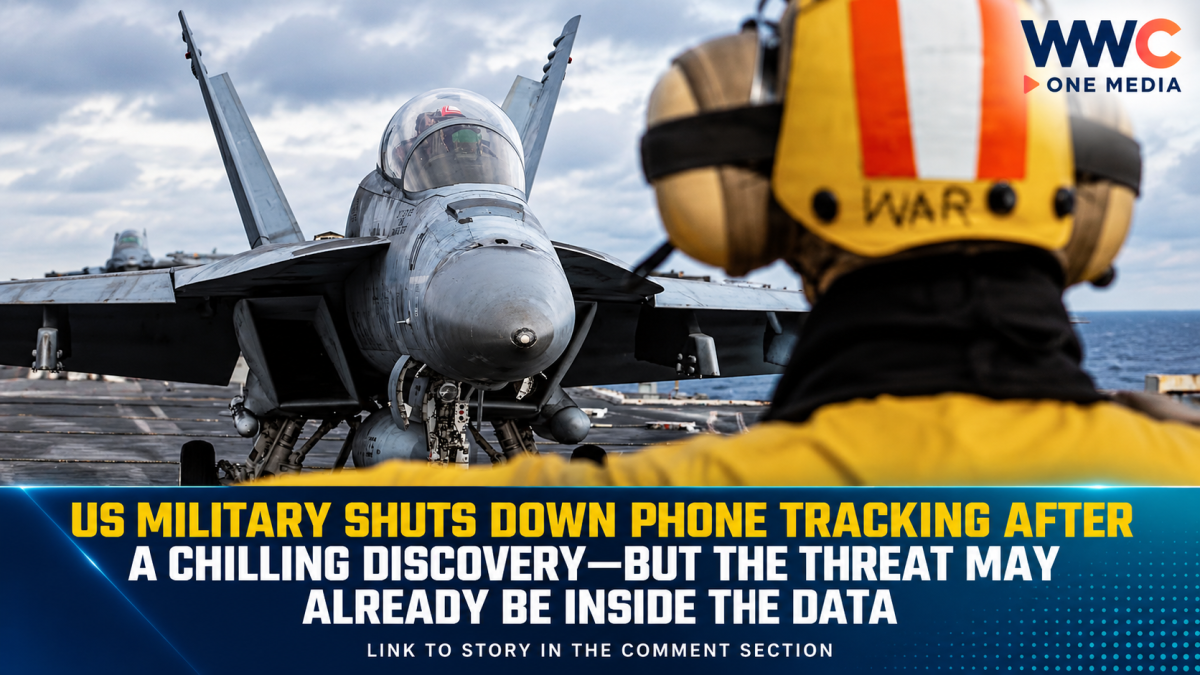
WASHINGTON — The U.S. military has begun shutting down advertising trackers on government-issued phones and computers after officials acknowledged a growing national-security threat: commercially available location data can be used to track and potentially target American service members in conflict zones.
The move was disclosed in letters released Friday by U.S. Sen. Ron Wyden and in statements provided to Reuters, following months of scrutiny over the sale of sensitive location information by commercial data brokers.
The issue goes far beyond ordinary online privacy.
Mobile advertising identifiers, commonly known as MAIDs, are unique identifiers associated with smartphones that allow apps and advertising systems to distinguish devices and build detailed records of user activity and location. That information can ultimately enter the commercial data ecosystem, where brokers collect, aggregate and resell location information.
In a battlefield environment, that data can become much more valuable—and dangerous.
From advertising data to a military security threat
The U.S. military’s latest action follows an alarming disclosure earlier this year from U.S. Central Command.
In May, Reuters reported that CENTCOM had received multiple threat reports involving adversaries exploiting commercially available location data to target or surveil U.S. personnel in the Middle East. Lawmakers warned that such information could reveal where troops gather and expose their patterns of activity.
The potential consequences are serious.
Commercial location information can reveal where a device regularly appears, potentially allowing an analyst to identify military facilities, personnel movements and recurring patterns. In a war zone, those patterns could potentially support surveillance, targeting or counterintelligence operations.
The problem is that the data does not necessarily have to be stolen through a sophisticated cyberattack.
It can potentially be purchased through commercial channels.
That is what has alarmed lawmakers and cybersecurity experts.
Military branches disable advertising IDs
According to information released by Wyden’s office, the Army, Air Force, Navy, Marine Corps and U.S. Special Operations Command have now adopted the recommended measure of disabling advertising identifiers on government-issued smartphones.
The exact timing has varied by branch.
The Air Force told Wyden that it disabled advertising identifiers on computers and mobile phones about two months ago. Special Operations Command said it had recently disabled them on Windows devices.
The Army said advertising IDs had already been blocked on Windows computers since before 2021, while advertising IDs on Android and Apple mobile devices had been disabled by default since at least February 2026.
TechCrunch reported that the measures cover government-issued iPhones, Android devices and Windows computers managed across the military’s enterprise network.
But the change may not completely eliminate the problem.
Turning off the tracker does not make a phone invisible
Disabling an advertising ID can make it significantly harder to associate commercial location records with a particular device through that identifier.
However, privacy and security experts caution that it is not a complete anonymity switch.
Other technical information, app-generated data and network-derived location signals can potentially be combined to identify or track devices.
That means the military’s latest move reduces one important source of identifying information—but does not necessarily eliminate every possible avenue for location surveillance.
This distinction is critical.
The Pentagon is not simply dealing with an advertising problem. It is confronting a broader ecosystem in which smartphones, applications, data brokers and commercially traded information can intersect with military intelligence.
Lawmakers say the Pentagon needs to go further
Wyden and Rep. Pat Harrigan are now asking the Defense Department’s inspector general to investigate whether the Pentagon has adequately protected service members from the commercial location-data threat.
In its September 4 release, Wyden’s office said the lawmakers want investigators to determine how location information from Defense Department personnel continues to appear in commercial datasets despite the military’s new safeguards.
One possibility is particularly difficult to solve: personal phones.
Military personnel and contractors may carry privately owned smartphones onto military facilities or during overseas deployments. Those devices may not receive the same centrally managed protections as government-issued equipment.
Wyden and Harrigan specifically raised concerns that commercially available location information could originate from personal devices rather than official military phones.
The warnings did not begin in 2026
The latest development is part of a much longer-running concern.
Earlier reporting documented instances in which commercially available location data was used to trace military personnel and movements around sensitive installations.
Reuters reported in May that a defense contractor had previously demonstrated how commercial location information could be used to track U.S. special operations personnel from bases in the United States to a sensitive facility in Syria.
Separately, journalists have demonstrated that large commercial datasets containing billions of location points can reveal movements around military and intelligence facilities.
WIRED also reported that U.S. officials had been warned for years about the national-security implications of commercially available location data, arguing that inexpensive commercial datasets could expose patterns of life around military installations.
Phone restrictions are becoming a bigger military issue
The advertising-tracker shutdown comes as the U.S. military is simultaneously tightening its approach to smartphones in the Middle East.
In July, Reuters reported that some deployed U.S. personnel could be required to surrender their phones because videos and images posted online could provide Iranian forces with information useful for assessing attacks and planning follow-up strikes.
U.S. Central Command chief Adm. Brad Cooper warned troops about the operational-security risks of publicly sharing material from attacks and military locations.
The concern illustrates a larger problem facing modern militaries: a smartphone can simultaneously be a communications device, a camera, a location beacon and a source of intelligence.
A bigger question for the Pentagon
The immediate question is whether disabling advertising identifiers will meaningfully close the security gap.
The answer appears to be: only partially.
The military’s decision removes one important mechanism through which smartphones can feed commercial tracking ecosystems. But lawmakers and researchers are warning that personal devices, applications, network information and other commercial datasets may still expose sensitive patterns.
Wyden’s office said the military branches deserve credit for adopting the anti-tracking measure but argued that continued availability of commercial location data originating from Defense Department facilities requires further investigation.
For the Pentagon, the issue is no longer simply about protecting troops’ privacy.
It is about whether information originally collected to sell advertisements can become intelligence that helps an adversary identify where American forces are, how they move—and potentially when they are most vulnerable.
And that may be the most unsettling part of the story: the data does not have to be stolen to become a weapon. It may already be available for sale.
WWC ONE MEDIA J.M.S




Leave a Reply