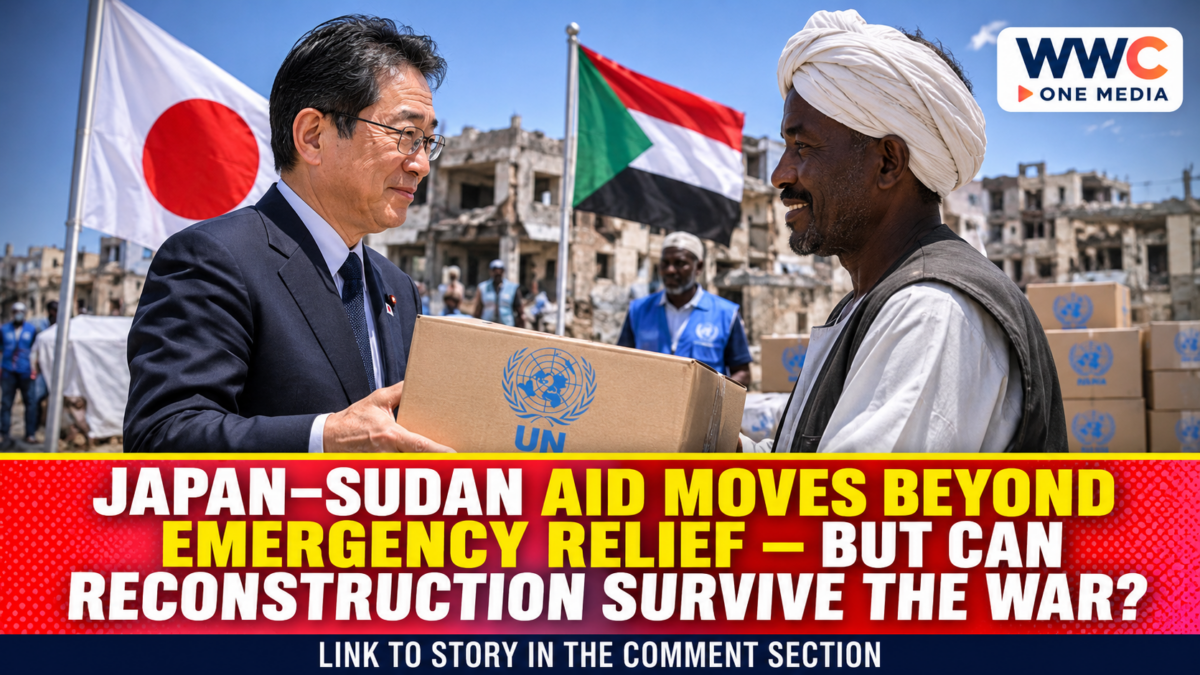
Japan is supporting Sudan through humanitarian assistance, education funding and a new reconstruction project for Khartoum State, with the latest major project announced on November 4, 2026. The initiatives show how Tokyo’s assistance is addressing both immediate humanitarian needs and some of the practical problems facing communities trying to recover from years of conflict.
The scale of the challenge remains substantial. Sudan’s armed conflict has continued since April 2023, and damaged public facilities, disrupted services and insecurity complicate efforts to restore ordinary life. Japan’s assistance now includes work on debris management, refugee education and international diplomatic pressure for a ceasefire. These activities do not amount to a peace settlement or a comprehensive reconstruction programme, but they provide a clearer picture of where Japanese support is being directed.
Japan–Sudan aid takes a practical turn in Khartoum
A major recent commitment concerns the removal and safe management of debris in Khartoum State.
On November 4, the Government of Japan and the United Nations Human Settlements Programme, known as UN-Habitat, exchanged notes for the Project for the Enhancement of Debris Management Capacity in Khartoum State. The project is valued at JPY 729 million, equivalent to approximately US$4.5 million.
At the same ceremony, the Japan International Cooperation Agency and UN-Habitat signed a grant agreement covering the project.
The initiative is expected to directly benefit more than 600,000 residents in heavily damaged neighbourhoods and priority public-service areas. Wider benefits are expected across three target localities, which are home to an estimated 4.6 million people.
The project is designed to provide equipment and strengthen local authorities’ ability to plan, remove and treat war debris. It also covers the identification and management of asbestos-containing materials, the reuse and recycling of suitable non-hazardous materials, and public awareness of health and environmental risks.
This is not simply a clean-up operation. Damaged roads, obstructed streets and unsafe building materials can prevent residents from reaching homes, markets and essential services. The project therefore connects urban maintenance with the practical conditions needed for communities to resume economic and social activity.
Why debris removal matters to economic recovery
The Khartoum project illustrates a basic problem facing cities affected by prolonged conflict: rebuilding cannot begin effectively if damaged neighbourhoods remain difficult or unsafe to access.
The official project description identifies three localities—Omdurman, Karrari and Khartoum—as part of the implementation structure. UN-Habitat Sudan will work with the Higher Council for Environment and Natural Resources, which is the main project counterpart for planning debris collection and treatment at the state level.
The Khartoum Cleaning Corporation will handle debris treatment, transfer and disposal operations. The Khartoum State Government, through the three localities, will be responsible for collection and safe disposal at the local level.
The division of responsibilities matters because reconstruction requires more than equipment or outside funding. Local institutions must be able to coordinate collection, treatment and disposal, while communities need safe access to the places where they live and work.
For residents, improved access to roads and public-service areas could support the return of daily activities. For local businesses, the removal of obstructions may help restore access to markets and commercial areas. These are potential benefits identified by the project’s objectives, not proof that normal economic activity has already resumed.
Education support adds another part of Japan’s response
Japan’s support also includes assistance for children affected by displacement.
At the Education Cannot Wait High-Level Replenishment Conference in Geneva on November 5, Japan’s representative, Kensuke Nagase, outlined the country’s contribution to education support for refugees in Sudan and Uganda.
Japan is contributing a total of 541 million yen in 2026 to Education Cannot Wait for refugees in the two countries. The amount is a combined contribution, not a Sudan-only allocation.
The initiative reflects a different dimension of humanitarian support. While debris management addresses damaged urban environments, education assistance is directed at children whose learning has been disrupted by conflict and displacement.
Keeping education available during emergencies can help children retain access to structured learning while families face uncertainty. However, the announced contribution should not be confused with a guarantee that every displaced child will have access to a functioning school or classroom.
The situation is particularly relevant to Sudan, where the conflict has placed pressure on schools, teachers and education services. WWC has previously examined the barriers facing children with disabilities in Sudan’s education emergency, including why reopening classrooms alone may not restore meaningful access for every learner.
Tokyo’s diplomatic position remains focused on a ceasefire
Japan’s reconstruction and humanitarian programmes are taking place alongside an international diplomatic effort to reduce the conflict.
In a July 14, 2026 statement, Japan joined other G7 foreign ministers in calling for an end to hostilities and direct negotiations between the Sudanese Armed Forces, the Rapid Support Forces and allied armed groups.
The statement also called for civilian protection, safe passage and unimpeded humanitarian access. It supported diplomatic efforts involving the United Nations, the Quad and the Quintet, with the objective of advancing a humanitarian truce, a permanent ceasefire and an inclusive political dialogue.
A subsequent G7 declaration issued on November 11 again addressed Sudan’s humanitarian situation. It raised concerns about the risk of famine in parts of Darfur and Kordofan, restrictions on humanitarian access and attacks affecting healthcare facilities, displacement camps and infrastructure used by civilians.
The declaration also stressed the importance of a Sudanese civilian-led, inclusive and transparent political dialogue process.
These statements establish Japan’s position as part of a wider G7 approach. They do not demonstrate that the parties have accepted a ceasefire or that the diplomatic process has produced a settlement.
The distinction is important because humanitarian projects and diplomatic pressure operate on different timelines. A debris-management programme can be implemented in designated locations, but wider reconstruction depends heavily on security, access and political conditions.
The recovery challenge is larger than individual projects
Japan’s support is part of a wider international response, but the projects address specific needs rather than the full range of Sudan’s recovery requirements.
Removing debris can improve access and reduce environmental risks. Education assistance can help protect learning opportunities for displaced children. Diplomatic engagement can support efforts to reduce violence and improve humanitarian access.
None of these measures alone can restore all public services, rebuild damaged infrastructure or resolve the conflict.
The scale of the humanitarian emergency is also visible in the continuing danger to civilian areas. WWC’s reporting on drone attacks and the risks facing Sudanese civilians examined how damage to civilian infrastructure can affect homes, essential services and humanitarian operations.
Japan’s wider regional assistance also includes programmes beyond Sudan. Its recent support for employment and protection services for displaced people from Myanmar in Thailand demonstrates another form of humanitarian engagement, although that programme is separate from the Sudan projects.
For Sudan, the central test will be whether international funding and technical support can be translated into durable improvements for people living in affected communities.
What happens next
The immediate focus for the Khartoum project will be implementation: equipment provision, local-authority capacity-building, debris collection and safe treatment and disposal.
The education contribution will need to be assessed through the support delivered to refugees in Sudan and Uganda, rather than by treating the combined funding amount as a Sudan-specific allocation.
Diplomatically, the next major question is whether calls for humanitarian access, de-escalation and negotiations produce measurable progress.
Japan’s assistance shows that support for Sudan is not limited to emergency relief. But the success of reconstruction will depend on more than the size of individual grants. Security, functioning local institutions, humanitarian access and sustained international engagement will determine whether these projects become part of a broader recovery.
Frequently asked questions
1. How much is Japan contributing to the Khartoum reconstruction project?
Japan’s project for improving debris-management capacity in Khartoum State is valued at JPY 729 million, or approximately US$4.5 million.
2. Which areas are included in the Khartoum project?
The implementation structure identifies Omdurman, Karrari and Khartoum localities in Khartoum State.
3. How many people could benefit from the debris-management project?
More than 600,000 residents are expected to benefit directly in heavily damaged neighbourhoods and priority public-service areas. Wider benefits are expected across target localities with an estimated combined population of 4.6 million.
4. How much is Japan contributing to refugee education?
Japan is contributing 541 million yen in 2026 to Education Cannot Wait for refugees in Sudan and Uganda combined. The announced amount is not exclusively for Sudan.
5. Has Japan’s diplomatic engagement ended the conflict in Sudan?
No. Japan has joined G7 calls for a ceasefire, civilian protection and humanitarian access, but the official statements do not establish that a peace agreement has been reached.