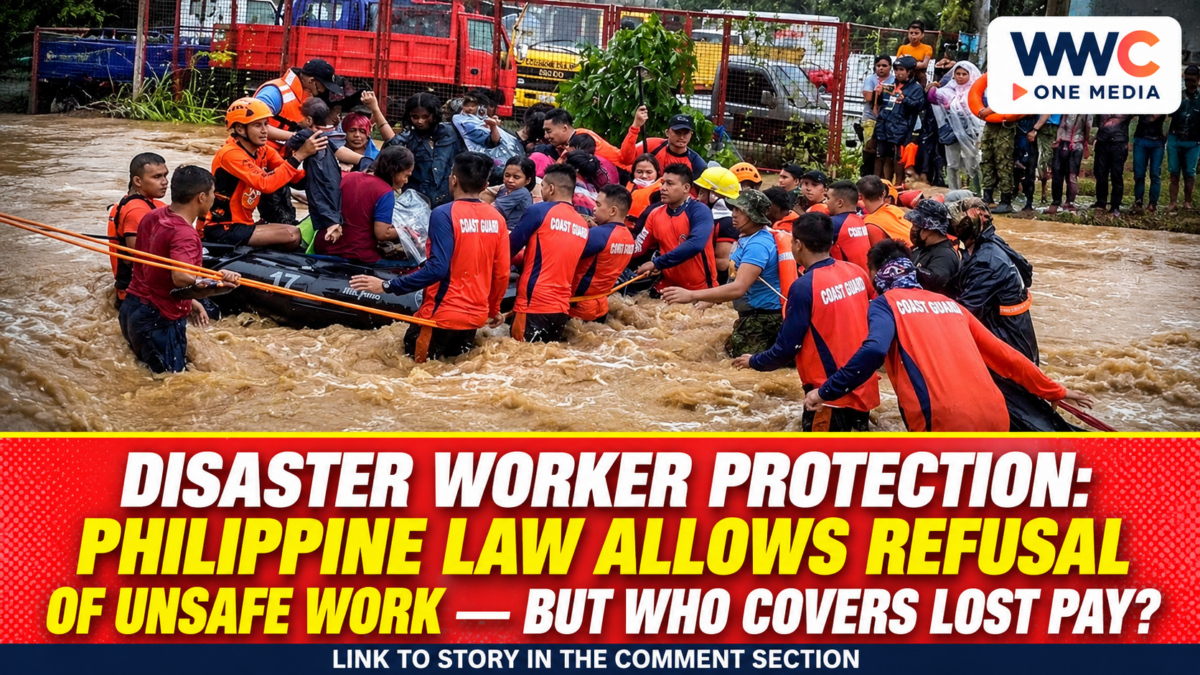
MANILA, Philippines — Philippine labour rules give employees protection when dangerous conditions make work unsafe, but the right to refuse hazardous work does not automatically guarantee income during a disaster-related shutdown. The distinction is becoming more important as employers prepare for weather disruptions and the possibility of further climate-related emergencies.
The rules place two responsibilities side by side: employers must protect workers from occupational hazards, while wage entitlements during work suspensions depend on the circumstances and applicable company arrangements. A proposed measure in the House of Representatives seeking additional pay for employees directly affected by natural calamities has also put the question of disaster compensation on the legislative agenda.
For businesses, the issue is not simply whether operations can continue during an emergency. It is whether safety decisions, employee communication and income arrangements are clear before a crisis disrupts work.
What disaster worker protection already covers
Republic Act No. 11058, or the Occupational Safety and Health Standards Law, establishes duties for employers, contractors and subcontractors to provide workplaces free from hazardous conditions. It also requires employers to inform workers about workplace hazards, explain preventive measures and establish procedures for emergencies.
The law gives workers a right to know about occupational risks and a right to refuse unsafe work under a specific condition: the Department of Labor and Employment must determine that an imminent-danger situation exists and the employer has not taken corrective action to remove the danger.
That qualification matters. The law does not mean every inconvenience, transport disruption or weather warning automatically creates the same legal basis for refusing work. The relevant question is whether the situation meets the legal standard for imminent danger and the required conditions have been satisfied.
The law also requires employers to provide appropriate protective equipment when necessary and to establish measures for emergencies and accidents. These obligations make workplace preparedness part of ordinary business compliance, not merely a voluntary disaster-response activity.
DOLE’s weather rules separate safety from pay
Labor Advisory No. 14, Series of 2026, signed on August 19, provides specific guidance for private-sector work suspensions during weather disturbances and similar occurrences.
Employers may suspend work to protect employees, coordinating the decision with the workplace safety and health committee, safety officer or another responsible company official. Workers who fail or refuse to work because of imminent danger arising from the weather disturbance are not to face administrative sanctions.
The advisory also explains how wages are treated. Employees who do not report because work has been suspended generally do not receive regular pay for the unworked period, unless a more favourable company policy, established practice or collective bargaining agreement applies. Workers may use accrued leave credits if the employer allows it.
For employees who report for work, the advisory provides that those who render at least six hours receive full regular pay. Those who work fewer than six hours receive the proportionate amount of their regular pay, subject to more favourable company policies or practices. Employers may also offer additional incentives or benefits to employees who report during adverse weather.
The practical distinction is important: protection from administrative sanctions is not the same as paid leave. A worker may be allowed to stay away from an imminently dangerous situation without being disciplined, yet still have to consider the applicable wage rules.
The law also addresses employer-caused danger
A separate provision in Republic Act No. 11058 addresses what happens when work is stopped because an employer has violated occupational safety requirements.
Section 23 states that if a stoppage of work due to imminent danger results from the employer’s violation or fault, the employer must pay the affected workers their wages during the stoppage or suspension of operations. The law also presumes the employer to be at fault when a work-stoppage order is issued because of an imminent-danger situation that threatens workers’ lives.
This is not the same as an ordinary weather-related suspension. The legal basis for the stoppage matters. A business closure prompted by an approaching storm and a government-ordered stoppage caused by an employer’s safety violation should not be treated as interchangeable situations.
For employers, this makes documented risk assessments, safety procedures and corrective action especially important. For workers, it means the circumstances behind a stoppage can affect their rights.
A proposed calamity-pay measure enters the debate
The House of Representatives’ Journal for September 9 and 10, 2025, records House Bill No. 4435, titled “An Act Providing for Additional Pay for Employees Directly Affected by Natural Calamities.” The journal lists the measure under Representative Johanne Monich Bautista and records its referral to the Committee on Labor and Employment and the Committee on Civil Service and Professional Regulation.
The bill’s presence in the House journal confirms that it was introduced and referred to committees. It does not establish that the measure has become law. The proposal should therefore be treated as a legislative initiative, not an existing employee entitlement.
The policy question is whether employees who continue working under difficult disaster conditions should receive additional compensation, and how eligibility should be determined. Any new requirement would also need clear rules on covered workers, qualifying events, employer obligations and enforcement.
A well-defined system could make expectations clearer for both employers and employees. But the design would need to distinguish workers who are genuinely required to perform essential duties from those who can safely work remotely or whose workplaces should be closed.
Why business continuity must include workers
Disaster planning is often measured through property protection, supply-chain recovery and the speed at which a company resumes operations. Those measures are incomplete if employees are left without clear instructions or safe ways to continue their work.
The effects of disruption can differ sharply by occupation. Office employees may have remote-work options, while delivery riders, construction personnel, retail staff, factory workers and health-care teams may face physical exposure or transport risks that cannot be solved through an online arrangement.
WWC has previously reported on emergency employment and livelihood support for calamity-hit Central Luzon workers. That recovery assistance illustrates a different part of the problem: when ordinary livelihoods are interrupted, temporary employment and livelihood programmes can help affected households regain income.
Infrastructure disruptions can also affect people whose jobs depend on connectivity. In Cebu, free work hubs for employees affected by power interruptions offered an alternative workspace when electricity and internet access at home became unreliable.
The protection question extends beyond employees working inside the country. WWC has also covered Cebu’s proposed emergency assistance system for families of overseas Filipino workers, highlighting how disasters can disrupt communication and create welfare concerns across borders.
These examples are not substitutes for statutory workplace protections. They show why preparedness must account for the different ways disasters interrupt people’s ability to work and earn.
What happens next
The immediate responsibility for private employers is to review their emergency procedures against existing occupational-safety requirements and DOLE’s weather-related work-suspension guidance. Employees should be informed in advance about reporting channels, work-from-home options, suspension decisions, leave arrangements and the process for raising safety concerns.
The legislative question is separate. House Bill No. 4435’s introduction and committee referral do not guarantee passage or implementation. Any later action should be checked against official House records before a new calamity-pay entitlement is reported as law.
PAGASA’s November 4 climate bulletin said a very strong El Niño was present in the tropical Pacific and expected to persist into the first half of 2027. It also cautioned that tropical cyclones and other rain-bearing systems could still bring heavy rainfall. That outlook is not a prediction of a particular workplace emergency, but it reinforces the value of preparing for different kinds of disruption.
The broader test for disaster worker protection is whether safety rules can be translated into decisions employees understand before conditions deteriorate—and whether income arrangements are clear when work cannot continue.
Frequently asked questions
Can employees refuse to work during dangerous weather in the Philippines?
DOLE’s Labor Advisory No. 14, Series of 2026, says workers who fail or refuse to work because of imminent danger caused by weather disturbances or similar occurrences should not face administrative sanctions. The Occupational Safety and Health Standards Law also recognises a right to refuse unsafe work under its specified legal conditions.
Does refusing to work during a typhoon guarantee full pay?
No. Under the 2026 advisory, employees who do not report because work is suspended generally are not entitled to regular pay for the unworked period unless a more favourable company policy, established practice or collective bargaining agreement applies. Accrued leave may be used if the employer allows it.
What happens if an employee works during a weather disturbance?
Under Labor Advisory No. 14, employees who work at least six hours receive full regular pay. Those who work fewer than six hours receive proportionate regular pay, subject to more favourable company policies or practices.
Is calamity pay already required by law?
House Bill No. 4435 proposes additional pay for employees directly affected by natural calamities. Its introduction and committee referral do not mean it has become law. Workers should not treat the proposal as an existing statutory entitlement.
What must employers do to protect workers during emergencies?
Republic Act No. 11058 requires employers to address workplace hazards, inform workers about risks, provide appropriate protective equipment when necessary and establish emergency and accident-response measures. Employers should also follow applicable DOLE guidance on work suspension during weather disturbances.