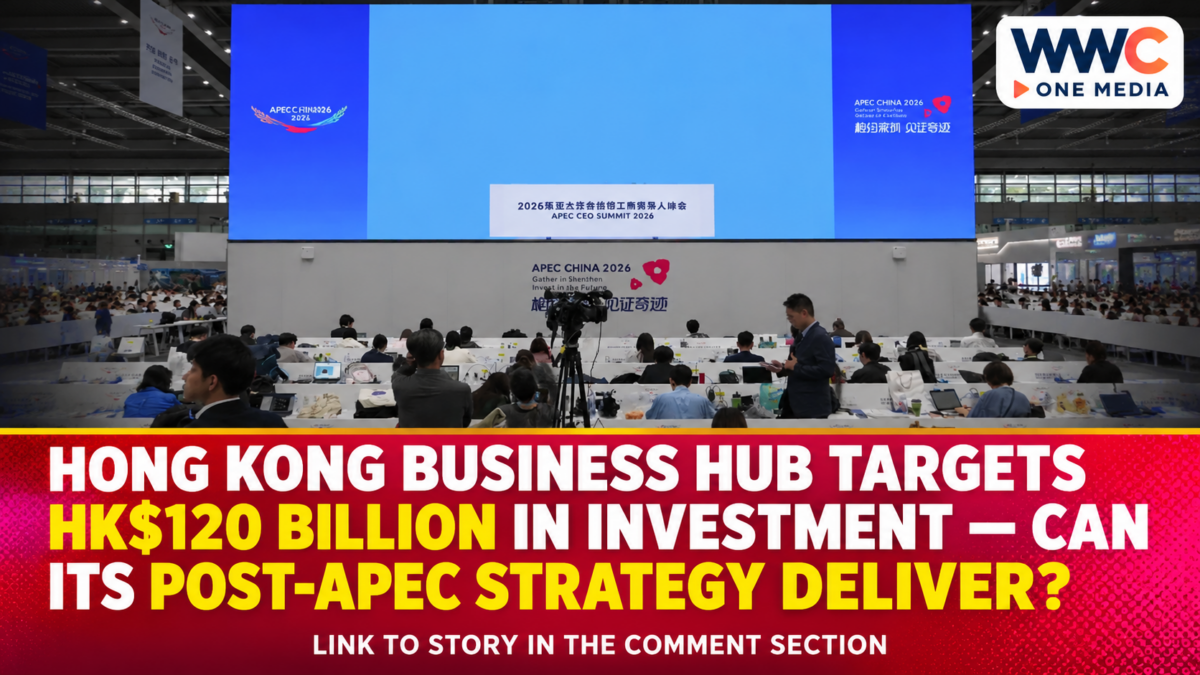
The Hong Kong business hub is pursuing at least HK$120 billion in direct investment through a government programme targeting 1,200 mainland Chinese and overseas enterprises during 2026 and 2027. Chief Executive John Lee reinforced the city’s international economic strategy during the APEC CEO Summit in Shenzhen on Nov. 17.
The initiative puts Hong Kong’s ability to attract corporate decision-makers, financial institutions and technology companies under renewed scrutiny following the Asia-Pacific Economic Cooperation Economic Leaders’ Meeting on Nov. 18 and 19.
For Hong Kong, the commercial opportunity extends beyond attracting foreign companies. It also involves helping mainland enterprises finance, organise and manage their international expansion.
The challenge is turning those ambitions into measurable economic activity.
Hong Kong business hub faces a measurable investment test
Hong Kong’s government outlined its investment attraction targets in written replies to the Legislative Council on Nov. 4.
The programme aims to deliver:
- At least 1,200 enterprises establishing or expanding operations.
- At least HK$120 billion in direct investment.
- At least 12,000 employment opportunities.
InvestHK assisted approximately 550 enterprises during the first nine months of 2026.
These figures establish a benchmark against which the government’s performance can be assessed through the end of 2027.
However, attracting a company and securing its long-term financial commitment are different achievements. An enterprise might establish a relatively small representative office before deciding whether to transfer more substantial operations.
Analysis: Hong Kong’s economic gains will depend not only on how many businesses arrive but also on the size, quality and durability of their investments.
More than 1,500 regional headquarters provide a foundation
Hong Kong’s existing international corporate presence offers a starting point for its expansion strategy.
Government survey results recorded 11,070 companies with parent organisations outside Hong Kong in 2025. That represented approximately 11% annual growth.
These companies employed 509,000 people, while more than 1,500 operated as regional headquarters.
For international businesses, selecting a regional headquarters involves decisions about where senior management, financial operations, legal responsibilities and commercial relationships should be concentrated.
A headquarters performing substantial operational functions can generate demand for specialised employees and external professional services.
Hong Kong’s international business connections also extend beyond the Asia-Pacific, as illustrated by WWC’s coverage of Hong Kong’s emerging Swiss business opportunities.
The important distinction is whether businesses establish a meaningful operational presence rather than merely registering an entity.
Mainland expansion could create a new source of demand
Hong Kong’s strategy also targets Chinese enterprises looking to enter overseas markets.
By September 2026, the government’s GoGlobal Task Force had assisted more than 360 mainland enterprises with establishing or expanding Hong Kong operations.
Authorities estimate that these businesses could generate approximately HK$61.3 billion in direct investment and around 8,500 jobs.
Approximately 30% have positioned their Hong Kong operations to perform headquarters, corporate treasury or other higher-value business functions.
These estimates should not be interpreted as confirmation that all the investment has already been spent or that every projected job has been filled.
Corporate treasury operations are particularly relevant because they can centralise a company’s financing requirements, cash management and financial risk controls across multiple markets.
Hong Kong’s 2026 Policy Address includes plans to expand support for these activities, with proposed amendments to corporate treasury tax arrangements expected to reach the Legislative Council during the first half of 2027.
The broader financial opportunity also connects with developments examined in WWC’s coverage of China’s planned Hong Kong dollar-bond sale.
Technology cooperation gives Hong Kong another growth avenue
Hong Kong’s development strategy is not limited to financial services.
The Hong Kong section of the Hetao Shenzhen-Hong Kong Science and Technology Innovation Co-operation Zone officially opened at the end of 2025.
Its development priorities include artificial intelligence, data science, health technology, advanced manufacturing and new energy.
For technology companies, combining research capabilities with access to financing and international customers could support commercial expansion.
A business developing a new technology, for example, may require investment, product certification, intellectual property advice and commercial partners before generating meaningful revenue.
Hong Kong could compete for some of those functions without needing to accommodate every stage of production.
The technology initiative forms part of a wider development agenda, previously examined in WWC’s reporting on Hong Kong’s Northern Metropolis development plans.
Analysis: Research infrastructure creates potential. Its eventual economic contribution will depend on commercial partnerships, business investment and the successful development of marketable products.
Why the APEC commitments matter to businesses
The 2026 APEC Leaders’ Declaration, published on Nov. 21, emphasised regional economic integration, technological cooperation, resilient supply chains and improved digital trading arrangements.
Hong Kong had also hosted the APEC Finance Ministers’ Meeting for the first time in October.
These developments provide a policy setting for Hong Kong’s efforts to attract international business.
For Philippine companies and other Southeast Asian enterprises, the potential opportunities include financing partnerships, distribution arrangements, technology collaborations and professional services.
Nevertheless, APEC operates through voluntary cooperation rather than binding commercial obligations.
Its declarations do not automatically eliminate tariffs, confer regulatory approvals or guarantee access to every participating economy.
Businesses must still assess market-specific requirements and commercial risks before committing capital.
What happens next
Hong Kong’s investment attraction programme runs through 2027, providing an opportunity to assess whether the government’s international outreach delivers tangible results.
Another policy to watch is the proposed corporate treasury tax legislation. Its eventual provisions could influence where businesses choose to organise their international financial operations.
Progress should also be measured through actual investment expenditure, sustained employment, corporate expansion and commercial activity within Hong Kong’s technology facilities.
The city’s post-APEC opportunity is therefore not simply a question of international visibility.
It is whether Hong Kong can become an indispensable part of how companies raise capital, organise their finances, develop technology and enter new markets.
The HK$120 billion target provides one benchmark. The quality and persistence of the economic activity it generates will provide the more meaningful verdict.
Frequently asked questions
What is Hong Kong’s investment target for 2026 and 2027?
Hong Kong aims to attract at least 1,200 mainland Chinese or overseas enterprises, generating at least HK$120 billion in direct investment and 12,000 job opportunities.
Has Hong Kong already secured the entire HK$120 billion?
The amount is a programme target, not confirmation that the full investment has already been received.
Why is Shenzhen important to Hong Kong’s business strategy?
Cross-border technology cooperation and the development of the Greater Bay Area provide opportunities for businesses to combine research, financing and international commercial activities.
What does APEC 2026 mean for Philippine businesses?
Regional cooperation could support opportunities in trade, technology and financial services. However, APEC commitments do not automatically remove individual market-entry requirements.