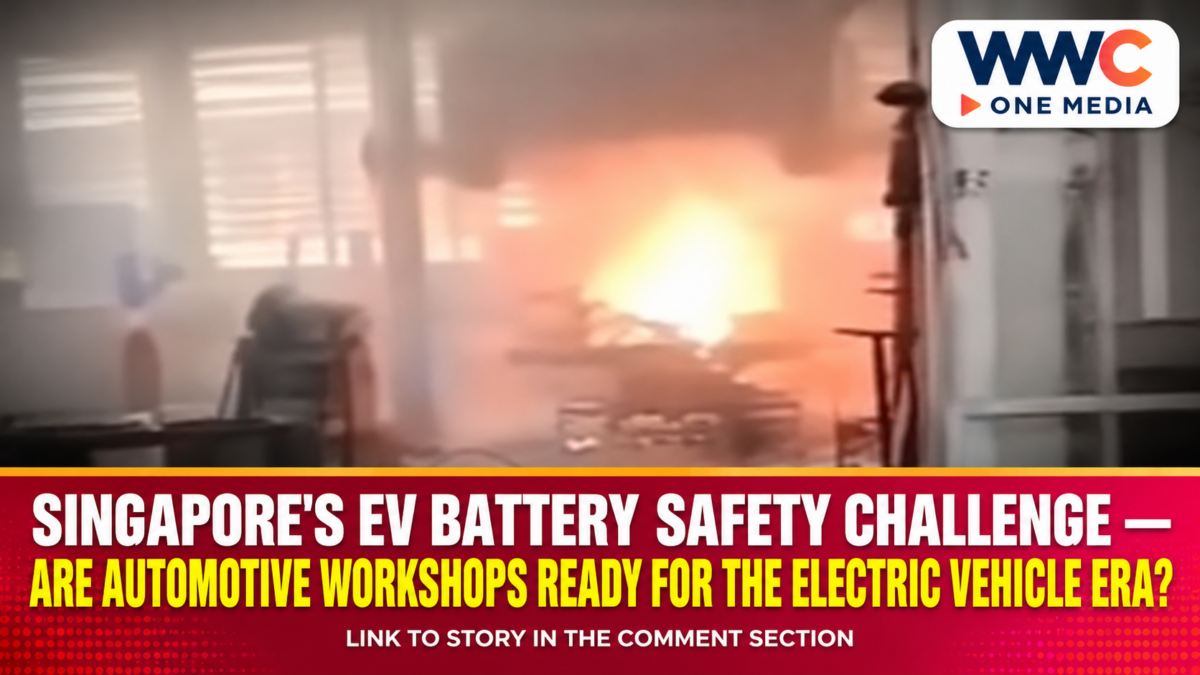
SINGAPORE — EV battery safety is becoming an increasingly important consideration for Singapore’s automotive servicing industry as the country develops its electric vehicle ecosystem. Government agencies have established specialist training programmes for technicians alongside workplace risk-management requirements and emergency-response guidelines.
The transition towards cleaner transportation is not simply about replacing petrol-powered vehicles with electric cars. It also requires businesses responsible for maintaining and repairing these vehicles to develop the technical capabilities necessary to manage unfamiliar hazards.
For automotive workshop operators, the challenge extends beyond mechanical expertise to employee training, electrical safety and emergency preparedness.
EV Battery Safety Requires Different Technical Expertise
Singapore’s Land Transport Authority (LTA) has recognised that the transition towards electric mobility requires automotive technicians to acquire additional competencies.
In May 2022, LTA announced a partnership with 21 organisations to develop training and certification opportunities for automotive professionals working with electric vehicles.
The initiative identified high-voltage electrical systems, fault diagnosis and electrical troubleshooting as important areas of technical development.
The implications for automotive businesses are significant. A workshop’s experience in servicing conventional vehicles should not automatically be treated as evidence of its readiness to perform specialised electric vehicle repairs.
WWC ONE MEDIA’s analysis is that workshop owners should regard investment in technical training as an essential operational expense rather than an optional business improvement.
The distinction between different vehicle technologies is also important when examining incidents such as the ComfortDelGro hybrid taxi fire along Geylang Road.
An incident involving an electrified vehicle does not automatically establish that its battery caused the fire.
Singapore Has Established Specialist EV Training
Singapore’s National EV Specialist Safety (NESS) certification provides foundational knowledge for automotive professionals entering the electric vehicle maintenance sector.
The programme is recognised under the national Workforce Skills Qualifications system.
Training opportunities listed by LTA include programmes offered through the Institute of Technical Education, Ngee Ann Polytechnic, Republic Polytechnic and Temasek Polytechnic.
Eligible Singapore citizens and permanent residents may receive subsidies covering up to 70% of course fees.
Singapore has also developed a career conversion programme to support employees moving into electric vehicle maintenance roles.
For independent automotive workshops, these initiatives offer a pathway towards developing relevant competencies without having to establish an entire training infrastructure independently.
However, entry-level certification should not be confused with comprehensive expertise in every battery configuration or advanced repair procedure.
Businesses must assess whether their employees possess the appropriate competencies for the particular work they undertake.
Workplace Fire Prevention Is a Management Responsibility
Singapore’s Ministry of Manpower requires employers and other responsible workplace parties to identify occupational hazards and take reasonable measures to eliminate or reduce associated risks.
The country’s workplace risk-management framework encompasses both regular operations and activities performed less frequently.
Businesses are expected to reconsider their risk assessments when significant operational changes occur, new equipment or procedures are introduced, or incidents demonstrate weaknesses in existing precautions.
For an automotive workshop introducing EV battery servicing, this framework provides an important starting point.
Management should consider whether existing operating procedures, employee competencies and emergency arrangements remain appropriate for the proposed activities.
The commercial question is whether businesses are incorporating these considerations into expansion plans before accepting unfamiliar repair assignments.
Investing in new diagnostic equipment without corresponding improvements in employee preparedness would represent an incomplete approach to operational development.
Fire Statistics Require Careful Interpretation
Singapore recorded 2,050 fires in 2025, representing a 3% increase from the previous year.
The Singapore Civil Defence Force (SCDF) also recorded a 13.5% increase in fires at non-residential premises.
These nationwide figures cover multiple categories of incidents and should not be interpreted as a measurement of electric vehicle battery fires.
Electric cars, conventional vehicles and smaller battery-powered mobility devices have different operating environments and safety considerations.
WWC ONE MEDIA’s earlier coverage of a mobility scooter fire in Yishun provides additional reading on battery-related public safety, although that category of equipment should not be directly equated with electric passenger cars.
Meaningful comparisons require consistent definitions and appropriate information about the number and types of vehicles in operation.
Without that context, individual emergencies can create misleading impressions about the relative safety of entire transport technologies.
Emergency Preparedness Extends Beyond Workshop Employees
Singapore’s emergency-response planning also addresses the importance of identifying electric vehicles during emergencies.
In September 2026, LTA and SCDF announced an initiative to obtain feedback on differentiated vehicle licence plate designs.
The initiative was intended to help responders and members of the public recognise electrified vehicles more readily during incidents.
The proposed identification measures were previously examined in WWC ONE MEDIA’s coverage of Singapore’s EV and hybrid vehicle licence plate consultation.
For businesses operating shared industrial premises, emergency preparedness should extend beyond individual repair technicians.
Workshop managers and building operators should consider how emergency information is communicated, how occupants are alerted and how responding personnel can obtain relevant information.
These considerations are particularly important when different businesses occupy the same building.
What Happens Next
Singapore’s automotive industry faces a continuing need to align technical capabilities with the country’s transition towards electric transportation.
The existence of specialist certification programmes provides an institutional foundation, but their availability alone does not establish that every workshop is adequately prepared.
In WWC ONE MEDIA’s assessment, the most important indicators of progress will be the quality of employee training, the effectiveness of workplace risk assessments and businesses’ ability to implement appropriate safety procedures consistently.
Electric mobility presents commercial opportunities for automotive service providers. Capturing those opportunities responsibly means recognising that workplace safety must develop alongside technical capability.
Frequently Asked Questions
What is Singapore’s NESS certification?
The National EV Specialist Safety certification provides foundational electric vehicle knowledge and high-voltage safety awareness for automotive professionals.
Are electric vehicle fires more common than conventional vehicle fires?
Overall fire statistics cannot establish that conclusion. Meaningful comparisons require vehicle-specific incident data and appropriate fleet population figures.
Who is responsible for workplace risk management in Singapore?
Employers, self-employed individuals and other responsible workplace parties must identify occupational hazards and implement appropriate risk-control measures.
Can conventional automotive workshops service electric vehicles?
Workshop operators should assess whether their technicians, equipment and safety procedures are suitable for the specific electric vehicle maintenance activities they intend to perform.