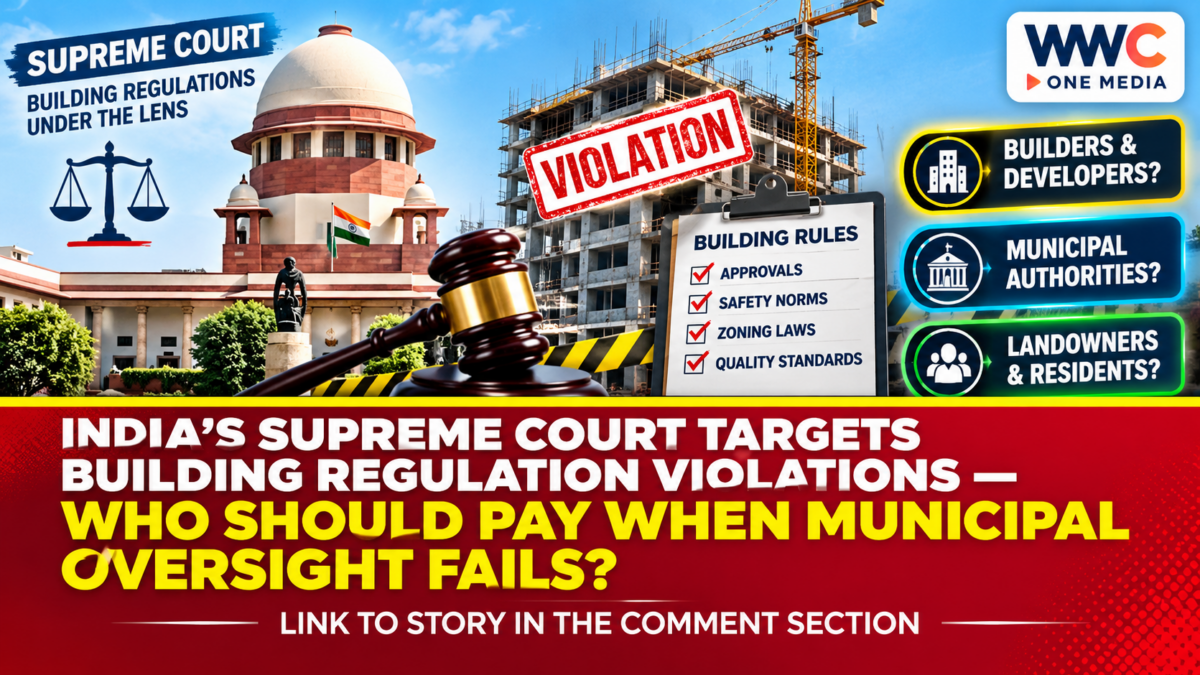
India’s Supreme Court has placed building regulation violations under judicial scrutiny, raising questions about the effectiveness of municipal oversight and the protection of property owners. Proceedings involving the State of Tamil Nadu, which expanded into a nationwide examination of construction compliance on March 25, 2026, were listed again on the court’s Nov. 23 calendar.
The judicial examination highlights an economic problem extending beyond individual disputes over construction permits.
When regulatory violations remain undetected until buildings are completed, the financial consequences can affect property developers, purchasers, neighbouring residents and public authorities.
For India’s urban development sector, the challenge is establishing an enforcement system that identifies violations before they become expensive and difficult to resolve.
Building Regulation Violations Raise Municipal Accountability Questions
The original proceedings involved construction undertaken without an approved building plan.
In an earlier order dated Feb. 16, 2026, subsequently reproduced in its March proceedings, the Supreme Court questioned how construction had progressed without effective municipal intervention.
The court directed state authorities to investigate the circumstances that allowed the building work to continue.
It also required an explanation from the relevant municipal authority.
The Greater Chennai Corporation commissioner subsequently submitted an affidavit stating that the violations occurred when the property was located within Madhavaram Municipality rather than the corporation’s jurisdiction.
That distinction introduces an important administrative question: which authority was responsible for enforcing the applicable regulations when the construction occurred?
The court’s March order temporarily placed that particular issue in abeyance while examining broader concerns.
The proceedings should not be interpreted as a final criminal conviction against individual municipal officials.
Supreme Court Expanded Its Examination Across India
The March 25 order identified concerns extending beyond the original property dispute.
The court highlighted apparent violations involving construction restrictions and the subsequent use of properties for activities different from their authorised purposes.
Particular attention was directed towards residential areas being used for unauthorised commercial activities.
The court included municipal authorities in the capital cities of India’s states and union territories as respondents in the proceedings.
It directed those authorities to investigate relevant land-use violations and provide detailed information through sworn statements.
The scope of the examination recognised that construction compliance affects surrounding communities, not merely individual property owners.
A residential development, for example, may have infrastructure designed around a particular level of vehicle traffic and demand for public services.
If numerous properties are subsequently converted into commercial establishments without appropriate assessments, additional infrastructure requirements could arise.
This is a potential urban planning consequence rather than a measured financial loss established in the proceedings.
Why Delayed Enforcement Can Increase Construction Costs
From an economic perspective, identifying a construction violation during the early stages of a project may offer more opportunities for corrective action.
Consider a hypothetical developer constructing a commercial property that exceeds its authorised building dimensions.
If the discrepancy is identified before substantial construction has occurred, redesigning the project may be financially manageable.
However, discovering the same issue after completion could require extensive alterations, additional engineering assessments or legal proceedings.
Prospective tenants and property purchasers could also experience uncertainty about when the building may lawfully operate.
These challenges illustrate why construction compliance should be treated as part of project management rather than a final administrative requirement.
Comparable concerns arise in Philippine infrastructure development, including Quezon City’s construction restoration and cleanup compliance framework.
WWC analysis: Governments could reduce avoidable economic losses by evaluating whether inspection systems identify material violations while corrective action remains practical.
Property Buyers and Businesses Face Separate Financial Risks
A completed building is not necessarily equivalent to a legally compliant property.
Before committing substantial financial resources, buyers and commercial tenants could benefit from reviewing the applicable permits, approved property use and relevant construction records.
Businesses seeking premises for retail, industrial or office activities should also consider whether the intended use is permitted.
A hypothetical investor purchasing a building for commercial operations could face additional expenses if the property’s approved use does not accommodate the proposed business.
The investor might need to seek regulatory approval, undertake alterations or reconsider the investment altogether.
These risks are particularly relevant when evaluating construction projects involving several public authorities.
WWC’s earlier coverage of infrastructure and regulatory questions surrounding Taguig’s lakeshore projects provides a Philippine example of why project authorisations deserve independent examination.
Responsibility for financial losses would depend on the applicable law, contractual commitments and circumstances of each dispute.
Neither the issuance of a permit nor a subsequent regulatory investigation automatically establishes that every participating party bears equal responsibility.
What Philippine Construction Companies Can Learn
India’s judicial proceedings do not directly determine the legal obligations of Philippine developers.
The Philippines has its own regulatory framework under Presidential Decree No. 1096, otherwise known as the National Building Code.
In a July 2022 decision involving a construction dispute, the Philippine Supreme Court explained that securing construction and occupancy authorisations involves responsibilities shared among owners and relevant construction professionals.
A separate February 2024 ruling clarified that the absence of a building permit does not, by itself, justify immediate demolition without the applicable legal procedures.
Together, these decisions illustrate the importance of both construction compliance and lawful enforcement.
The commercial significance of completing regulatory requirements is also reflected in WWC’s examination of a Cebu health facility facing construction and occupancy documentation questions.
For developers, establishing clear contractual responsibilities for obtaining permits, documenting inspections and addressing construction deviations could reduce disputes.
Public authorities, meanwhile, should ensure that corrective measures remain consistent with applicable legal safeguards.
What Happens Next?
India’s Supreme Court listed the Loganathan proceedings for Nov. 23, 2026.
The outcome of that particular hearing requires confirmation through the corresponding judicial order before any new directions or penalties can be established.
Further official records will be important in determining how the nationwide examination develops and whether additional enforcement measures are adopted.
The broader economic question remains whether municipalities can protect compliant developers and property owners while preventing unauthorised construction from transferring avoidable costs to surrounding communities.
Effective regulation should identify problems early, establish clear responsibilities and ensure that enforcement follows the law.
Frequently Asked Questions
Why is India’s Supreme Court examining building regulation violations?
The court identified concerns involving unauthorised construction, land-use violations and the effectiveness of municipal enforcement.
What are building bye-laws?
They are regulations governing aspects of construction, property development and building use within an applicable jurisdiction.
Are municipal officials automatically liable for construction violations?
No. Individual liability depends on applicable legal duties, evidence and findings in the relevant proceedings.
Does a missing building permit automatically justify demolition in the Philippines?
No. The Philippine Supreme Court has clarified that the absence of a permit alone does not justify summary demolition without appropriate legal procedures.
What should property investors examine before purchasing a building?
Relevant considerations include approved construction plans, building and occupancy permits, permitted property use and outstanding regulatory proceedings.