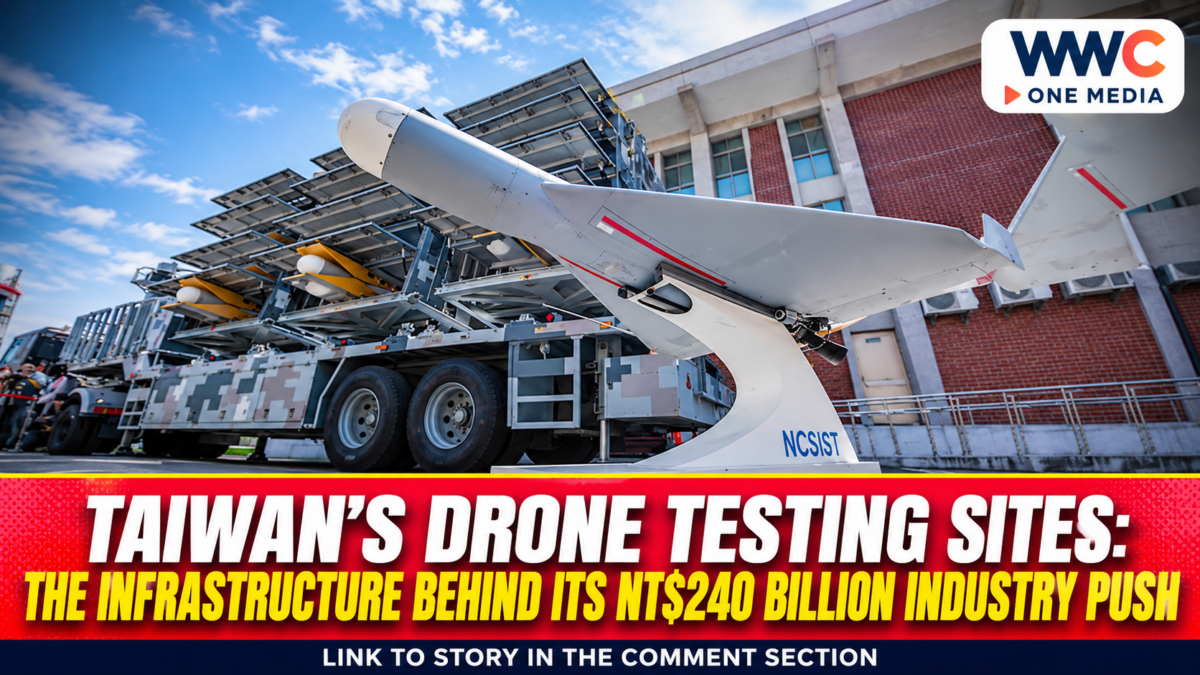
TAIPEI — Taiwan has identified 18 small- and medium-sized drone testing sites for domestic developers, while also coordinating access to two airports for larger aircraft as the government works to strengthen its unmanned-systems industry. The initiative comes as the island’s aviation authority reports more than 42,000 registered drones and tens of thousands of approved drone operations.
The testing infrastructure is part of a wider industrial strategy that combines domestic manufacturing, research and development, national security requirements and commercial applications. The challenge is no longer simply producing more drones: manufacturers also need places to test them, clear operating rules, reliable certification procedures and access to customers.
For Taiwan, that means building an industry capable of serving both civilian and government demand without weakening aviation safety. The distinction matters because a growing number of registered aircraft does not automatically translate into a mature manufacturing and export sector.
Drone testing sites address a growing operational market
The Civil Aviation Administration identified 18 small- and medium-sized testing sites as part of its programme to support domestic drone development. It said eligible organisations can apply through its remote-control drone management information system, where the application process for the designated testing locations has been simplified.
The authority has also coordinated the use of Chiayi Shuishang Airport and Hengchun Airport in Pingtung County for larger-drone research and testing. The facilities are intended to support work involving medium- and high-altitude operations, longer flight endurance, resistance to wind and specialised payloads.
These facilities address a practical problem for manufacturers. Testing a prototype requires more than a functioning aircraft. Developers need suitable locations, permission to operate, safety procedures and an environment where performance can be evaluated under controlled conditions.
The availability of testing sites can help reduce uncertainty during development, but it does not automatically certify a drone for commercial use or authorise unrestricted flights elsewhere.
Taiwan’s official drone-management system continues to distinguish between permitted areas, restricted zones and activities that require approval. Operators are expected to check the applicable restrictions before flying.
Registration figures show how quickly drone use is expanding
The Civil Aviation Administration reported that Taiwan had 42,016 registered drones as of June 2026. It also recorded 23,518 professional operator certificates held by 17,343 people.
The authority counted 895 valid organisations eligible to apply for drone operations, with 31,613 approved activity cases recorded at the time of its August announcement.
The largest category was aerial photography, which accounted for 84.75 percent of approved operations. Agricultural pesticide spraying represented 4.51 percent, while data monitoring accounted for 2.71 percent.
Those figures show that Taiwan’s drone activity is still concentrated in established uses, particularly aerial imaging. However, the authority is also examining more complex commercial applications.
In logistics, it had approved 10 pilot programmes, with three continuing in trial operations. These mainly involve transporting daily necessities and medical supplies to remote areas.
The authority said experience from these pilot programmes would help inform the gradual development of commercial logistics regulations.
That is an important distinction for companies planning to use drones for delivery. A pilot programme demonstrates that an application is being tested under an approved arrangement; it does not mean a nationwide commercial delivery system is already authorised.
The NT$240 billion law links industry growth to national security
Taiwan’s drone development push also has a substantial legislative and funding dimension.
The Act on Strengthening National Defense Self-Reliance and Developing Unmanned Systems Industry was promulgated on September 11, 2026. Article 4 provides for a total of NT$240 billion over six consecutive years through the annual budget process, with NT$40 billion per year as the principle allocation.
The law identifies the Ministry of Economic Affairs as the principal competent authority, while the Ministry of National Defense handles matters involving military procurement. Relevant agencies are expected to coordinate on areas including research support, cybersecurity reviews and testing-site designation.
The legislation also seeks to connect civilian industrial capabilities with national defense requirements. It covers the development of unmanned systems, critical technologies and trusted supply chains.
The funding provision and the rest of the law do not share the same commencement date. Article 4 took effect upon promulgation, while Articles 1 to 3 and 5 to 23 are scheduled to take effect six months after September 11, 2026.
That distinction matters when assessing what the government can implement immediately and what remains subject to the law’s later commencement.
The six-year allocation is also a budgetary framework, not proof that the entire amount has already been spent or awarded to manufacturers. Actual spending will depend on the annual budget process.
Certification and supply-chain standards remain critical
Expanding production capacity is only one part of building a competitive drone industry. Buyers and regulators also need confidence that aircraft, components and software meet appropriate safety and cybersecurity requirements.
Taiwan’s Executive Yuan has identified certification and testing as part of its wider industrial development programme. It has reported work to improve cybersecurity testing, streamline procedures and connect domestic certification capabilities with international systems.
The government has also set a 2027 target for a fully non-red supply chain in public-sector drone procurement. Its procurement guidance includes restrictions on participation by suppliers and personnel from mainland China, Hong Kong and Macau in the covered government procurement arrangements.
This is a procurement and supply-chain policy, not a blanket description of every privately operated drone or commercial product in Taiwan.
The distinction is important for businesses. A manufacturer seeking government contracts may face requirements beyond the technical performance of its aircraft, including the origin and security of critical components.
For companies considering overseas sales, the ability to meet recognised testing and certification requirements can influence whether a product is accepted in another market.
What the expansion could mean for manufacturers
The 18 testing sites and two larger-aircraft locations provide a foundation for more structured development. They could help manufacturers move from prototype work toward more systematic testing, while the wider legislation creates a framework for government support and procurement.
Taiwan’s existing aerospace and technology base is relevant to that effort. WWC has previously examined the development of Taiwan’s drone industry through a Chiayi delegation’s engagement with European defence manufacturers. That international outreach illustrates why testing and product validation matter: manufacturers need to demonstrate that their systems can meet the expectations of potential customers and partners.
The industrial challenge also extends to components. WWC has covered Thunder Tiger’s cooperation with Taiwan’s National Chung-Shan Institute of Science and Technology on micro-turbojet technology, a development connected to the effort to strengthen domestic capabilities in drone propulsion.
But expansion also requires effective regulation. WWC previously reported on Taiwan’s enforcement actions involving drone operators and restricted locations. That coverage highlights the other side of industry growth: more aircraft and more applications increase the importance of airspace management and compliance.
For Taiwan, the commercial opportunity will depend on whether manufacturers can turn testing access, technical capability and government support into products that meet actual customer needs. The number of testing sites alone cannot establish that outcome.
What happens next
The next stage will involve making the testing infrastructure usable, maintaining clear application procedures and improving the regulatory framework for more advanced operations.
The Civil Aviation Administration has said it will continue working with local governments to strengthen enforcement and airspace management. It has also encouraged operators to use its official management system or DRONE MAP application to check restrictions before flying.
The larger policy test will be whether Taiwan can connect its testing facilities with reliable certification, domestic production capacity and sustainable commercial demand.
The 18 sites provide an important starting point. The long-term measure of success, however, will be whether the infrastructure helps create safer operations, stronger manufacturers and products that can compete in international markets.
Frequently asked questions
How many drone testing sites has Taiwan identified?
Taiwan’s Civil Aviation Administration identified 18 small- and medium-sized drone testing sites for domestic developers.
Where can larger drones be tested?
The Civil Aviation Administration has coordinated access to Chiayi Shuishang Airport and Hengchun Airport in Pingtung County for larger-drone research and testing.
How many drones are registered in Taiwan?
The Civil Aviation Administration reported 42,016 registered drones as of June 2026.
What is Taiwan’s NT$240 billion drone law?
The Act on Strengthening National Defense Self-Reliance and Developing Unmanned Systems Industry provides for NT$240 billion over six consecutive years through the annual budget process, with NT$40 billion per year as the principle allocation.
Can drone operators fly anywhere below 400 feet without approval?
No. The rules depend on the designated airspace and applicable restrictions. Operators must check the official drone-management system and comply with relevant aviation and local requirements.