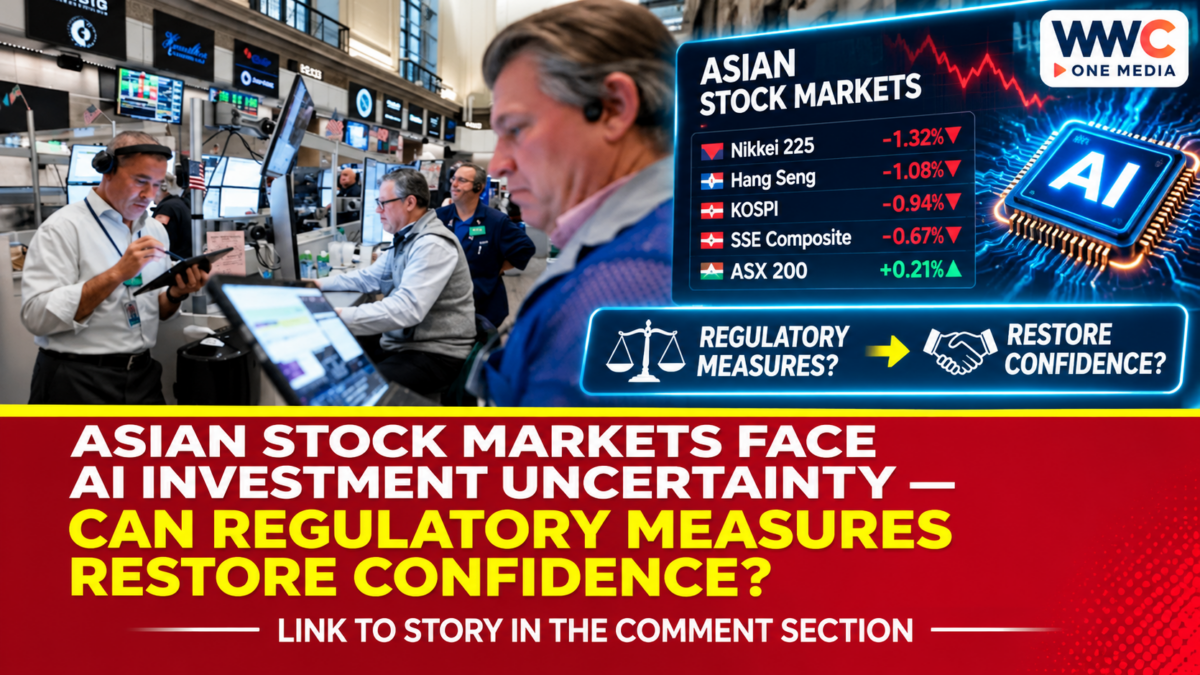
Taiwan’s benchmark stock index recovered 2.16% on Nov. 23, 2026, while South Korea’s financial regulator announced temporary changes to corporate share repurchase rules. The developments highlight the different responses to volatility across Asian stock markets as authorities confront uncertainty surrounding technology investment.
The recovery in Taiwan provides a counterpoint to fears of an indiscriminate regional crash. However, a single positive session does not establish that the preceding losses have been reversed or that concerns about artificial intelligence investment have disappeared.
Asian stock markets confront an uneven recovery
Taiwan’s TAIEX finished Monday at 36,811.89, gaining 778.60 points. The benchmark initially opened at 35,899.48 and reached a session low of 35,442.41 before recovering.
The improvement followed a difficult week. The index had ended Nov. 13 at 43,675.12 and Nov. 20 at 36,033.29. Monday’s advance therefore recovered only part of the earlier decline.
The historical losses are examined in WWC ONE MEDIA’s coverage of Taiwan’s stock market decline and emergency measures.
Japan, meanwhile, observed Labour Thanksgiving Day on Monday. Japan Exchange Group also confirmed that its derivatives markets would not conduct holiday trading because of scheduled disaster-recovery testing.
A regional comparison must account for such differences in trading schedules. An unchanged reference level from a closed exchange cannot be interpreted as a new session’s performance.
South Korea gives listed companies more flexibility
South Korea’s Financial Services Commission announced on Nov. 23 that it would temporarily relax restrictions on the daily quantity of share repurchase orders placed by listed companies.
The measure runs from Nov. 24, 2026, through Feb. 23, 2027. It follows an emergency government market review held on Nov. 22.
The commission identified uncertainty surrounding artificial intelligence, semiconductor businesses and possible US interest-rate increases as concerns affecting domestic market conditions.
WWC analysis: A share repurchase allows a company to acquire its own outstanding shares. Greater flexibility over the timing of purchase orders may help companies implement authorised programmes during volatile periods.
However, regulatory permission is not equivalent to an obligation to buy. Individual companies must still consider their financial capacity and competing uses for corporate cash. A temporary rule change cannot guarantee either higher share prices or a sustained recovery.
Technology gains do not tell the entire market story
Taiwan’s official sector statistics reveal a noticeable divergence during Monday’s session. Its semiconductor index rose 2.58%, while the electronics industry index gained 2.85%. The benchmark excluding electronics declined 0.25%.
These figures suggest that investors assessing the overall market should also examine the distribution of gains and losses across industries.
WWC’s previous examination of Asian technology shares and Nvidia’s earnings performance provides background on the distinction between commercial performance and market valuations.
WWC analysis: A company can report strong historical earnings while investors reduce their expectations for future profitability. Equally, a recovery in share prices can occur without a corresponding improvement in the underlying business during that particular session.
The important question is whether future customer demand and operating cash flow will justify the capital committed to new infrastructure. Monday’s closing prices cannot answer that question independently.
Borrowed money adds another dimension to market volatility
The Taiwan Stock Exchange’s published educational guidance explains how falling securities prices can place pressure on investors who finance purchases with borrowed funds. Collateral requirements and the possibility of forced sales are important features of these arrangements.
WWC analysis: Consider an investor who purchases shares partly with borrowed money. If those shares lose value, the debt does not automatically decline with them. The investor may need additional cash to maintain the position under the applicable lending agreement.
When multiple investors experience similar difficulties, selling undertaken to meet financial obligations could reinforce downward price pressure. That is a possible transmission mechanism, not a finding that forced liquidation caused Monday’s market movements.
Trading volume and turnover likewise require careful interpretation. Taiwan recorded total trading value of approximately NT$1.114 trillion on Monday. That measures transactions, rather than the amount of new money entering the market.
What the uncertainty means for Philippine businesses
For Philippine companies, regional technology volatility warrants attention to business fundamentals rather than automatic assumptions about domestic share prices.
WWC analysis: An electronics supplier may be exposed to changes in international orders, while a company financing technology infrastructure may be more sensitive to borrowing costs. Their risks are different even when both operate within the broader technology economy.
WWC’s earlier coverage of Anthropic’s public offering and the regional AI market sell-off examines another important distinction: capital can continue flowing into selected businesses while valuations decline elsewhere.
The Monday developments do not independently establish the direction of Philippine corporate earnings, domestic credit conditions or the peso. Those outcomes require separate economic and corporate evidence.
What happens next
South Korea’s temporary buyback rule takes effect on Nov. 24. Subsequent corporate disclosures may clarify whether listed companies use the additional flexibility available to them.
For Taiwan, later trading sessions will help establish whether Monday’s improvement develops into a sustained recovery. Investors can also examine corporate financial results and evidence of changes in business investment commitments.
Regulatory action may address immediate market pressures, but it cannot resolve every question about the commercial returns expected from AI infrastructure. The next test is whether financial markets and underlying business performance begin to support the same outlook.
Frequently asked questions
Did Taiwan’s stock market fall on Nov. 23, 2026?
No. The TAIEX rose 2.16%, ending the session at 36,811.89.
What measure did South Korea announce?
Its financial regulator temporarily relaxed daily corporate share repurchase order limits for the period Nov. 24, 2026, to Feb. 23, 2027.
Was Japan’s stock market open on Nov. 23?
No. The date was a scheduled market holiday.
Does Taiwan’s rebound prove that the AI sell-off is over?
No. One session’s performance cannot establish a lasting recovery or the future profitability of AI investments.