
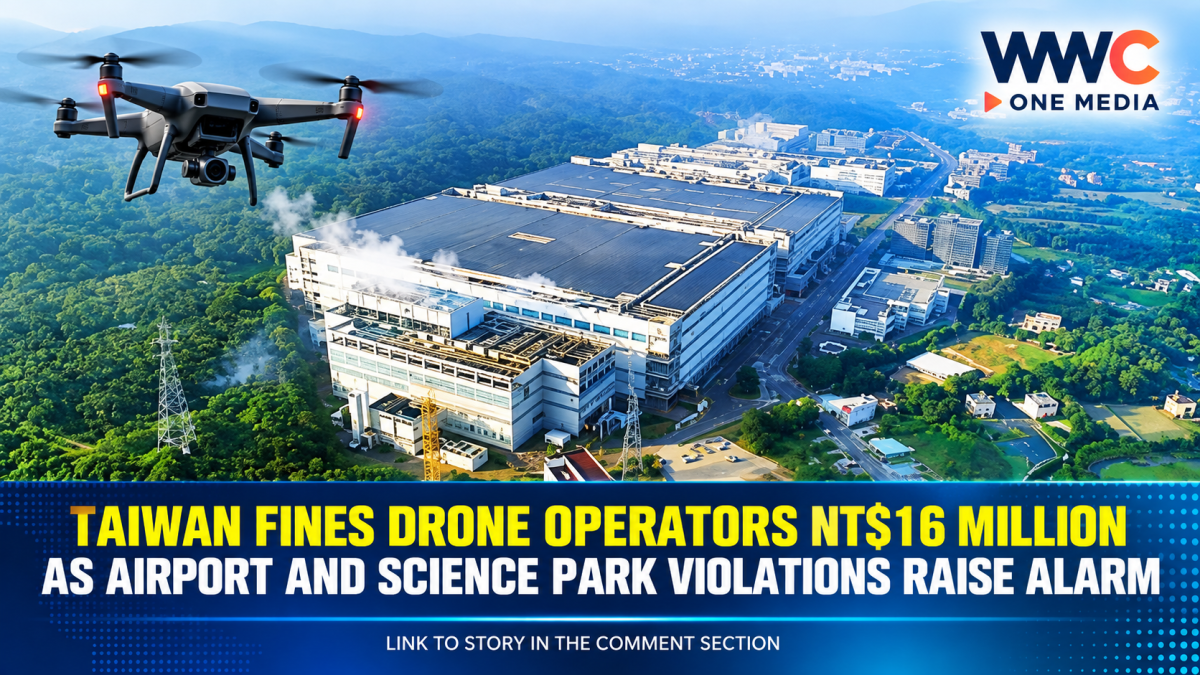
TAIPEI, Taiwan — Taiwanese authorities have fined drone operators a combined NT$16 million (US$505,849) in 72 cases over the past year and a half, with more than 80 percent of the violations occurring near airports, reservoirs and science parks.
The figures have renewed concerns over aviation safety, water security and the protection of Taiwan’s high-tech industries as drones become increasingly popular across the country.
The Civil Aviation Administration (CAA) said it fined drone operators in 47 cases last year and 25 cases in the first half of this year.
Of those violations, 24 occurred in restricted airspace around airports, 19 near reservoirs and 15 in science parks. The remaining cases involved other restricted locations, including Taipei Main Station and power plants.
Drone Near Taoyuan Airport Disrupts Flights
One recent incident highlighted the potential danger posed by unauthorized drone flights.
Last month, a drone-detection sensor was triggered inside the controlled area surrounding Taiwan Taoyuan International Airport, forcing both the north and south runways to temporarily suspend takeoffs and landings for 10 minutes.
The disruption affected nine flights.
Aviation experts warned that even a small drone can create a serious risk when commercial aircraft are taking off or landing.
Lu Yen-liang, director of the Department of Aviation Technology at Chaoyang University of Technology, said commercial aircraft travel at high speeds and relatively low altitudes during takeoff and landing.
A drone being sucked into an aircraft engine or colliding with an aircraft could potentially lead to a major disaster.
YouTuber Fined NT$330,000 Over Nuclear Plant Drone Flight
Authorities have also taken action against high-profile violations.
YouTuber Chung Ming-hsuan was fined NT$330,000 after illegally operating a drone near the Ma-anshan Nuclear Power Plant in June and failing to display the aircraft’s registration number, according to the CAA.
The case underscored the broad range of locations where drone flights are restricted because of safety and security concerns.
Taiwan’s restricted areas include not only airports, but also critical infrastructure such as power plants and reservoirs.
Reservoir Crashes Could Threaten Water Supplies
Experts said drone restrictions around reservoirs are designed to prevent more than just physical damage.
A drone crashing into reservoir facilities could damage equipment, contaminate water sources or trigger secondary accidents.
Power plants face similar concerns, with unauthorized aircraft potentially posing risks to sensitive infrastructure.
Under Taiwan’s Civil Aviation Act, people who operate drones without approval in prohibited areas such as reservoirs and science parks can face fines ranging from NT$30,000 to NT$1.5 million.
In serious cases, authorities can also confiscate the drone.
Science Parks Face Trade Secret Concerns
Taiwan’s science parks present another major challenge for authorities.
As centers of advanced semiconductor and high-tech manufacturing, the facilities contain sensitive equipment and valuable intellectual property.
Lu said science parks need protection from unauthorized aerial photography that could expose trade secrets.
A drone crash inside a science park could also damage sensitive equipment or injure workers.
The concerns are particularly significant for Taiwan, whose technology industry plays a central role in global semiconductor and artificial intelligence supply chains.
Taiwan’s importance to the global chip industry has made the protection of its high-tech infrastructure an increasingly important security issue.
More Than 36,000 Licensed Drone Operators
Despite the growing number of violations, drone use in Taiwan continues to expand.
CAA data showed that, as of the end of June, Taiwan had 36,066 valid drone licenses and 42,016 registered drones.
One drone operator told the Taipei Times that he checks the CAA’s official information before every flight to make sure drones are permitted in the area.
However, other operators may simply be unaware of the rules — or may knowingly take the risk.
Former National Cheng Kung University professor Melody Dai said enforcing restrictions around airports is a top priority because of the direct threat to aviation safety.
However, local government no-fly zones often have fewer resources and rely more heavily on reports from the public, meaning some violations could potentially go undetected.
Calls for Better Warnings for Beginners
Some drone operators say Taiwan needs to do more to make restrictions easier for new users to understand.
Drone operator Wu Ming-yang said notifications through government apps might not be enough for beginners, who could accidentally enter restricted airspace without fully understanding the regulations.
He called on retailers to place clearer warning labels on drones and do more to promote information about flight restrictions.
Wu also called for Taiwan to legalize drone flights during the 30 minutes before sunrise and after sunset, saying the change would help photographers capture better footage.
Authorities Urge Drone Users to Check Before Flying
The CAA has urged operators to check restricted areas before launching their drones.
Users can download the Ministry of Transportation and Communications’ Drone Map app or use the CAA’s drone management system to identify restricted airspace.
For authorities, the message is increasingly clear:
A drone may be small, but flying one in the wrong place can have serious consequences.
From temporarily shutting down airport runways to potentially exposing sensitive technology or threatening critical infrastructure, Taiwan’s growing drone industry is also creating a growing challenge for regulators.
As more drones take to the skies, authorities face increasing pressure to strike a balance between encouraging recreational and commercial drone use and ensuring that Taiwan’s airports, water supplies and critical infrastructure remain protected.
WWC ONE MEDIA J.M.D



Leave a Reply