
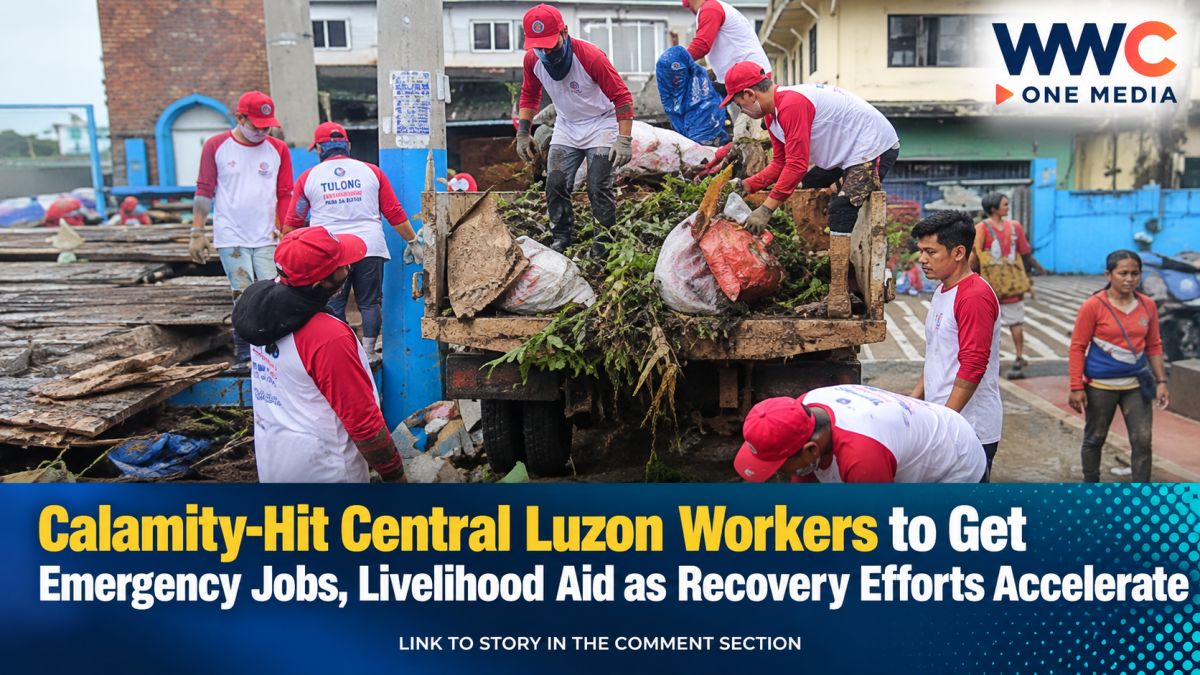
CENTRAL LUZON, Philippines — Thousands of workers affected by heavy monsoon rains and the enhanced southwest monsoon, or habagat, are set to receive emergency employment and livelihood assistance as the government steps up recovery efforts across Central Luzon.
The Department of Labor and Employment (DOLE) has allocated a combined ₱386.64 million for emergency employment and livelihood support for 49,879 affected workers in Bataan, Bulacan, Nueva Ecija, Pampanga and Tarlac.
The assistance is being delivered through DOLE’s Tulong Panghanapbuhay sa Ating Disadvantaged Workers (TUPAD) and DOLE Integrated Livelihood Program (DILP).
Nearly 49,000 workers lined up for emergency employment
The biggest portion of the package is going to TUPAD, which has been allocated ₱357.85 million for 48,667 beneficiaries across the five Central Luzon provinces.
Under TUPAD, qualified workers receive temporary employment while helping communities recover through activities such as cleanup operations, rehabilitation work and other community-based projects.
The program is designed to provide immediate income to workers whose livelihoods have been disrupted by disasters while also putting additional manpower into community recovery.
Labor Secretary Francis Tolentino said the approach addresses two needs at once: giving affected workers immediate financial support while helping them rebuild more sustainable sources of income.
Livelihood aid aims to help families rebuild
Beyond short-term employment, DOLE is allocating ₱28.79 million through its livelihood program for 1,212 beneficiaries.
The assistance will support a range of small-scale livelihood activities, including farming equipment, sari-sari stores and rice retailing, food vending, fishing, livestock, processing and repair services.
That distinction is important.
TUPAD provides temporary work and income during the recovery period, while DILP is intended to help beneficiaries establish or restore income-generating activities that can continue beyond the immediate disaster response.
Bulacan seeks additional emergency jobs
Bulacan could receive an additional round of support.
DOLE Regional Office III is seeking ₱22.487 million in additional funding from local government units to extend TUPAD assistance to 3,500 workers in Calumpit, Guiguinto, Hagonoy, Paombong, Bulakan, Angat and Sta. Maria.
If funded, beneficiaries would take part in 10- to 15-day emergency employment activities, including community cleanup and rehabilitation work following the heavy rains.
The proposed expansion reflects the continuing demand for temporary employment in communities that suffered disruption from the weather disturbances.
Central Luzon recovery goes beyond relief
The latest DOLE package forms part of a wider government response to weather-related damage.
Rather than limiting assistance to food and immediate relief, authorities are also trying to restore workers’ ability to earn—an especially important issue for informal workers, small entrepreneurs and families whose livelihoods depend on agriculture, fishing, vending and other weather-sensitive activities.
DOLE has reported that its broader livelihood and emergency-employment programs assisted more than 760,000 disadvantaged and informal workers nationwide during the first half of 2026, underscoring the scale of the government’s employment-support efforts.
From disaster survivors to income earners
For Central Luzon workers, the emergency jobs could provide a critical bridge between disaster and economic recovery.
A temporary paycheck can help families cover immediate expenses after flooding and prolonged rains, while livelihood assistance can give affected workers tools or capital to restart small businesses and other sources of income.
The challenge now is ensuring that the assistance reaches the workers who need it most and that temporary employment translates into a stronger recovery for communities.
As Central Luzon continues rebuilding after the monsoon’s impact, the government’s strategy is becoming clearer: relief alone is not enough—workers also need a way to earn again.
With nearly 50,000 workers targeted for assistance, the next question is how quickly these emergency jobs and livelihood projects can reach the communities still trying to recover.




Leave a Reply