
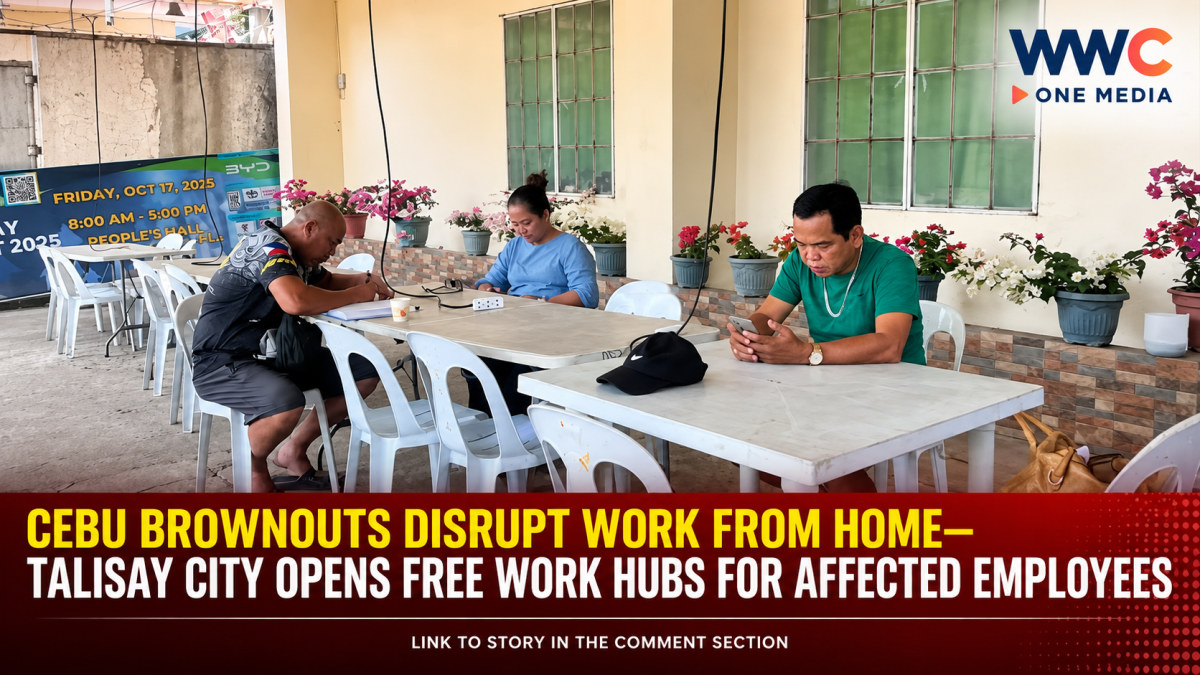
TALISAY CITY, Cebu — As recurring power interruptions continue to disrupt households and businesses across Cebu, Talisay City is offering a practical lifeline to residents who depend on electricity and internet connectivity to earn a living from home.
The city government has set up free work hubs for work-from-home (WFH) employees affected by power outages, giving residents an alternative place where they can continue working when their homes lose electricity.
The move comes as Cebu and other parts of the Visayas continue to experience rotational brownouts linked to tight electricity supply during periods of high demand.
According to the Philippine Information Agency, the National Grid Corporation of the Philippines (NGCP) recorded 96 yellow alerts and 33 red alerts on the Visayas Grid from January 1 to September 7, 2026, based on data cited by the Department of Energy.
A red alert means available supply is insufficient to meet demand and required reserves, while a yellow alert indicates that the operating margin is too low to meet contingency requirements.
A lifeline for Cebu’s WFH workforce
For employees whose jobs require stable electricity, internet access and uninterrupted online meetings, rotational brownouts can mean more than inconvenience.
Missed meetings, interrupted calls, lost work, disrupted online systems and reduced productivity can quickly become serious problems—particularly for employees working night shifts or handling time-sensitive tasks.
The impact is also being felt beyond individual households.
Recent reporting on Cebu’s power crisis found that businesses have been changing work schedules, using expensive generator sets and exploring solar power as prolonged rotational brownouts affect their operations. Business groups have warned that additional electricity and fuel costs could eventually put pressure on consumers.
The crisis has also affected students and other people who rely heavily on electricity. PIA reported that a Cebu IT student has had to plan coding work and online classes around rotational interruptions.
Why the brownouts are happening
Authorities have emphasized that the current rotational interruptions are largely connected to a regional supply shortage, rather than simply isolated problems with neighborhood distribution lines.
PIA reported that rotational interruptions are being implemented because electricity supply in the Visayas has fallen below demand during peak periods.
The situation has also been compounded by generating units being unavailable or operating at reduced capacity.
The Philippine News Agency previously reported that several major power plants in the Visayas had been forced offline or were operating at derated capacity, reducing available generation and increasing the possibility of manual load dropping.
Talisay has experience keeping workers connected
Talisay’s latest initiative also builds on the city’s previous experience providing alternative workspaces during power disruptions.
Following Typhoon Odette in 2021, Talisay City was among Cebu localities that hosted 24-hour work-sharing facilities for workers whose homes had lost electricity or connectivity. PNA reported that the workstations at Talisay City Hall helped employees maintain their jobs while communities recovered.
PLDT and Smart also previously supported digital workstations in Talisay and other Cebu localities, with the Talisay facility operating around the clock during that post-Odette initiative.
That experience underscores why accessible work hubs can be particularly important in a region where many workers depend on reliable electricity and connectivity.
The bigger problem remains unresolved
While free work hubs can help residents get through individual brownouts, they do not solve Cebu’s underlying electricity problem.
The Cebu Chamber of Commerce and Industry has warned that businesses are already adjusting operations because of the continuing power situation. Industry representatives have called for additional dependable generation capacity as well as improvements in transmission and distribution infrastructure.
The situation has also prompted calls for closer coordination among national energy agencies and the National Grid Corporation of the Philippines.
For Talisay residents working from home, however, the immediate priority is much simpler: find a place where the lights stay on long enough to finish the workday.
The city’s free work hubs provide exactly that temporary solution—while Cebu waits for a more permanent answer to its worsening power crunch.



Leave a Reply