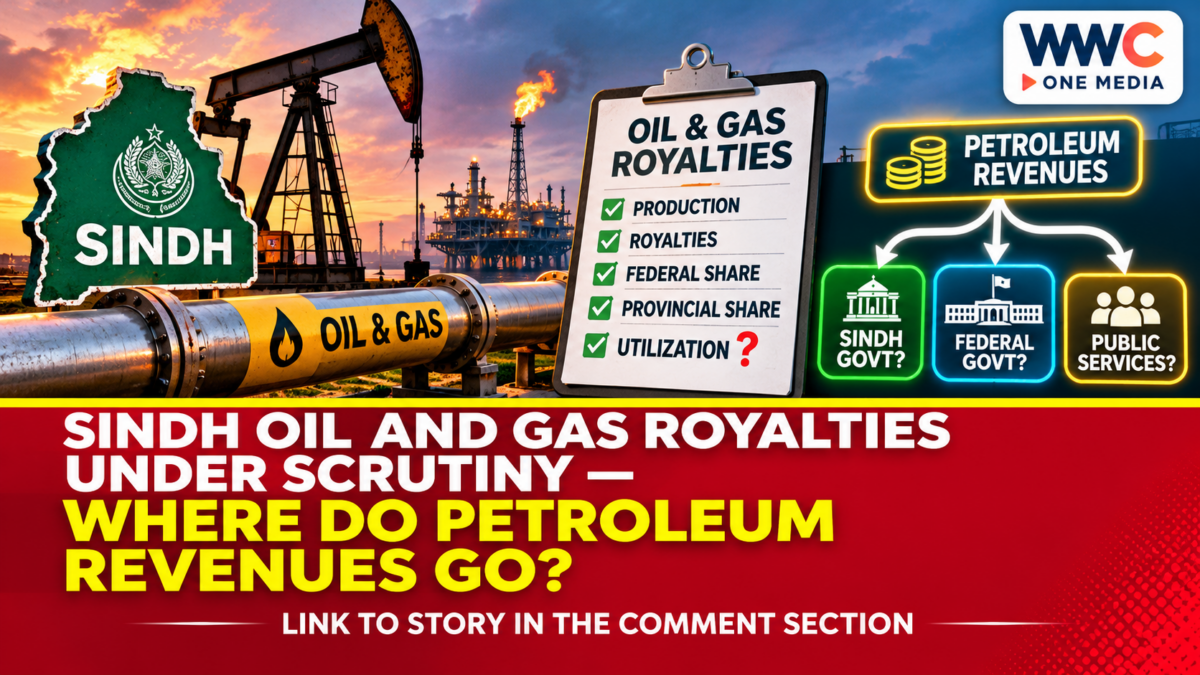
KARACHI, Pakistan — Pakistan’s Senate petroleum subcommittee has intensified its examination of how resource-related revenues are distributed among communities in Sindh, with a November 19 notice placing district-level financial records on the agenda of a November 23 meeting. The review follows an earlier parliamentary session on Nov. 6 that sought historical documentation of petroleum payments and their transfer to provincial governments.
The scrutiny of oil and gas royalties highlights a fundamental challenge for resource-producing regions: ensuring that revenue generated through extraction can be traced from government collection to actual community development.
The parliamentary process also raises questions about the relationship between provincial finances, energy infrastructure and the responsibilities of petroleum companies.
Oil and gas royalties face closer parliamentary examination
The Senate subcommittee, convened by Senator Jam Saifullah Khan Dharejo, requested a more detailed examination of financial arrangements involving petroleum-producing areas of Sindh during its November 6 meeting.
Its subsequent meeting notice called for provincial energy and finance officials to explain how royalties are distributed among producing districts.
The requested information covers government receipts, district allocations, cash releases, expenditure and unused balances.
Each represents a different stage in public financial management. Money recorded as an allocation does not necessarily mean that it has been transferred to the relevant spending authority. Similarly, transferred funds do not establish that a development project has been completed.
The distinction is important when assessing whether natural-resource revenues are producing measurable benefits.
The available official records establish parliamentary scrutiny, rather than a completed investigation or finding of financial misconduct.
Pakistan’s Constitution establishes provincial revenue rights
Article 161 of Pakistan’s Constitution provides for specified natural gas royalties and federal excise proceeds to be paid to the province where the relevant wellhead is located.
It also establishes provincial entitlement to specified federal excise proceeds associated with oil production.
These provisions provide a constitutional foundation for examining the relationship between petroleum production and provincial finances.
However, identifying the province entitled to receive particular revenues is different from establishing how much each district should subsequently receive.
District-level distribution requires examination of the applicable administrative arrangements and government accounts.
During the November 6 proceedings, petroleum officials explained that royalties were transferred to Sindh’s provincial government before subsequent district allocations.
WWC analysis: An effective accountability framework must therefore examine both the initial payment and the subsequent distribution. Reviewing only one stage could leave important questions unanswered about where financial resources ultimately go.
Why historical petroleum records matter
The subcommittee requested records covering approximately 10–15 years of petroleum royalty collections and provincial transfers during its earlier November meeting.
Dr. Nawaz Ahmed Virk, identified in the official proceedings as chairman of the Directorate General of Petroleum Concessions, informed lawmakers that a royalty of 12.5% of well production was payable.
That statement provides context for the financial review. It does not establish the amount owed by any particular petroleum operator.
Calculating actual liabilities would require examination of the applicable contractual terms, production records, relevant prices and accounting periods.
Lawmakers also requested information concerning production bonuses and other payments.
These should be evaluated separately rather than combined into a single royalty figure without examining their legal and accounting treatment.
For the Philippines, similar distinctions are relevant to WWC ONE MEDIA’s examination of Malampaya’s natural gas production and government revenue arrangements.
Pakistan and the Philippines operate under different petroleum frameworks. Nevertheless, both illustrate why transparent accounting is necessary to establish the public financial benefits associated with natural-resource production.
Producing communities need measurable development outcomes
The Senate subcommittee’s mandate also covers the implementation of a gasification directive affecting communities within five kilometres of specified petroleum-producing areas.
Its November 19 notice identifies Ghotki/Qadirpur, Tando Allah Yar, Tando Muhammad Khan, Badin and Sanghar among the areas covered by its monitoring responsibilities.
The November 6 proceedings also addressed employment, corporate social responsibility and community development initiatives.
These matters are connected to the wider discussion about the benefits of petroleum extraction, but they remain distinct from government royalty collections.
WWC analysis: The presence of a producing gas field does not, by itself, establish that nearby households have access to domestic gas services. Infrastructure construction, funding and the arrangements governing connections all require separate consideration.
A development programme should therefore be assessed through documented implementation rather than announced expenditure alone.
The same accountability principle applies to other extractive industries, including those examined in WWC’s coverage of Philippine mineral royalties and domestic economic benefits.
What a detailed financial audit could establish
A forensic audit, if formally commissioned, could provide a more detailed examination of financial transactions than a conventional review of budget estimates.
WWC analysis: Useful evidence would include reconciliations between company payment records, federal receipts, provincial accounts, district allocations and actual project expenditure.
Any differences would need to be assessed individually. Timing differences, accounting classifications or administrative delays can produce discrepancies without necessarily establishing misconduct.
An appropriately documented examination could distinguish these explanations from more serious accounting problems, should any be identified.
For petroleum operators, clear records could also reduce uncertainty about whether contractual financial obligations have been satisfied.
The relationship between resource production, public revenue and community welfare is likewise relevant to WWC’s earlier reporting on the proposed Semirara coal contract auction.
No verified audit findings establishing a specific financial loss in Sindh are presented in this report.
What happens next
The next important developments will be the official publication of the subcommittee’s November 23 conclusions, any formally authorised audit arrangements and the release of supporting financial documentation.
A reliable reconciliation would allow lawmakers and the public to distinguish amounts collected from those allocated, transferred and ultimately spent.
For Sindh, the central question is whether its petroleum revenues can be connected to documented public benefits.
That question cannot be answered by production figures or budget allocations alone. It requires credible financial records, clearly assigned institutional responsibilities and evidence of completed development programmes.
Frequently asked questions
Why are Sindh’s oil and gas royalties under scrutiny?
Pakistan’s Senate petroleum subcommittee has requested detailed information about royalty collections, district distributions and the utilisation of public funds.
What does Pakistan’s Constitution say about natural gas royalties?
Article 161 provides for specified natural gas royalty and excise proceeds to be transferred to the province where the relevant wellhead is situated.
Has a forensic audit established missing petroleum revenues?
No completed forensic audit establishing a specific financial loss was independently verified for this report.
Which communities are covered by the Senate’s gasification monitoring?
The official mandate identifies areas including Ghotki/Qadirpur, Tando Allah Yar, Tando Muhammad Khan, Badin and Sanghar.
Does receiving royalties guarantee local development?
No. Public benefits depend on how funds are distributed, spent and translated into completed projects.