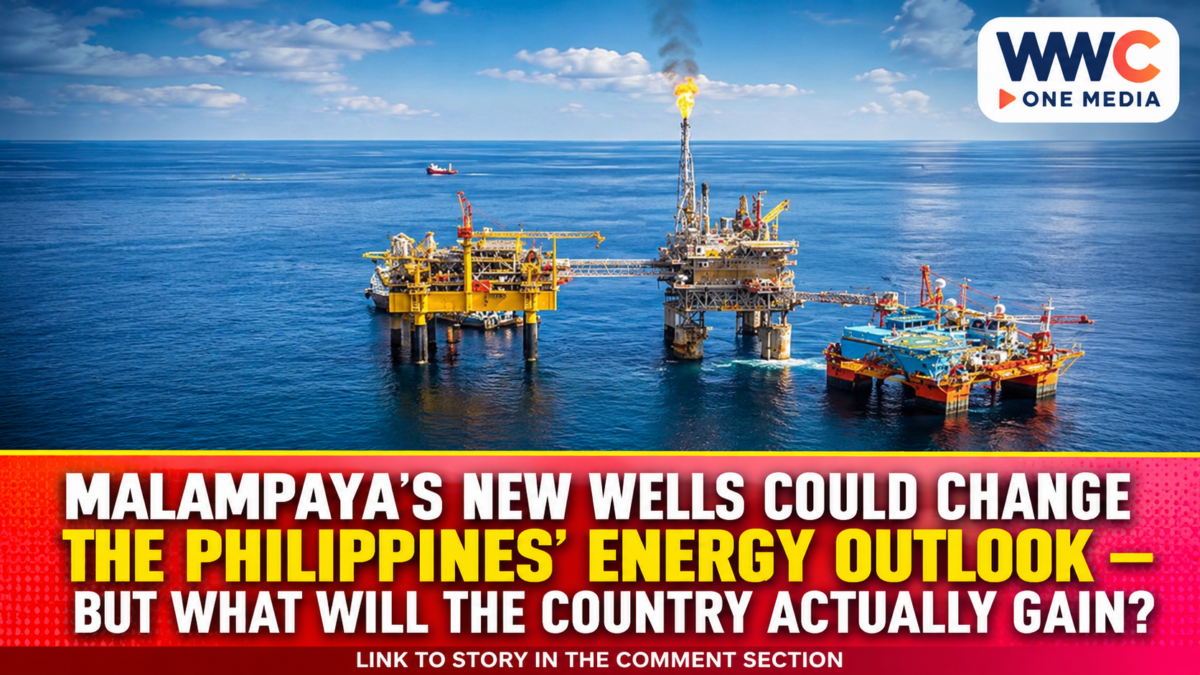
MANILA, Philippines — The Malampaya gas field has entered a new production phase after two deepwater wells began delivering natural gas to the country’s existing power infrastructure, giving the Philippines more time to use its own offshore energy resources.
The development could strengthen electricity supply in Luzon and generate additional economic value from a project that has contributed billions of dollars to government revenues. But the long-term benefit will depend on how much gas the wells actually deliver, how efficiently the resource is used and how the government accounts for its share of the proceeds.
The Department of Energy (DOE) confirmed that Malampaya Phase 4 (MP4) has achieved first gas, marking the introduction of newly developed domestic natural gas into the production system. The milestone follows the completion of the Malampaya East-1 and Camago-3 wells offshore Palawan.
Malampaya’s new wells bring additional gas into production
The two wells form the central part of MP4, a development programme designed to reinforce the existing Malampaya gas field.
Gas from the wells passes through the Shallow Water Platform offshore Palawan and the existing 504-kilometre subsea pipeline before reaching the Onshore Gas Plant in Batangas. From there, the fuel is supplied to gas-fired power plants serving the Luzon grid.
The DOE estimates that MP4 will add 222 billion cubic feet of natural gas to the country’s resource base. That volume is equivalent to approximately 14 billion kilowatt-hours of electricity, or enough to meet the annual electricity requirements of roughly 5.7 million Filipino households.
The department also projects that the additional gas could extend Malampaya’s production life by approximately six years, to around 2034.
These figures describe the estimated resource and its potential electricity equivalent. They should not be interpreted as a guarantee that every unit of gas will be produced, converted into electricity or delivered to consumers without operational constraints.
The project is significant because it adds new production to a field that has been supplying the country for decades.
Why Malampaya still matters to the power sector
Malampaya has remained an important source of domestic natural gas since commercial operations began in 2001.
The DOE says the project currently provides approximately 20% of Luzon’s power requirements. Its gas supports power generation at facilities connected to the existing supply network, making the field an important part of the region’s electricity mix.
The renewed production comes as the Philippines continues to manage concerns over power reliability, fuel availability and the cost of electricity.
Natural gas can provide dispatchable generation, meaning gas-fired plants can produce electricity when required, subject to available fuel and operating conditions. This can complement renewable energy sources whose output may vary with weather and time of day.
However, domestic gas production does not automatically translate into lower electricity bills. Generation costs also depend on fuel pricing, plant efficiency, supply contracts, transmission charges and other components of the electricity market.
The country’s continuing power challenges are evident in other parts of the grid. WWC ONE MEDIA previously examined how tight electricity supply and generating-plant constraints affected the Visayas.
For Luzon, additional Malampaya gas can improve the availability of fuel for power generation. Whether consumers experience a direct price benefit will depend on how the additional supply affects actual generation costs and market conditions.
The government’s share is built into the service contract
Malampaya’s financial importance is not limited to the value of the gas sold to power producers. The project also operates under a government service contract that determines how proceeds are divided between the State and its contractors.
In its February 2025 decision involving Service Contract No. 38, the Supreme Court discussed the contract’s revenue-sharing provisions. Section 7.3 provides that 60% of the net proceeds from petroleum operations must be remitted to the government, while Section 7.4 allows contractors to retain the remaining 40% as a service fee.
The arrangement reflects the structure of petroleum service contracts, under which private contractors undertake operations and provide the required technology and financing.
The Supreme Court decision also addressed a long-running dispute over the treatment of contractors’ income taxes under the original Malampaya arrangement. The Court granted the consolidated petitions, reversed the challenged Commission on Audit decisions and lifted the 2010 Notice of Charge.
That case concerned the interpretation and implementation of the existing contract. It should not be confused with a new royalty calculation arising from MP4.
The distinction matters because government earnings from the additional wells will depend on actual production, sales, operating costs and the applicable contractual accounting rules. A projected revenue figure is not the same as money already received by the Treasury.
What additional production could mean for public revenues
The economic value of MP4 will be measured over time, not simply by the announcement of first gas.
As the wells produce and deliver gas, the project can generate proceeds subject to the service contract’s revenue-sharing framework. The government’s share can support public finances, while the continued operation of the field can help sustain domestic energy supply.
The Malampaya project has already made a substantial contribution to the country. The project consortium’s official website says the field has generated more than US$14 billion in revenues for the Philippine government over the past two decades.
That historical contribution provides context for the importance of extending production. It does not, however, establish the amount that MP4 alone will contribute in future years.
The actual financial outcome will depend on production performance and the commercial conditions under which the gas is sold.
The issue is especially relevant as the Philippines considers other energy infrastructure investments, including liquefied natural gas facilities. WWC ONE MEDIA has examined the country’s wider pipeline of proposed fuel, LNG and infrastructure projects.
Domestic gas and imported LNG can both support gas-fired generation, but they expose the country to different supply and price considerations. Malampaya’s continued output gives the Philippines access to an indigenous resource, while imported fuel remains subject to international market conditions.
Exploration remains important beyond Phase 4
The completion of MP4 does not remove the need to identify future sources of domestic energy.
The DOE has said it wants to sustain exploration activities and encourage investment in conventional energy resources through the Philippine Conventional Energy Contracting Program.
That direction reflects a wider challenge: existing fields eventually decline, and new discoveries require substantial capital, technical capability and time before they can contribute to commercial production.
The development of Malampaya East-1 and Camago-3 also demonstrates the scale of work involved in offshore exploration. Deepwater drilling, subsea infrastructure and connections to existing facilities require coordinated engineering and investment.
Natural gas, meanwhile, remains a fossil fuel. Its role in the country’s energy mix must be considered alongside the expansion of renewable energy, energy efficiency and improvements to the electricity grid.
The Philippines’ exposure to international fuel markets also reinforces the importance of diversifying its energy sources. Global gas-market movements can influence the cost of imported supplies, as explored in WWC ONE MEDIA’s report on changing positions in the international natural gas market.
What happens next
The next major measure of MP4’s success will be its production performance over time.
The DOE and the project consortium will need to monitor the wells’ output, the reliability of the associated infrastructure and the volume of gas delivered to power plants.
Actual production and sales data will also be important in assessing the financial contribution of the new wells. These records can help establish whether the project is meeting its expected output and how much value is ultimately generated for the government.
For consumers, the key question is whether the additional domestic supply can help support dependable electricity generation at competitive costs.
For the government, the challenge is to ensure that the country receives the contractual share of proceeds while maintaining a policy environment that supports responsible investment in domestic energy resources.
Malampaya’s new wells have extended the field’s productive potential. The next test is whether that additional resource can translate into reliable power, measurable public revenue and a stronger energy position for the Philippines.
Frequently asked questions
What is Malampaya Phase 4?
Malampaya Phase 4 is a development programme involving two new deepwater wells, Malampaya East-1 and Camago-3, together with subsea infrastructure connected to the existing Malampaya facilities.
How much additional natural gas will the project provide?
The DOE estimates that MP4 will add 222 billion cubic feet of natural gas to the country’s resource base.
How long could the new wells extend Malampaya’s production?
The DOE estimates that the additional gas could extend the field’s production life by approximately six years, to around 2034.
How much of Malampaya’s net proceeds goes to the government?
Under Sections 7.3 and 7.4 of Service Contract No. 38, 60% of net proceeds from petroleum operations goes to the government, while contractors retain 40% as a service fee.
Will the new wells automatically lower electricity bills?
No. Additional domestic gas can support power generation, but electricity prices also depend on fuel costs, plant operations, supply contracts, transmission charges and market conditions.