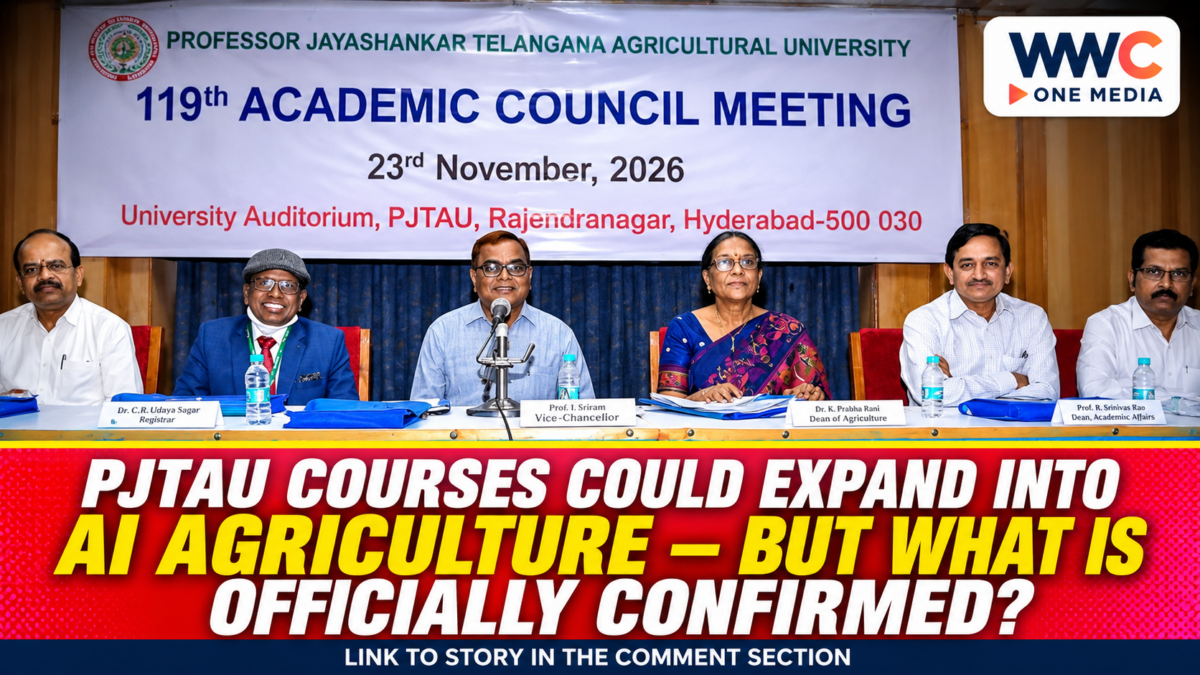
HYDERABAD — November 24, 2026 — Professor Jayashankar Telangana Agricultural University (PJTAU) is drawing attention over reported plans for new undergraduate courses in artificial intelligence and food science, alongside a proposed statewide farmer outreach campaign for early 2027. However, the university’s publicly accessible admission information does not yet confirm the reported new programmes or publish an official schedule for the proposed tours.
The distinction matters for prospective students and farming communities. PJTAU already has established food and nutrition programmes, agricultural research facilities and extension services, while its own publications have documented training on artificial intelligence in agriculture. But an existing academic capability is not the same as formal approval of a new degree. Students should wait for an official prospectus or admission notification before making decisions based on the reported expansion.
PJTAU courses: What the current admission record shows
PJTAU’s publicly accessible admission information for the 2026–27 academic year identifies B.Tech programmes in Agricultural Engineering and Food Technology among its undergraduate options under the MPC stream.
The university’s current online admission page also provides application information, fee details and supporting documents for applicants. The page reviewed does not list a B.Tech in Artificial Intelligence in Agriculture or a new B.Sc. in Food Science and Dietetics.
That absence should be interpreted carefully. A website that has not yet been updated does not prove that an academic proposal was rejected or never discussed. It does mean, however, that applicants do not yet have a publicly available admission notice establishing the new programmes, their eligibility requirements, intake capacity or application dates.
For students, those details are essential. A course title alone cannot establish whether a programme is accepting applications, whether it has received all required approvals or what qualifications applicants must meet.
The university’s official admissions and academic information should therefore remain the reference point for students until formal notifications are published.
Food science is already part of the university’s academic work
PJTAU’s existing academic structure provides important context for the reported interest in a new food-science degree.
Its Department of Foods and Nutrition is part of the College of Community Science. The department says it began its postgraduate programme in 1968 and introduced doctoral studies in 1978.
Its academic work covers food science, food processing and preservation, food safety, quality assurance, product development, clinical nutrition, dietetics and public health nutrition.
The department’s published student experiences also identify an existing undergraduate qualification in B.Sc. (Hons.) Food Science and Nutrition. This is relevant because the reported proposed B.Sc. in Food Science and Dietetics should not be confused with the university’s existing food and nutrition education.
A new programme could have a different curriculum, qualification structure or professional emphasis. But without the approved syllabus and official course notification, it would be premature to describe the reported proposal as an entirely new academic field at the university.
The university’s Department of Food and Nutrition provides the clearest public account of its current teaching and research areas.
AI in agriculture is not a new subject for PJTAU
The university has also documented earlier academic engagement with artificial intelligence.
In its April–June 2023 institutional newsletter, PJTAU reported organising a guest lecture titled “Artificial Intelligence in Agriculture and Allied Sectors.” The session was arranged by the Placement Cell of the College of Agriculture, Rajendranagar.
The university publication said the lecture covered potential AI applications across agricultural operations, horticulture and animal husbandry. Around 105 undergraduate, postgraduate and doctoral students from the Rajendranagar college attended, while 150 participants from other university locations joined online.
That record demonstrates that AI-related agricultural learning was already part of the university’s capacity-building activities several years ago.
It does not, however, establish that PJTAU has approved a four-year B.Tech degree in Artificial Intelligence in Agriculture, nor does it independently confirm a proposed partnership with IIT Hyderabad and BITS Pilani.
A formal degree programme requires more than a lecture or academic collaboration. Students need an approved curriculum, faculty arrangements, admission rules, infrastructure and a clear statement of the qualification they will receive.
The wider agricultural sector is increasingly exploring digital tools, including data analysis, remote sensing, automation and decision-support systems. WWC has examined the regional dimension of that shift in its report on ASEAN’s resilient agriculture plan and the role of research, education and technology.
For universities, the challenge is to connect technological instruction with actual farm conditions rather than treating AI as a subject that exists only in classrooms.
Farmer outreach depends on extension services reaching communities
The reported Rythu Bharosa Yatras would place a different responsibility on the university: bringing scientific information directly to farmers.
PJTAU already has an established extension structure. Its website lists regional research stations, Krishi Vigyan Kendras and other extension-related services. These institutions help connect research, agricultural recommendations and farming communities.
The Government of Telangana’s Socio-Economic Outlook 2025 also documents the Rythu Nestham programme, which uses video-conferencing facilities at Rythu Vedikas to connect farmers with scientists and extension officers.
The government report records 566 video-conferencing units installed at Rythu Vedikas across 532 rural mandals. It says 40 episodes had been organised by January 7, 2025, benefiting 410,457 farmers, including 76,102 women farmers.
This provides evidence of an existing system for distributing agricultural information. It also shows why additional field-based campaigns could be useful if they are properly organised and supported.
However, the public records reviewed do not confirm the reported January–February 2027 schedule for statewide Rythu Bharosa Yatras. Nor do they establish which districts would be covered, how many teams would participate or what specific advice would be delivered.
For farmers, those practical details matter more than the campaign name. Useful outreach should provide locally relevant guidance on crop selection, water management, pest control, weather risks and access to agricultural services.
Why climate pressures make agricultural education important
Agricultural universities operate in an environment where weather variability, water availability and production costs can affect decisions at farm level.
Research and extension services are important because farmers need information that reflects local soil, crop and climate conditions. A recommendation suitable for one district may not be appropriate for another.
The Philippines has faced similar questions about the connection between agricultural research, infrastructure and practical support. WWC’s report on a Kalinga irrigation project designed to improve water access for farmers illustrates why agricultural resilience requires more than advice: farmers also need reliable infrastructure and resources.
The same principle applies to Telangana. Training campaigns can help farmers understand available technologies and practices, but their impact depends on whether farmers can access water, equipment, quality inputs, extension officers and suitable markets.
A university-led outreach programme should therefore be assessed by its reach, the relevance of its advice and whether farmers can use the information after the campaign ends.
What happens next
The next important step is formal documentation from PJTAU.
For the reported new degrees, students should look for an official university notification, approved programme details, eligibility criteria, intake information and the next academic year’s prospectus. If the courses involve external institutional partners, the university should also clarify the nature of those arrangements.
For the reported farmer tours, the relevant confirmation would be an official university or Telangana Agriculture Department announcement identifying the campaign dates, districts, participating teams and planned activities.
Until those documents become publicly available, the reported proposals should not be treated as confirmed admissions opportunities or a final statewide outreach schedule.
PJTAU’s existing record already shows work in food and nutrition education, AI-related agricultural training and farmer extension. The question now is whether its next academic and outreach initiatives will be formally approved, adequately resourced and made accessible to the people they are intended to serve.
Frequently asked questions
Is PJTAU introducing a B.Tech in Artificial Intelligence in Agriculture?
The programme has been reported as a proposal, but the publicly accessible university admission information reviewed does not yet confirm it as an approved course open for admission.
Does PJTAU already offer food-science education?
Yes. Its Department of Foods and Nutrition documents existing academic work in food science, food processing, nutrition and dietetics. The university also identifies an existing B.Sc. (Hons.) Food Science and Nutrition qualification.
Has PJTAU officially announced the January 2027 Rythu Bharosa Yatras?
An official schedule confirming the reported January–February 2027 campaign was not located in the public university and government records reviewed.
Has PJTAU previously conducted AI-related agricultural training?
Yes. Its April–June 2023 newsletter documents a guest lecture on artificial intelligence in agriculture and allied sectors for students and other participants.
Where can students check PJTAU admission announcements?
Students should monitor the university’s official website, admission notices, prospectus and published course catalogues for confirmed programme details.