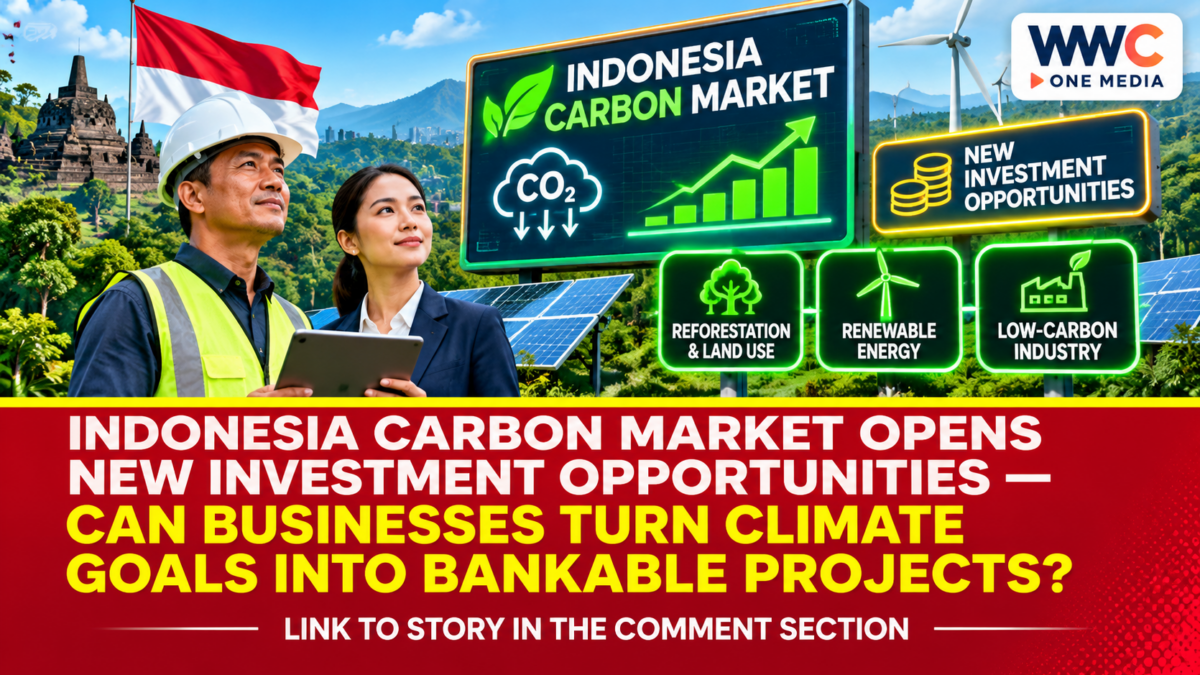
JAKARTA — Indonesia’s efforts to attract private investment into its energy transition gained further momentum following a Nov. 23, 2026, update from the Global Green Growth Institute on its REDI4JET initiative. The programme brings businesses and financial institutions into discussions about developing cleaner energy projects and accessing carbon-related financing.
The Indonesia carbon market presents a potential additional income stream for eligible investments. However, turning environmental commitments into commercially viable infrastructure requires more than establishing a marketplace for emissions reductions.
Businesses must also address regulatory requirements, financing costs, project preparation and the interests of affected communities.
Indonesia carbon market develops a stronger regulatory framework
Indonesia inaugurated international trading through IDXCarbon on Jan. 20, 2025, following the establishment of its domestic carbon exchange in 2023.
At the international launch, authorities identified 1.78 million tonnes of carbon dioxide equivalent in authorised carbon units originating from energy-sector activities.
The amount represented authorised units at that time, rather than confirmed sales or investment proceeds.
Indonesia subsequently updated its regulatory framework through Presidential Regulation No. 110 of 2025 and Financial Services Authority Regulation No. 10 of 2026, which took effect on July 6.
The revised exchange rules broaden the categories of eligible units and establish requirements for recording them in the Carbon Unit Registry System, known as SRUK. They also address certain foreign carbon units and extend relevant financial consumer-protection principles to market participants.
WWC analysis: These changes make regulatory preparation increasingly important. A developer should establish whether a proposed project satisfies applicable requirements before treating future credit sales as a dependable source of income.
Businesses face the challenge of developing financeable projects
The REDI4JET programme is supported by the International Climate Initiative, with Indonesia’s Coordinating Ministry for Economic Affairs as its principal government partner.
The implementing consortium comprises the Global Green Growth Institute, Climate Policy Initiative and Perspectives Climate Research.
Its planned activities include investment preparation assistance and two pilot project-design documents for potential emissions-reduction activities.
The initiative also intends to assess the support required by businesses seeking to participate in carbon markets.
WWC analysis: A renewable-energy developer may possess suitable land, access to technology and an environmental objective without having secured construction financing.
Potential lenders would still need to evaluate expected electricity sales, development expenditure, contractual arrangements and the project’s ability to repay borrowed money.
Carbon-credit income could improve the project’s financial outlook, but its contribution would depend on whether eligible reductions are achieved and whether buyers are available.
These considerations are particularly relevant to Southeast Asian infrastructure development, as explored in WWC ONE MEDIA’s coverage of regional cooperation on island solar power and reduced diesel dependence.
International carbon financing offers a separate commercial opportunity
Article 6 of the Paris Agreement provides mechanisms for international cooperation on emissions reductions.
Article 6.2 addresses reporting and accounting arrangements for internationally transferred mitigation outcomes, while Article 6.4 establishes an international crediting mechanism overseen within the United Nations climate framework.
For businesses, the distinction between developing an emissions-reduction project and qualifying for an international transfer is important.
A project may generate environmental benefits without automatically producing carbon units eligible for a particular buyer or market.
WWC previously examined Norway’s carbon-credit purchase programmes involving Indonesia and Morocco, which illustrate how international climate cooperation can be connected to renewable infrastructure.
WWC analysis: Project developers should distinguish between proposed credit volumes, issued units, completed transfers and actual payments. These represent different stages of commercial implementation.
A large theoretical emissions reduction does not necessarily establish that an equivalent amount of credit revenue will be received.
Carbon credits cannot replace sound project economics
The commercial value of carbon financing depends on the circumstances of individual developments.
Consider a hypothetical renewable power facility that expects to generate income through electricity sales and eligible carbon credits.
If construction costs rise or the project produces fewer qualifying credits than anticipated, expected financial returns could deteriorate.
A developer relying heavily on future credit income could encounter financing difficulties if issuance or sales take longer than expected.
WWC analysis: Project financial models should therefore account for the possibility of delayed payments, lower credit prices and additional verification expenditure.
Such analysis does not diminish the potential importance of carbon finance. Instead, it distinguishes supplementary project revenue from guaranteed funding.
Financial institutions may also benefit from examining whether borrowers can support their obligations under less favourable market conditions.
A just energy transition must consider workers and communities
REDI4JET’s planned stakeholder consultation extends beyond commercial organisations to civil society, including issues involving community safeguards, consent, complaints and the distribution of benefits.
This dimension distinguishes a socially inclusive transition from a programme concerned exclusively with investment volumes.
WWC analysis: A financially successful energy project may still face implementation difficulties if affected communities have unresolved concerns or if the distribution of economic benefits lacks transparency.
Businesses should consider these issues during project preparation rather than treating them as administrative matters to address after investment decisions.
For Philippine readers, similar implementation questions arise in efforts to connect environmental planning with actual infrastructure spending.
WWC’s earlier examination of DENR partnerships and local government climate projects highlights why institutional coordination matters when environmental objectives require investment.
Indonesia and the Philippines have separate regulatory systems, but both offer relevant contexts for examining the relationship between sustainable investment and community welfare.
What happens next
Further REDI4JET activities are planned for 2027, following work to identify the needs of participating organisations.
The next meaningful developments will include the preparation of potential mitigation projects, technical assistance and evidence that developers can secure financing under applicable market rules.
The November announcement does not establish that the proposed pilot projects have reached financial close or generated saleable carbon credits.
Indonesia’s evolving regulatory framework provides a basis for expanding carbon-related investment. Its commercial significance will ultimately depend on actual project delivery, credible emissions reductions and transparent financial arrangements.
For businesses, the opportunity is not simply participating in an emerging market. It is developing projects capable of delivering both measurable environmental benefits and sustainable commercial outcomes.
Frequently asked questions
What is the Indonesia carbon market?
It is a framework through which eligible carbon units can be traded, including through Indonesia’s regulated carbon exchange, IDXCarbon.
What is REDI4JET?
It is an initiative intended to support investment preparation and an inclusive energy transition in Indonesia.
Can renewable-energy projects earn carbon-credit revenue?
Potentially, if they satisfy the applicable eligibility, verification, registration and commercial requirements.
Does REDI4JET guarantee financing for participating businesses?
No. The announced assistance and project-preparation activities do not constitute guaranteed financing or investment returns.
When will further REDI4JET activities take place?
Additional capacity-building and project-development activities are planned for 2027.