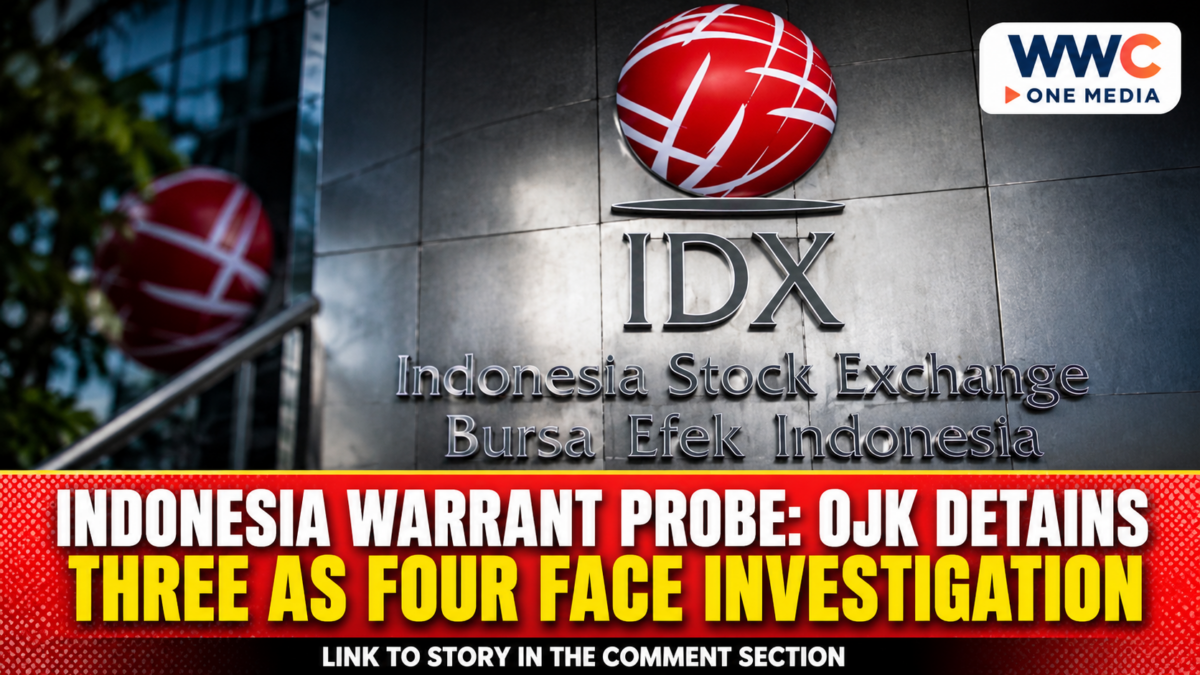
Indonesia’s financial regulator has detained three people in an investigation into suspected manipulation involving equity warrants and structured warrants traded on the Indonesia Stock Exchange. The case concerns transactions dated May 29, 2023, while a fourth suspect is being processed separately by Jakarta police.
The investigation matters because the alleged conduct, as described by the regulator, involved the use of other people’s identities and bank accounts to open securities accounts and fund transactions. OJK estimates that the alleged activity caused losses of about Rp6.97 billion, but the figure remains an investigative estimate, not a court-established finding. OJK
Indonesia warrant probe centres on trades from May 2023
OJK’s Nov. 16, 2026, press release says its investigators detained three private-sector employees: JF, also known as O; FS; and S. They were placed in the detention facility of the Indonesian National Police’s Criminal Investigation Agency, known as Bareskrim, for the purposes of the investigation.
The regulator also identified a fourth suspect, TGB, also known as T, who works at a securities company. OJK said this individual was undergoing legal proceedings in a separate case handled by the Jakarta Metropolitan Police, or Polda Metro Jaya.
The distinction is important: OJK announced the detention of three people in this investigation, while describing four suspects in the alleged trading activity. The fourth person was not described as being detained alongside the other three in this case. OJK
The suspected transactions took place on May 29, 2023. OJK said the securities involved were Series I Warrants of PT Chemstar Indonesia Tbk, identified by the code CHEM-W; Series I Warrants of PT Era Media Sejahtera Tbk, identified as DOOH-W; and three structured warrants: ADRODRCM3A, BUKADRCV3A and INCODRCX3A.
The regulator’s release identifies the instruments involved in the investigation. It does not, by itself, establish that the companies whose securities underlie or are associated with those instruments committed wrongdoing.
OJK describes alleged use of other people’s identities and bank accounts
The regulator’s account centres on how securities accounts were allegedly created, managed and funded.
OJK said the suspects allegedly bought or obtained other people’s identities to open and manage multiple securities accounts. It also alleged that transaction funding was channelled through bank accounts belonging to other parties.
The regulator said the suspected activity created a false or misleading picture of trading activity, market conditions or securities prices on the exchange. These are allegations in an ongoing criminal investigation, not findings that have been established through a final court judgment.
The alleged use of third-party identities and accounts is significant because securities trading depends on reliable account ownership and transaction records. If investigators establish that accounts or funding sources were misrepresented, the case could raise questions about the effectiveness of identity checks, account supervision and trading surveillance.
That is an analysis of the issues raised by the regulator’s description. OJK’s release does not provide a transaction-by-transaction account, identify the individual account holders or explain how each suspect allegedly participated.
Rp6.97 billion is an estimated loss, not a final ruling
OJK placed the estimated loss connected to the alleged conduct at approximately Rp6.97 billion.
The regulator did not publish a detailed calculation in the release. It did not provide a breakdown by security, account, transaction or affected investor. The amount should therefore be described as OJK’s estimate in the investigation, rather than a final measure of damages or a confirmed amount recoverable by investors.
The case also should not be treated as proof that every trade in the named warrants was improper. The regulator identified specific instruments and a particular trading date. The public statement does not establish that all holders, buyers or sellers of those instruments were involved in the alleged conduct.
WWC has previously examined the wider questions facing Indonesia’s equity market, including concerns about transparency and the risk of a market downgrade. The present case is a separate enforcement matter; it should not be treated as proof of every broader concern raised in debates about Indonesia’s market structure.
Investigation began before the November detentions
OJK said the case developed from its market supervision and examination work. The matter moved through preliminary inquiry and into the investigation stage under an investigation warrant issued in May 2026.
The sequence shows that the Nov. 16 detentions were not described as the starting point of the case. They came after regulatory monitoring and investigative steps that began months earlier.
OJK said the suspects were charged under provisions of Indonesia’s Capital Market Law, including Article 104 in conjunction with Article 91 and/or Article 92 of Law No. 8 of 1995. The regulator also referred to amendments under Law No. 4 of 2023 on Financial Sector Development and Strengthening and Law No. 1 of 2026 on Criminal Adjustments.
The precise legal outcome will depend on the investigation and subsequent proceedings. The detention announcement does not amount to a conviction.
Why warrant-market oversight matters
The case highlights the importance of credible trading records in markets where investors buy and sell instruments with specific contractual features.
For regulators, the central issue described by OJK is not simply that particular warrants changed hands. It is the allegation that the trading activity may have presented a misleading picture of market activity, conditions or prices.
That distinction matters. Market prices are useful only when investors can have reasonable confidence that trading reflects genuine orders and properly identified accounts. Alleged use of third-party identities and bank accounts can undermine that confidence if proven.
WWC has also explained the separate Philippine regulatory framework for structured warrants and the safeguards required for those products. That framework is not Indonesian law, but it offers local readers a useful reference for understanding why product disclosures, investor suitability and oversight matter when new warrant products enter a market.
Indonesia’s case also arrives amid wider scrutiny of its equity market. WWC’s earlier reporting on the sharp decline in Indonesian stocks and concerns about foreign investor confidence provides background, although the OJK investigation should be assessed on its own evidence and legal process.
What happens next
OJK said the three detained suspects were being held to support the investigation. It also said it would continue coordinating with the Indonesian National Police and the Attorney General’s Office on financial-sector criminal cases.
The next meaningful developments would be further official information about the investigation, any formal prosecutorial steps and, eventually, judicial findings. Until then, the allegations, the estimated loss and the roles attributed to the suspects must remain clearly identified as matters under investigation.
For investors, the immediate lesson is to distinguish between an instrument being named in a regulatory case and a finding that its issuer or every market participant was involved. The public record currently establishes the regulator’s allegations and enforcement steps—not a final verdict.
Frequently asked questions
How many people were detained in Indonesia’s warrant-trading case?
OJK said three people were detained on Nov. 16, 2026. It also identified a fourth suspect who was being processed in a separate case handled by Polda Metro Jaya.
How much money was allegedly lost?
OJK estimated the alleged losses at approximately Rp6.97 billion. The regulator did not publish a detailed calculation in its announcement.
Which securities were named in the investigation?
The release named CHEM-W, DOOH-W, ADRODRCM3A, BUKADRCV3A and INCODRCX3A.
When did the suspected transactions take place?
OJK identified May 29, 2023, as the trading date involved in the alleged conduct.
Have the suspects been convicted?
The Nov. 16 announcement concerns detention and an ongoing investigation. It does not report a final court judgment or conviction.