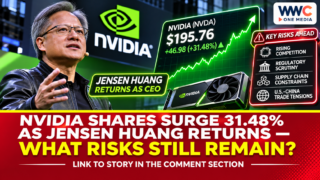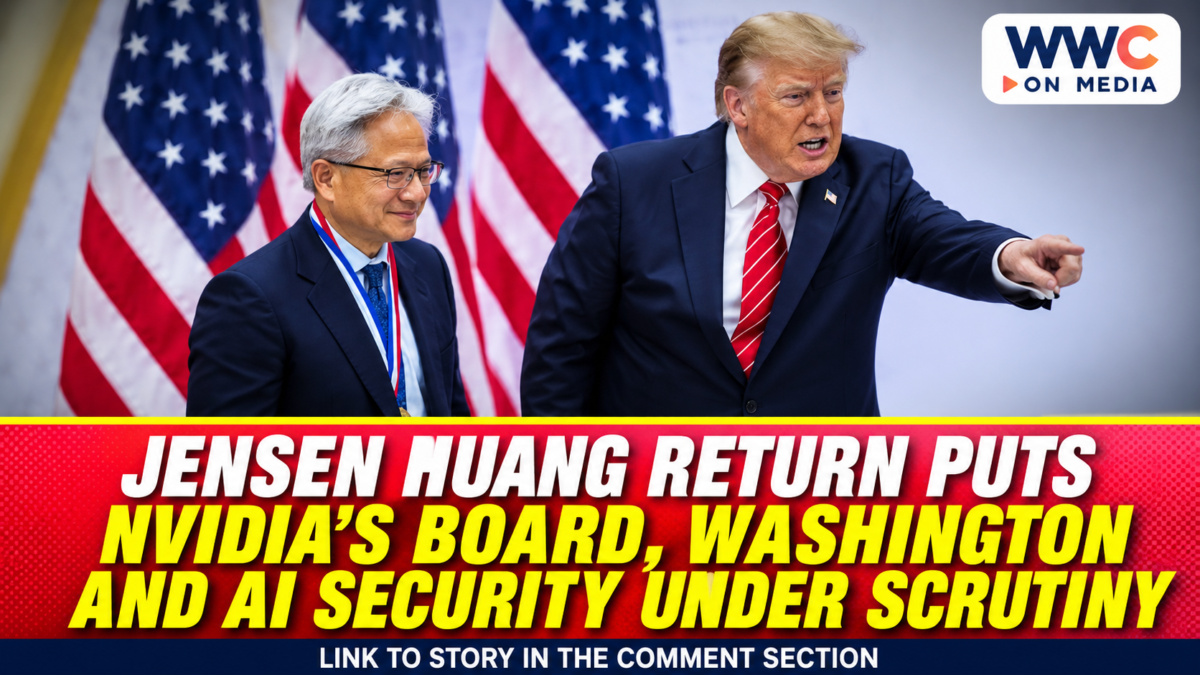
SANTA CLARA, California — November 24, 2026. Nvidia has reinstated Jensen Huang as president and chief executive officer, reversing his departure from the company’s top position less than two weeks earlier. The board’s November 23 announcement also disclosed that senior US government officials had provided input into its decision, while confirming that internal investigations and government inquiries would continue.
The decision restores the company’s most recognisable executive to its leadership at a time when Nvidia’s position in the artificial intelligence industry is expanding rapidly. But the return does not close the questions surrounding corporate oversight, the protection of sensitive technology or the movement of advanced processors through international supply chains.
For investors and technology customers, the distinction is important: leadership continuity has been restored, but the compliance and national-security issues identified by the company and US lawmakers remain unresolved.
Jensen Huang Return Reverses Nvidia’s Leadership Transition
Nvidia announced on November 23 that its board had unanimously reinstated Huang, effective immediately, as president and chief executive officer and as a member of the board.
The company said the directors reached the decision after discussions and meetings with Huang. It stated that the board was satisfied with his candor and ability to lead the business.
One detail stands out in the announcement: Nvidia said the board received input from senior levels of the US government before making its decision. The company added that, based on that input, the board was confident Huang’s reinstatement posed no national-security risk.
However, Nvidia did not identify the government officials involved, describe the information they provided or explain whether the input related to a specific investigation or a broader assessment.
The announcement therefore confirms government involvement in the board’s deliberations, but it does not establish the precise role played by President Donald Trump or any individual administration official.
That distinction matters. A board decision remains a corporate governance action, even when government advice forms part of the decision-making process. NVIDIA Newsroom
Two Oversight Processes Will Continue Despite the Return
Nvidia’s announcement makes clear that Huang’s reinstatement does not end the company’s internal scrutiny.
The board said a committee composed solely of independent directors is continuing an investigation into reports that Huang had been the target of a foreign-intelligence effort. The committee has retained independent legal counsel, and the company said Huang supports the investigation and will cooperate.
Separately, Nvidia disclosed that it had established a National Security and Export Control Committee, also composed solely of independent directors. Its mandate is to oversee trade-compliance and national-security risks.
The company also said it was beginning a search for a chief compliance officer. The new executive is expected to oversee compliance across Nvidia and report to the board’s Nominating and Corporate Governance Committee.
These are significant organisational steps because they create separate oversight responsibilities rather than treating the issue as solely a question of executive leadership.
They also show that the board has not presented Huang’s return as a final resolution of the concerns. The investigations are expected to proceed to completion, while Nvidia says it will continue cooperating with government inquiries. NVIDIA Newsroom
Congress Still Wants Answers From Nvidia’s Leadership
The corporate decision comes as US lawmakers prepare to question Huang and another senior Nvidia executive.
A November 17 announcement by three House committee chairmen said Huang and Nvidia General Counsel Tim Teter had voluntarily agreed to participate in transcribed interviews before the House Foreign Affairs Committee, the Select Committee on the Chinese Communist Party and the House Intelligence Committee.
The announced schedule places Huang’s interview on December 1, with Teter due to appear on December 2.
The committees said they wanted answers about Nvidia’s role in a potential national-security breach and the possible access of restricted Chinese actors to advanced American chips. These are the committees’ stated investigative concerns, not findings that Nvidia or Huang committed an offence.
The distinction is particularly important because an agreement to appear before congressional committees does not establish guilt or wrongdoing. The interviews are an opportunity for lawmakers to gather information and examine the company’s safeguards.
WWC previously examined the congressional questioning scheduled for Huang and the wider national-security concerns surrounding the chipmaker. That earlier coverage provides context for why his reinstatement does not remove the pending political and regulatory questions.
For Nvidia, the interviews will test whether the company can provide a clear account of its controls, customer relationships and handling of sensitive technology. Republican Foreign Affairs Committee
Nvidia’s China Exposure Remains a Business Risk
The scrutiny surrounding Nvidia cannot be separated from the strategic importance of advanced AI processors.
The company’s latest financial results, released November 17, reported third-quarter fiscal 2027 revenue of US$115.8 billion, up 103% from a year earlier. Data Center revenue reached US$107.6 billion, reflecting the scale of demand for computing infrastructure.
But the company’s outlook also highlighted a major geographic limitation: Nvidia said its fourth-quarter forecast did not assume any Data Center compute revenue from China.
That is not a declaration that every Nvidia product is barred from China. It is a specific forecast assumption covering Data Center compute revenue.
The company’s earlier regulatory filing also described the practical difficulty of completing sales even when US export licences were available. Nvidia reported that Chinese government restrictions had prevented it from selling all H200 products covered by US licences. It also disclosed a US$400 million charge during the first half of fiscal 2027 associated with H200 excess inventory and purchase obligations.
Those disclosures help explain why export controls are not simply a question of whether a government approves a shipment. Manufacturers must also consider destination-country rules, customer eligibility, inspection requirements and whether a transaction can be completed commercially.
WWC has previously examined how Nvidia’s China sales outlook differs from the question of whether individual export licences have been issued. It has also reported on the wider US regulatory challenge surrounding advanced AI chip exports.
The broader point is that Nvidia’s growth and its exposure to geopolitical restrictions can exist at the same time. Strong global revenue does not eliminate the risks created by limited access to a major technology market. NVIDIA Newsroom+1
A CEO’s Return Does Not Replace Corporate Controls
Huang’s return restores leadership continuity at a company whose products have become central to the global AI infrastructure buildout. But the board’s own disclosures indicate that the next phase will involve more than resuming normal executive duties.
The creation of an independent national-security and export-control committee, the continuing investigation and the planned chief compliance officer position suggest that Nvidia is adding oversight mechanisms while government scrutiny continues.
That approach may help reassure customers, suppliers and shareholders that the company is treating compliance as a board-level responsibility. However, the effectiveness of those measures will depend on their actual authority, independence and ability to identify problems before they become regulatory or commercial crises.
The board has not published the findings of its continuing investigation. Nor has the company provided a detailed account of the government input it received before reinstating Huang.
For now, the public record supports a narrower conclusion: Nvidia has restored its chief executive, but it has not declared the underlying questions closed.
What Happens Next
The next major scheduled development is Huang’s December 1 transcribed interview with the three House committees, followed by Teter’s appearance on December 2.
Nvidia’s independent directors are also expected to continue their investigation, while the company begins its search for a chief compliance officer. The newly established National Security and Export Control Committee will have an ongoing role in overseeing the company’s trade-compliance and national-security risks.
The details that emerge from those processes will matter more than the leadership announcement alone. Investors and customers will be watching for evidence that Nvidia can maintain its AI growth while strengthening the controls required to operate in a politically sensitive semiconductor market.
Huang is back in the chief executive’s office. Whether the company can restore confidence in its governance and compliance systems remains a separate test.
Frequently Asked Questions
1. Has Jensen Huang returned as Nvidia CEO?
Yes. Nvidia announced on November 23, 2026, that its board unanimously reinstated Huang as president and chief executive officer, effective immediately.
2. Did Donald Trump personally order Nvidia to reinstate Huang?
Nvidia disclosed that its board received input from senior levels of the US government. Its announcement did not identify the officials involved or establish that President Donald Trump personally ordered the reinstatement.
3. Are investigations involving Nvidia and Jensen Huang over?
No. Nvidia said its independent-director committee investigation would continue. The company also confirmed the creation of a separate National Security and Export Control Committee.
4. When will Jensen Huang appear before US lawmakers?
The House committee announcement scheduled Huang’s transcribed interview for December 1, 2026. Nvidia General Counsel Tim Teter is scheduled for December 2.
5. Does Nvidia expect to earn Data Center compute revenue from China in its next quarter?
Nvidia’s November 17 financial outlook said it was not assuming any Data Center compute revenue from China in its fourth-quarter fiscal 2027 forecast. This does not mean every Nvidia product category is necessarily excluded from the Chinese market.