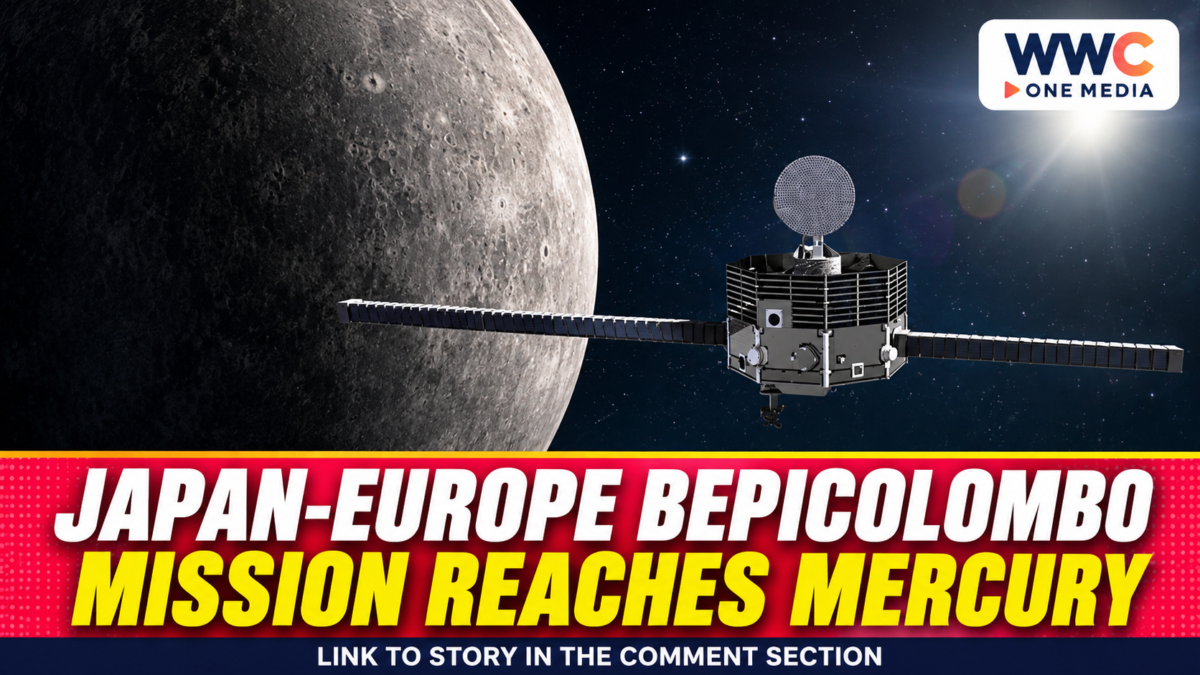
TOKYO — November 24, 2026. The Japan Aerospace Exploration Agency (JAXA) and the European Space Agency (ESA) have achieved a major milestone in the BepiColombo mission, placing the combined spacecraft in orbit around Mercury on November 21. The arrival came with an unexpected complication: a software issue interrupted the first major thruster burn, forcing the spacecraft into safe mode before the manoeuvre was completed.
The spacecraft is safe and in a stable orbit, ESA confirmed on November 23. The incident has not, at this stage, displaced the planned December separation of Japan’s Mio orbiter and Europe’s Mercury Planetary Orbiter (MPO). That distinction is important: the mission has reached Mercury, but the two scientific spacecraft have not yet begun independent orbital operations. ESA+1
The next phase will determine how the two orbiters are deployed and prepared for detailed observations. After eight years of travel, the mission is moving from a complex interplanetary journey into the demanding work of studying the planet itself.
The BepiColombo Mission Reaches Orbit, but the First Burn Falls Short
The orbit-insertion manoeuvre began at 18:24 UTC on November 21, as the spacecraft passed about 635 kilometres above Mercury’s surface. ESA had planned a 37-minute firing of four axial thrusters to slow the spacecraft and secure its orbit.
After contact was re-established, mission controllers found that the manoeuvre had stopped early and the spacecraft had entered safe mode. ESA’s analysis found that the burn delivered around 77% of the planned velocity change. The agency later confirmed that BepiColombo had nevertheless achieved Mercury orbit capture and was in a stable orbit. ESA
ESA traced the anomaly to a software issue involving attitude guidance and thruster control. The agency said its teams and Airbus, the lead spacecraft manufacturer, were investigating the issue. The mission’s planned sequence of later manoeuvres was adjusted to account for the spacecraft’s new trajectory. ESA
The episode is a reminder that reaching a destination and completing a mission are different achievements. Orbit insertion is a critical step, but the spacecraft must still carry out additional operations before its instruments can begin their main scientific work.
Why Japan and Europe Built Two Orbiters for One Planet
BepiColombo is a joint mission led by ESA in cooperation with JAXA. It carries two scientific orbiters designed to examine different aspects of Mercury: ESA’s MPO and JAXA’s Mio, also known as the Mercury Magnetospheric Orbiter.
The spacecraft were launched together aboard an Ariane 5 rocket from French Guiana on October 20, 2018. Their route involved nine planetary swing-by manoeuvres, using the gravity of Earth, Venus and Mercury to alter the spacecraft’s trajectory and gradually reduce the energy needed to reach the innermost planet. Mercury Magnetospheric Orbiter MIO+1
The two orbiters have different scientific assignments. Mio is designed to study Mercury’s magnetic field, magnetosphere, plasma environment, thin atmosphere and dust. MPO will examine the planet’s surface, mineral and chemical composition, interior structure, gravity and magnetic field. Mercury Magnetospheric Orbiter MIO
This division allows researchers to investigate Mercury as both a physical world and a planet surrounded by a dynamic space environment. Measurements of the surface alone cannot explain how the planet interacts with the solar wind or how its magnetic environment behaves.
Mercury’s Extreme Environment Makes the Mission Unusually Demanding
Mercury is the closest planet to the Sun, and its environment creates difficult conditions for spacecraft operations. JAXA’s mission information says sunlight around Mercury is about ten times as intense as it is near Earth. The planet’s surface can also reach temperatures of up to 430 degrees Celsius. Mercury Magnetospheric Orbiter MIO
Mio’s design includes reflective surfaces and heat-management measures to limit the amount of solar energy absorbed by the spacecraft. MPO uses a heat shield and an attitude-control system intended to keep sensitive equipment protected from intense sunlight. Mercury Magnetospheric Orbiter MIO
The long journey was also a matter of orbital mechanics, not simply distance. A direct route towards Mercury would require substantial energy to counter the Sun’s gravitational pull. The series of planetary flybys allowed BepiColombo to change its speed and direction through carefully planned gravitational interactions.
The mission’s eight-year journey therefore reflects the difficulty of reaching a stable orbit around a small planet so close to the Sun.
December Separation Is the Next Major Test
The next major milestone is the separation of Mio from MPO. ESA’s November 23 update said the separation remained on track for December 9 in Germany, corresponding to December 10 in Japan. The Japanese mission fact sheet also lists the separation for December 9 UTC, or December 10 Japan time. ESA+1
The two orbiters will then move towards their respective operational configurations. Mio is expected to use an extended elliptical orbit, while MPO will gradually lower its orbit for closer study of the planet. The mission design calls for the spacecraft to observe Mercury from different orbital heights and perspectives. Mercury Magnetospheric Orbiter MIO
The separation is not a ceremonial event. It is a complex operation involving spacecraft configuration, deployment and subsequent orbit adjustments. The teams must also verify the condition of the spacecraft and their scientific instruments before routine observations can begin.
For context, Japan’s other deep-space missions face similar demands for long-duration spacecraft management. WWC has reported on Hayabusa2’s revised asteroid mission, where the condition of ageing propulsion equipment forced JAXA to change its original plan.
What Mercury Could Reveal About Planet Formation
Mercury is one of the least explored planets in the inner Solar System. Its unusually large metallic core, magnetic field and proximity to the Sun make it an important subject for understanding how rocky planets formed and evolved.
The mission’s two-orbiter design is intended to connect observations of the planet’s interior and surface with measurements of the surrounding magnetic and plasma environment. Researchers can compare how Mercury’s magnetic field interacts with the solar wind and how that interaction changes around the planet.
That work could help scientists test explanations of Mercury’s internal structure and geological history. It may also improve understanding of how planets behave in environments exposed to intense stellar radiation.
The broader space sector is also developing the infrastructure needed to support increasingly complex missions. WWC has examined Mitsubishi Electric’s investment in European launch capabilities, while its coverage of asteroid-deflection modelling explores another field where accurate navigation and reliable scientific data are essential.
What Happens Next
The immediate priority is to complete the investigation into the software anomaly while carrying out the remaining orbit-adjustment manoeuvres. ESA has said the early-ending burn did not require additional manoeuvres in the remaining orbit-insertion sequence and did not affect Mio’s planned separation or MPO’s ability to reach its intended science orbit. ESA
The December separation will be followed by spacecraft and instrument checks. The scientific phase is planned to begin in April 2027, according to ESA’s mission schedule. ESA+1
For now, BepiColombo has achieved the difficult task of entering Mercury orbit. The next measure of success will be whether both orbiters can separate, settle into their intended paths and deliver the observations that justified the long international effort.
Frequently Asked Questions
1. Did Japan and Europe successfully reach Mercury?
Yes. The combined BepiColombo spacecraft entered Mercury orbit on November 21, 2026. The spacecraft was in a stable orbit after an early-ending thruster burn.
2. What caused the BepiColombo thruster problem?
ESA traced the interruption to a software issue involving attitude guidance and thruster control. The agency said the spacecraft entered safe mode after the burn stopped early.
3. What is Japan’s Mio spacecraft designed to study?
Mio will investigate Mercury’s magnetic field, magnetosphere, plasma, thin atmosphere and dust.
4. When will Mio separate from Europe’s MPO?
The planned separation is December 9, 2026, in Germany, corresponding to December 10 in Japan.
5. When will BepiColombo begin its main science mission?
The scientific phase is planned to begin in April 2027, after separation, orbit adjustments and instrument checks.