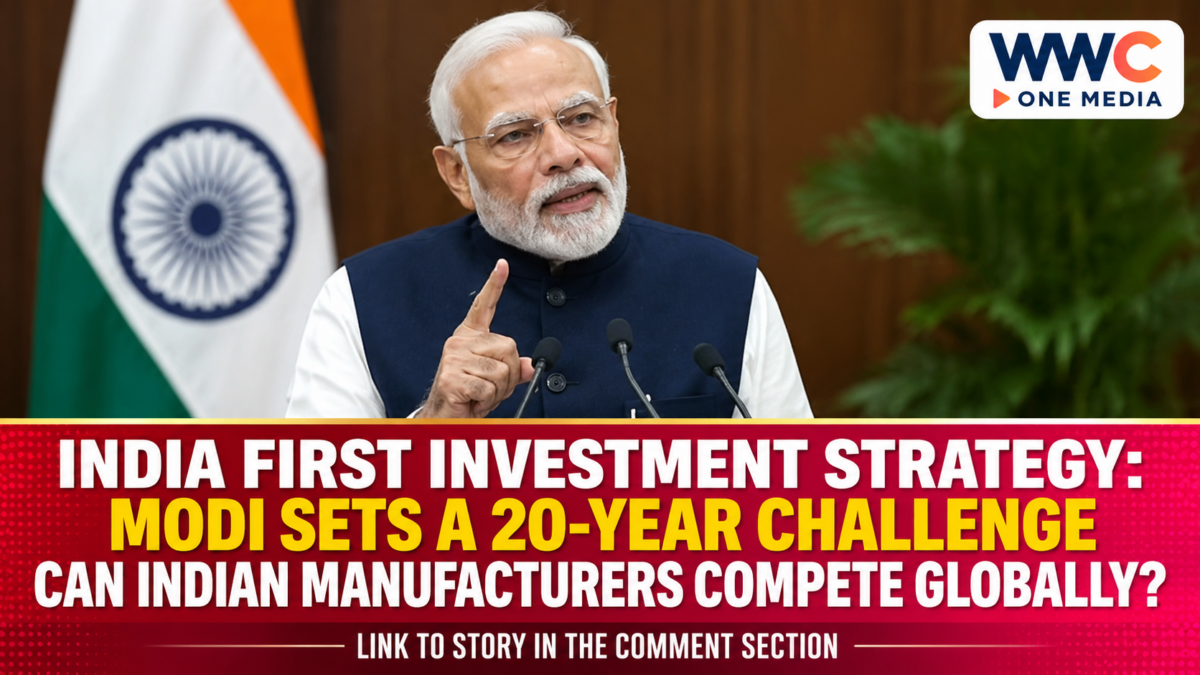
NEW DELHI, India — Indian Prime Minister Narendra Modi has urged businesses to adopt an India First investment strategy over the next 20 years, placing domestic industrial development at the centre of the country’s long-term economic ambitions.
Speaking at the Federation of Indian Chambers of Commerce and Industry (FICCI) annual convention on Nov. 19, 2026, Modi challenged companies to develop stronger manufacturing capabilities and produce goods capable of competing internationally.
The appeal comes as India’s merchandise exports approach US$50 billion in a single month. However, the country’s substantial import requirements highlight a more complicated industrial challenge: increasing the economic value retained within India rather than simply expanding the volume of goods sold overseas.
For corporate leaders, the next phase of industrial growth could require a significant reassessment of where companies invest, how they source materials and which products they develop.
India First investment strategy targets industrial capabilities
The prime minister’s address placed particular emphasis on investments that could strengthen India’s productive capacity over the coming two decades.
His appeal was not limited to expanding established businesses. Modi encouraged industry leaders to identify emerging commercial opportunities and prepare for changes in international demand.
The distinction matters because expanding an existing factory is not necessarily the same as developing new industrial expertise.
A manufacturer may increase production while continuing to depend on imported machinery, specialised materials and proprietary technologies. Although such expansion can generate employment and revenue, it may leave critical stages of production outside the domestic economy.
An investment strategy focused on building technical capabilities could help companies capture a greater share of the value generated throughout their supply chains.
However, the commercial viability of those investments would still depend on financing costs, productivity, technological expertise and customer demand.
These considerations extend beyond headline economic growth, as explored in WWC’s examination of the debate surrounding India’s economic performance.
Strong export figures reveal a deeper industrial challenge
India’s Department of Commerce reported merchandise exports of US$49.47 billion in October 2026, compared with US$34.11 billion during the same month in 2025.
Merchandise imports reached US$89.35 billion, up from US$76.69 billion a year earlier.
Engineering goods generated US$12.74 billion in October export earnings, while electronic goods contributed US$6.64 billion.
The figures demonstrate the scale of India’s participation in international trade. They also show that substantial export earnings can coexist with even larger import requirements.
A trade deficit does not automatically indicate industrial weakness. Imports can include machinery, technology and production materials that support future economic activity.
The more meaningful question is whether businesses are using those imported resources to develop increasingly sophisticated products and sustainable domestic capabilities.
For Philippine readers, this challenge has a familiar parallel. WWC’s coverage of the Philippines’ electronics-driven export expansion examines the importance of securing greater economic value from participation in international manufacturing networks.
Pharmaceutical and metals industries face new opportunities
Modi identified pharmaceutical ingredients and specialised metal products as areas where Indian companies could expand domestic capabilities.
The pharmaceutical example illustrates the difference between manufacturing a finished product and controlling the industrial processes necessary to produce its ingredients.
Developing upstream production can offer companies greater flexibility in procurement and potentially reduce exposure to external supply disruptions.
But pharmaceutical manufacturing requires more than investment capital. Businesses must also account for technical validation, regulatory requirements, quality assurance and production consistency.
A similar economic principle applies to metals.
Selling raw materials and manufacturing specialised industrial products represent different commercial opportunities. Higher-value manufacturing may offer greater revenue potential, but it also demands engineering expertise, specialised equipment and dependable customers.
Companies considering these investments would need to evaluate whether domestic facilities could compete with established international suppliers without sacrificing quality or affordability.
Agriculture and machinery could broaden the manufacturing base
The prime minister also encouraged businesses to explore opportunities in agricultural processing and industrial equipment.
For agricultural enterprises, the opportunity lies in developing commercially differentiated products rather than relying entirely on unprocessed commodities.
A food-processing investment, for example, could connect farmers with manufacturers, packaging businesses, logistics providers and international distributors.
Success would depend on more than factory capacity. Reliable procurement, consistent product specifications, food safety and access to buyers would remain essential.
Industrial machinery presents another potential avenue for expansion.
Manufacturers capable of developing equipment suited to specific commercial needs could build relationships with customers across multiple markets.
Such opportunities would also create a case for closer cooperation between major industrial groups and smaller specialist suppliers.
The objective should be to build commercially sustainable production networks rather than pursue domestic manufacturing regardless of its cost.
What India’s industrial ambitions could mean for the Philippines
WWC analysis: India’s manufacturing push deserves attention from Southeast Asian economies seeking to attract long-term industrial investment.
International manufacturers evaluating new production facilities must consider infrastructure, workforce capabilities, energy reliability, regulatory conditions and supplier availability.
India’s industrial ambitions could introduce additional competition for projects that might otherwise be considered for Southeast Asian locations.
However, industrial development does not necessarily create a zero-sum competition between countries.
Philippine and Indian companies could potentially develop complementary commercial relationships in specialised manufacturing, business services, technology and distribution.
WWC’s analysis of changing ASEAN supply chains and Philippine investment opportunities explores why domestic competitiveness remains important even when international production networks are expanding.
For Philippine policymakers, the relevant lesson is that attracting a factory represents only one stage of industrial development. Building the supplier networks, technical expertise and research capabilities that encourage companies to remain and expand can be equally important.
What happens next?
The prime minister’s address sets a direction for industrial investment, but it does not establish a binding corporate spending requirement or guarantee that new manufacturing projects will materialise.
The next meaningful developments would be company announcements identifying specific projects, financing arrangements, production schedules and commercial partnerships.
Investors and policymakers should also examine whether future manufacturing expansion produces measurable improvements in productivity, product quality and domestic industrial capabilities.
Import substitution alone would not establish international competitiveness if locally manufactured alternatives remain considerably more expensive or fail to meet customer requirements.
India’s next industrial test, therefore, is not simply whether companies can manufacture more products domestically.
It is whether they can manufacture products that customers around the world would willingly choose on the strength of their quality, reliability and commercial value.
Frequently asked questions
What is Modi’s India First investment strategy?
It is an appeal for Indian businesses to prioritise long-term investments that strengthen domestic industrial capabilities and support international competitiveness.
When did Modi announce his investment priorities?
He outlined the priorities during the FICCI annual convention in New Delhi on Nov. 19, 2026.
Which industries could benefit from the strategy?
The address identified pharmaceutical ingredients, specialised metals, agricultural processing and machinery manufacturing as areas with potential for industrial development.
How much did India export in October 2026?
India recorded merchandise exports of US$49.47 billion during October 2026.
Is the investment strategy legally mandatory?
The address presented an appeal to businesses rather than a binding investment requirement. Individual projects would remain subject to commercial decisions and applicable regulations.