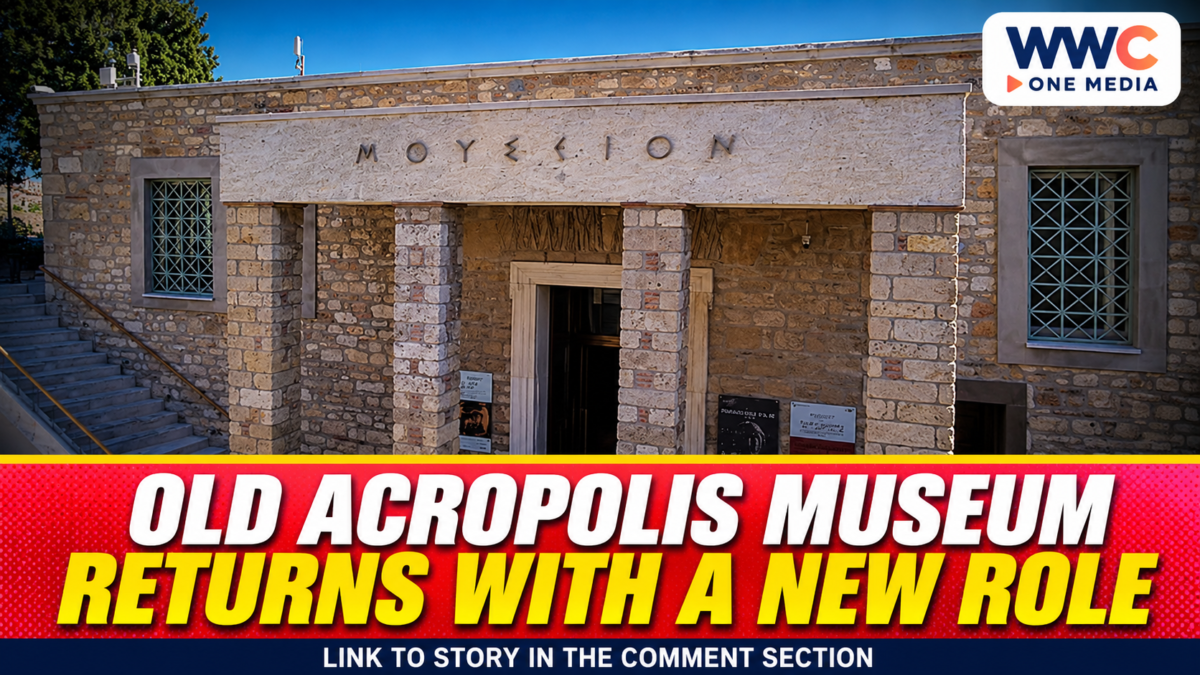
ATHENS, Greece — November 24, 2026. The Old Acropolis Museum has reopened on the Acropolis Hill after an extensive restoration, returning a historic archaeological building to public use with a programme that combines ancient objects, contemporary art and digital interpretation. The museum welcomed visitors again on November 23, introducing four exhibitions that connect the archaeological history of Athens with new ways of presenting cultural heritage.
The reopening gives the building a purpose beyond preserving objects associated with the ancient citadel. Its new programme brings together material from the Acropolis and the wider city, an exhibition by contemporary artist Michael Rakowitz, and a digital presentation that uses artificial intelligence to help visitors explore the Parthenon’s sculptural history.
The shift is significant because the museum had spent nearly two decades outside the regular visitor experience after its collections were transferred to the newer Acropolis Museum. Rather than simply restoring the old galleries to their former arrangement, the project gives the site a broader cultural and educational role.
A historic building gets a new purpose
The museum’s origins reach back to 1865, when the building was founded as a purpose-designed place for archaeological finds from the Acropolis. Its location, close to the Parthenon, made it part of the early effort to preserve and present objects uncovered on the ancient hill.
That role changed when the collections were moved to the newer Acropolis Museum. The old building then remained closed to ordinary public visits for approximately 20 years. In 2019, the Greek government decided to revise earlier plans for its limited use and pursue a more substantial transformation.
The reopening marks the return of the building to the public-facing cultural life of the Acropolis. The government’s announcement describes it as a fully renovated museum with four exhibitions, rather than a storage or administrative facility. Ο Πρωθυπουργός της Ελληνικής Δημοκρατίας+1
The approach reflects a wider challenge facing historic institutions: how to keep an important building relevant without reducing its purpose to displaying familiar objects. The new museum programme attempts to answer that question by combining archaeological interpretation with contemporary cultural work.
What visitors will find inside
The museum’s programme includes one permanent exhibition and three temporary presentations.
The permanent display focuses on architectural fragments from lost Acropolis buildings, religious offerings and inscriptions. The wider exhibition programme also brings together archaeological finds connected to Athens’ long history.
The three temporary exhibitions are titled Athens City Idea, What You Leave Behind Is Not What Is Engraved, and Parthenon Alive. Together, they introduce different ways of understanding the ancient city: through archaeological material, contemporary artistic interpretation and digital reconstruction.
The government’s reopening announcement also identifies more than 800 finds from excavations in the city as part of the museum’s permanent display. This gives the venue a scope extending beyond the most familiar monuments on the Acropolis itself. Ο Πρωθυπουργός της Ελληνικής Δημοκρατίας+1
That broader perspective matters. The Acropolis is often understood through its major temples and sculptures, but the history of Athens also survives in inscriptions, religious objects, fragments of buildings and everyday archaeological evidence. Presenting these materials together can help visitors see the ancient site as part of a larger urban and social history.
The Parthenon enters the digital gallery
One of the new presentations, Parthenon Alive, uses digital technology to interpret the monument’s sculptural history. The project was developed by the Technical University of Crete in collaboration with the Ephorate of Antiquities of the City of Athens.
The official programme identifies an AI-assisted digital representation of the Parthenon frieze as part of the presentation. The technology is intended to make aspects of the monument’s history more accessible through a visual experience, rather than relying only on traditional display cases and written descriptions. NEON+1
Digital reconstruction can help explain how architectural and sculptural elements relate to one another, particularly when visitors encounter them as fragments or in separate collections. It does not replace the physical archaeological record, however. Its value depends on how clearly the presentation distinguishes surviving evidence from digital interpretation.
That distinction is important for museums using artificial intelligence. Technology can make complex heritage easier to explore, but historical accuracy still depends on the quality of the underlying research and the care taken in presenting what is known.
Contemporary art joins the archaeological setting
The reopening also introduces contemporary art to the Acropolis Hill through What You Leave Behind Is Not What Is Engraved, the third part of the Michael Rakowitz & Ancient Cultures exhibition series.
The project is a collaboration between the Hellenic Ministry of Culture and the NEON organisation. It is curated by NEON director Elina Kountouri and features a new commission by artist Michael Rakowitz. Its stated themes include diaspora, memory, identity, loss and the movement of objects across different historical and geographical settings.
The exhibition is scheduled to run from November 23, 2026, through 2028. Its organisers describe it as the first contemporary art exhibition presented on the Acropolis Hill. neon.org.gr+1
Placing contemporary work beside archaeological material creates an opportunity for visitors to consider how societies remember the past and how cultural objects acquire meaning across generations. It also gives the museum a role in discussing heritage as something that continues to be interpreted, rather than a subject frozen in antiquity.
The idea has parallels elsewhere. WWC has examined how museums bring historical objects into new public experiences, including the presentation of ancient Roman frescoes and mosaics after restoration and South Korea’s efforts to make museum collections more participatory.
Why the reopening matters to cultural preservation
The Old Acropolis Museum’s return is not only a matter of adding another stop to Athens’ visitor itinerary. It restores public access to a building closely connected with the development of archaeological preservation in modern Greece.
Its new role also highlights a practical issue for heritage sites: preservation requires more than maintaining walls and roofs. Museums need ways to interpret collections, support conservation and give visitors reasons to engage with the material responsibly.
A similar challenge appears in the restoration of historic sites elsewhere. WWC’s report on the return of Shuri Castle’s restored main hall examined how reopening a heritage landmark can involve balancing public access with the protection of historically important structures.
For Athens, the old museum’s programme offers a different model: it places archaeological displays, digital interpretation and contemporary art within one historic setting. Whether that combination attracts sustained public interest will depend on the quality of its exhibitions and how effectively the site is maintained.
What happens next
The museum has reopened, and its contemporary art exhibition is scheduled to continue through 2028. Its published visitor information lists winter opening hours of 8 a.m. to 5 p.m., with last admission at 4:30 p.m.; summer hours are listed as 8 a.m. to 8 p.m., with last admission at 7:30 p.m. Visitors should check the official Hellenic Heritage ticketing and access information before travelling, as admission arrangements and access conditions may change. neon.org.gr
The longer-term test will be whether the restored building can sustain its new mix of exhibitions while protecting the archaeological material and historic setting that give it importance.
For now, the Old Acropolis Museum has returned as more than a preserved landmark. It is once again a public space for examining Athens’ past, while also making room for contemporary questions about memory, technology and cultural heritage.
Frequently asked questions
When did the Old Acropolis Museum reopen?
It reopened to the public on November 23, 2026, following its restoration. Ο Πρωθυπουργός της Ελληνικής Δημοκρατίας
Where is the Old Acropolis Museum?
It is on Acropolis Hill in Athens, Greece, close to the Parthenon. NEON+1
What exhibitions are inside the renovated museum?
The programme includes a permanent archaeological exhibition and three temporary presentations: Athens City Idea, What You Leave Behind Is Not What Is Engraved, and Parthenon Alive. Ο Πρωθυπουργός της Ελληνικής Δημοκρατίας
Does the museum use artificial intelligence?
Yes. The Parthenon Alive presentation includes an AI-assisted digital representation of the Parthenon frieze. Ο Πρωθυπουργός της Ελληνικής Δημοκρατίας
How long will the Michael Rakowitz exhibition run?
The exhibition What You Leave Behind Is Not What Is Engraved is scheduled to run from November 23, 2026, through 2028.