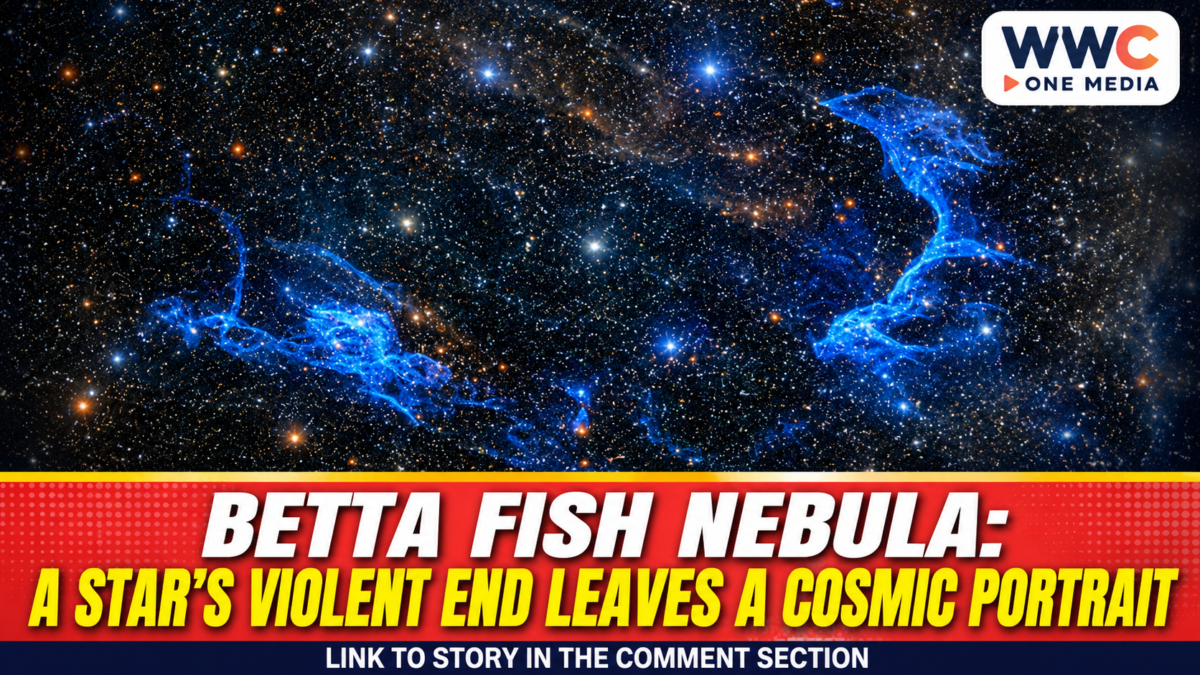
A new image released on November 23, 2026, gives astronomers and the public a detailed look at SNR G295.5+09.7, a supernova remnant nicknamed the Betta Fish Nebula. The image was captured in Chile using the Dark Energy Camera (DECam), mounted on the U.S. National Science Foundation’s Víctor M. Blanco 4-meter Telescope at Cerro Tololo Inter-American Observatory. sciencesprings+1
The object is not a newly discovered fish-shaped cloud or a star-forming nursery. It is material left behind after a massive star exploded. Its glowing filaments offer a visible record of what happens when expelled stellar matter collides with the thin gas between stars—and show how modern wide-field instruments can reveal detail in structures spread across enormous distances.
Betta Fish Nebula: What the image actually shows
The Betta Fish Nebula is the informal name given to supernova remnant SNR G295.5+09.7. It lies in the constellation Centaurus, in the southern sky, at an estimated distance of almost 6,800 light-years from Earth. The object is located in the Carina–Sagittarius arm of the Milky Way. sciencesprings+1
The nickname comes from the appearance of its thin, flowing structures. In the new image, blue filaments curve through the surrounding field of stars, creating a resemblance to the trailing fins of a betta fish.
That resemblance is a useful visual description, not a scientific classification. The object is a supernova remnant: a cloud of gas and stellar material produced by the death of a massive star. Its formal designation, SNR G295.5+09.7, is the more precise identifier astronomers use.
The release describes the image as the most detailed view of the remnant to date. It also says the object may not have been imaged by a professional observatory before. That qualification matters. It is safer to describe the image as a potentially first professional-observatory view than to declare it definitively the first image ever made. sciencesprings
How a supernova produced the glowing filaments
A supernova is the explosive death of a star. In this case, a star many times more massive than the Sun expelled its outer layers into space. That material expanded into the interstellar medium—the sparse mixture of gas and dust found between stars.
As the expelled material encountered and collided with surrounding gas, the interaction caused the gas to glow. The resulting emission forms the bright, threadlike structures visible in the image. sciencesprings
The distinction between the original star and the remnant is important. The star itself no longer exists in its former state. What astronomers observe is the expanding aftermath of its destruction, shaped by the interaction between the expelled material and its galactic environment.
The image also contains much more than the remnant. Thousands of stars from the Milky Way’s Carina–Sagittarius arm appear in the background. The field includes distant galaxies beyond our own, as well as diffuse, brownish interstellar clouds within the Milky Way. sciencesprings
These background features help place the nebula in context: it is one structure within a much larger and more crowded region of the galaxy.
Why the Dark Energy Camera matters
The image was made with DECam, a 570-megapixel camera developed for the Dark Energy Survey. The U.S. Department of Energy funded the instrument, and it was built and tested at Fermilab before being mounted on the Víctor M. Blanco 4-meter Telescope in Chile. sciencesprings
A camera designed for a wide-field survey can serve purposes beyond its original scientific programme. Its broad view allows astronomers to capture an extended object and much of the surrounding sky in the same observation. That is useful for studying nebulae and supernova remnants, where the visible structure may stretch across a large area.
The new image was produced through the NOIRLab Legacy Imaging Program. The programme reserves observing time on NOIRLab telescopes to collect data for colour images that can be shared with the public. It continues work begun through the Gemini Legacy Imaging Program at the International Gemini Observatory in 2002. sciencesprings
This is an important distinction between a scientific instrument and a single image. DECam was built for a survey with a defined research purpose, but its capabilities can also contribute to public-facing astronomy and the visual documentation of objects in the night sky.
WWC has previously examined how space instruments contribute to discoveries beyond a single mission in its report on the scientific legacy of NASA’s Swift Observatory. The instruments and objectives differ, but both stories illustrate how astronomical observations can remain valuable well beyond the moment an image or mission update is released.
The neutron star left at the centre of the story
The massive star’s outer layers were expelled, but its core also underwent a dramatic change. According to the NOIRLab release, the remaining core collapsed under gravity, but the collapse stopped short of producing a black hole. A neutron star formed instead and is shown within the remnant’s outer shell. sciencesprings
Neutron stars are among the densest objects known in astronomy. The release gives a general illustration of their extreme density: about 1.4 times the mass of the Sun compressed into a sphere roughly 20 kilometres in diameter. That comparison describes neutron stars generally; it should not be mistaken for a new measurement of this particular remnant’s central object. sciencesprings
The formation of a neutron star is one possible outcome of a massive star’s collapse. If the remaining core had continued collapsing instead, a black hole could have formed. The final outcome depends on the physical properties of the collapsing core.
The image therefore captures more than a visually unusual cloud. It shows the surrounding debris of a stellar explosion and the compact object associated with the star’s collapsed core.
Why a detailed image is useful to astronomy
An image does not, by itself, settle every scientific question about a supernova remnant. It can, however, give researchers a clearer view of the remnant’s visible structure and its relationship to the surrounding field.
Filaments, shells and diffuse clouds are not merely decorative patterns. They are observable features that can help astronomers compare the remnant’s structure with other observations and investigate how stellar material interacts with its environment.
The public release does not announce a new peer-reviewed study, a revised age estimate or a new measurement of the neutron star. Its principal contribution is the detailed visual record. Treating the image as a new scientific discovery beyond what the release establishes would overstate the announcement.
The broader subject also connects to other areas of space research. WWC’s coverage of asteroid-deflection modelling and the challenges of predicting an asteroid’s response shows a different side of astronomy: understanding celestial objects requires observations and models that account for their physical structure, not just their appearance.
For readers in the Philippines, the image is also a reminder that space science is not limited to large observatories overseas. Local scientific interest is growing through student research and satellite technology, including a Davao team’s CubeSat experiment selected for testing at the University of the Philippines Diliman.
What happens next
The November 23 release presents the new DECam image as the most detailed view of SNR G295.5+09.7 to date. It does not announce a new observing campaign, a confirmed follow-up study or a revised scientific model for the remnant.
The next stage of scientific work would depend on further observations and analysis. Astronomers could compare the image with data collected at other wavelengths, examine the remnant’s structure in greater detail, or investigate the compact object within it. Those are possible research directions, not announced outcomes.
For now, the image offers a striking view of a stellar explosion’s long aftermath. The Betta Fish Nebula’s unusual shape may draw the eye, but its scientific value lies in what it records: the interaction of material from a dead star with the environment between stars.
Frequently asked questions
1. What is the Betta Fish Nebula?
It is the nickname for SNR G295.5+09.7, a supernova remnant in the constellation Centaurus. Its glowing filaments resemble the flowing fins of a betta fish.
2. How far away is the Betta Fish Nebula?
The remnant is estimated to be almost 6,800 light-years from Earth.
3. What telescope captured the new image?
The image was captured using the 570-megapixel Dark Energy Camera mounted on the Víctor M. Blanco 4-meter Telescope at Cerro Tololo Inter-American Observatory in Chile.
4. Why does the nebula appear blue?
The blue filaments are glowing gas produced as material expelled by the supernova interacts with gas in the interstellar medium.
5. Is the Betta Fish Nebula a newly discovered object?
No. The new development is the detailed image released in November 2026. The object is already identified by its astronomical designation, SNR G295.5+09.7.