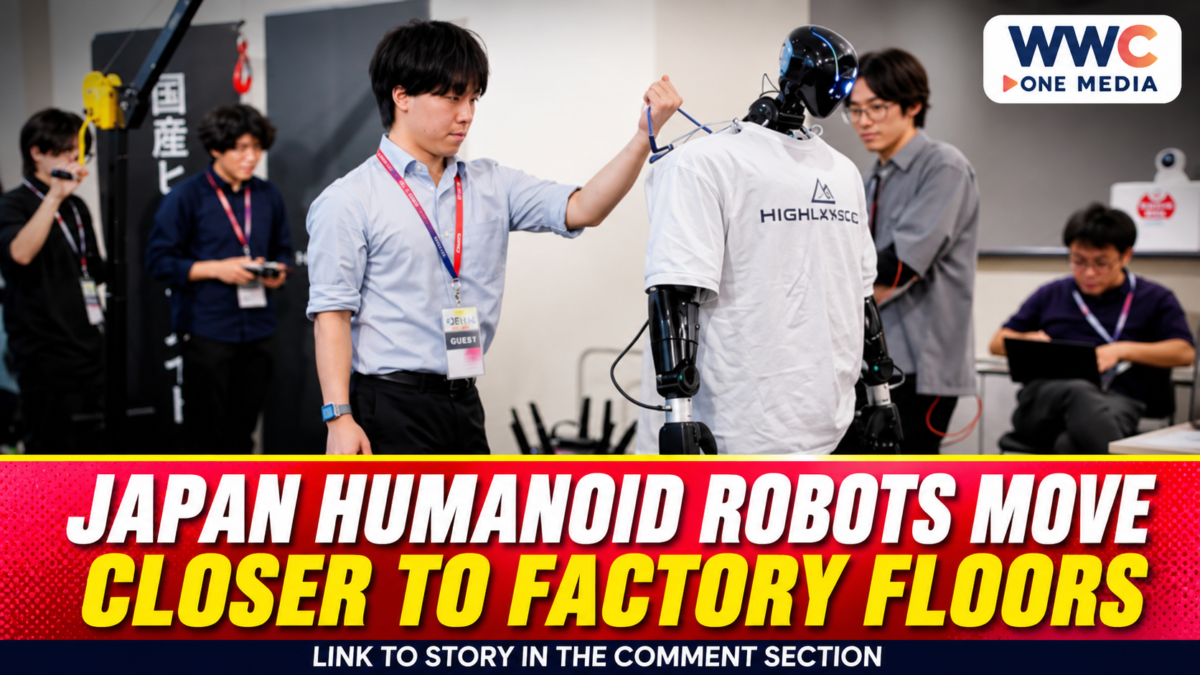
TOKYO — November 24, 2026. Japan’s humanoid robotics industry is moving beyond laboratory demonstrations, with startups developing machines for manufacturing, logistics and other workplaces. Projects announced this year include a robot-data facility in Tokyo, a planned manufacturing partnership with Mitsubishi Motors and an airport trial involving Japan Airlines.
The developments point to a business strategy built around practical deployment rather than spectacle. For Japanese companies facing labour constraints and increasingly complex operations, the commercial question is whether humanoid machines can perform useful work safely, consistently and at a cost that makes sense.
The answer remains unproven at industrial scale. But several companies are now investing in the hardware, software, training data and manufacturing relationships needed to find out.
Japan Humanoid Robots Are Being Built Around Actual Workplace Tasks
One of the clearest examples is ATOM Inc., a Tokyo-based startup developing bipedal robots with two arms and five-fingered hands.
The company raised JPY 3 billion in a seed funding round announced in May 2026. Its stated development focus includes transport, replenishment and kitting work, particularly in manufacturing and logistics. The investment announcement identified Shunsuke Aoki as the company’s chief executive. Beyond Next Ventures
ATOM is also building the training infrastructure needed to improve its machines. In August, it announced the opening of its Physical AI Foundry in Toyosu, Tokyo. The approximately 1,700-square-metre facility is designed to collect work-related data, train and evaluate AI models, test robots in physical environments and improve their hardware.
ATOM’s announced plan is to build capacity for 200 humanoid robots operating at the facility by the end of 2027 and produce a cumulative 300,000 hours of training data. These are company targets, not completed results. 株式会社アトムのプレスリリース
The approach addresses a technical problem: robots need more than the ability to recognise an object. They must also understand how to grasp it, how much force to apply and how to adjust when an object moves or behaves differently than expected.
That distinction becomes critical in factories, where handling small components and assembling parts can require controlled movements rather than simple picking and carrying.
Mitsubishi Partnership Gives Humanoid Development an Industrial Route
A separate development involves Highlanders, a startup originating from the University of Tokyo.
In July 2026, Mitsubishi Motors and Highlanders announced a memorandum of understanding to explore the joint development of humanoid robots for use at Mitsubishi’s manufacturing facilities. The companies also said they would explore mass production of Highlanders products at Mitsubishi Motors’ Kyoto Plant. MITSUBISHI MOTORS
The wording matters: the agreement is an exploration of cooperation, not confirmation that a mass-production programme is already operating.
Still, the partnership offers a potentially important connection between a robotics startup and an established vehicle manufacturer. A car plant provides a demanding environment for testing whether a robot can work around equipment, materials and existing production processes.
Japan’s Ministry of Economy, Trade and Industry also lists Highlanders among companies participating in its robot foundation-model research and development initiative. The ministry’s programme information describes the startup’s work on humanoid and quadruped robots, physical-intelligence models and data gathered from real operating environments. GENIAC(METI/経済産業省)
For a young robotics company, access to industrial environments could be as important as developing a more advanced robot. Real production conditions expose weaknesses that controlled demonstrations may not reveal.
Airport Trials Show Where Humanoid Machines Could Be Tested
Humanoid robots are also being considered outside factories.
Japan Airlines, JAL Ground Service and GMO AI & Robotics announced in April a demonstration programme involving humanoid robots at airports, scheduled to begin in May 2026.
The project focuses on ground-handling operations, which include activities such as baggage and cargo handling and the use of ground-support equipment around aircraft. The companies said they would first examine airport operations and identify tasks where humanoid robots could work safely, followed by repeated tests designed to simulate actual operating conditions. Press Release
This is a useful test case because airports combine crowded workspaces, specialised equipment and strict safety requirements. A robot that can move through a demonstration area may still struggle with the changing conditions of a working airport.
The companies described the initiative as a demonstration experiment, not a completed deployment or a confirmed replacement of airport employees.
The project nevertheless shows why humanoid designs attract interest. Their body shape may allow them to operate around infrastructure already designed for people, potentially reducing the need to redesign every workplace for a specialised machine.
Startups Are Also Targeting Smaller Indoor Environments
Not every Japanese humanoid project is aimed at heavy manufacturing.
ZEALS announced the launch of D1, a compact humanoid developed for indoor environments, on August 5. Its stated applications include healthcare and elder-care facilities, hotels, logistics sites and manufacturing workplaces.
The company describes D1 as capable of dialogue, reception and guidance, navigation, multilingual support, item transport and task assistance using its two arms. The planned starting price was JPY 5 million per unit.
ZEALS also set a target of producing 100 units during fiscal 2026 and reaching 10,000 cumulative operational hours. These figures are goals announced by the company; they should not be mistaken for confirmed production or operating totals. omakaserobotics.ai
The emphasis on indoor environments reflects a different commercial challenge. Hospitals, hotels and care facilities often have narrow corridors, elevators and shared spaces. A robot intended for those locations must navigate safely while interacting with people and existing services.
That makes reliability, maintenance and ease of integration central to whether customers will adopt the technology.
Physical AI Could Be the Deciding Factor
The term physical AI describes AI systems designed to perceive and act in the physical world. In humanoid robotics, that involves connecting visual information, language instructions, movement planning and physical control.
Japan’s METI-backed GENIAC programme lists ATOM and Highlanders among organisations involved in robot foundation-model development. Its published descriptions show that participating work extends beyond robot bodies to AI models, training data and the ability to perform tasks in real environments. GENIAC(METI/経済産業省)+1
This matters because a humanoid robot is not commercially useful simply because it resembles a person. It must complete tasks repeatedly, respond to unexpected conditions and operate within safety requirements.
The investment challenge is therefore broader than manufacturing a machine. Companies must develop the software, collect training data, maintain equipment and demonstrate that the robot can fit into a customer’s existing workflow.
WWC has previously examined how Taisei’s ¥24 billion technology fund is targeting AI and robotics for construction, another example of established Japanese companies seeking ways to bring emerging technologies into industrial operations.
The wider automation market is also evolving. Epson’s collaborative robotics push in Southeast Asia illustrates how businesses are exploring machines designed to work alongside employees rather than operate only in isolated production areas.
Japan’s labour-market pressures also form part of the context. The changing demand for foreign professionals as AI reshapes hiring shows why technology and workforce planning are increasingly connected in the country’s economic debate.
What Happens Next
The next stage will be measured by operational evidence.
For ATOM, the milestones include expanding its data-generation capacity and moving toward its planned 2027 market introduction. For Highlanders and Mitsubishi Motors, the key question is whether their exploratory partnership advances into specific development and manufacturing arrangements.
The airport demonstration and ZEALS’ D1 production targets will also provide important tests of whether humanoid robots can move from planned applications into sustained use.
Businesses will need evidence on reliability, safety, maintenance costs, productivity and the amount of human supervision required. Without those details, announced production targets and demonstrations remain early indicators rather than proof of commercial success.
Japan’s humanoid robotics push is gaining industrial connections. Its real breakthrough, however, will come when machines can deliver dependable results on the factory floor, in warehouses and in public-facing workplaces.
Frequently Asked Questions
1. Which Japanese startups are developing humanoid robots?
ATOM Inc. and Highlanders are among the companies developing humanoid robots in Japan. ATOM is focused on manufacturing and logistics tasks, while Highlanders is developing humanoid and other robotic platforms alongside physical-intelligence technology.
2. Is Mitsubishi Motors already mass-producing humanoid robots?
No. Mitsubishi Motors and Highlanders signed a memorandum of understanding to explore joint humanoid development and possible mass production at Mitsubishi’s Kyoto Plant. The announcement does not confirm that mass production has begun.
3. What is physical AI in robotics?
Physical AI refers to artificial intelligence designed to perceive, make decisions and act in real-world environments. For humanoid robots, it can involve recognising objects, understanding instructions, planning movements and controlling physical actions.
4. How much is ZEALS’ D1 humanoid robot expected to cost?
ZEALS announced a planned starting price of JPY 5 million per unit. The company also announced production and operational-hour targets for fiscal 2026.
5. Are humanoid robots replacing Japanese factory workers?
The projects reviewed are primarily focused on testing and developing robots for specific tasks. Their announcements do not establish that humanoid robots are replacing workers on a large scale. The immediate focus is on whether machines can safely assist with selected operations.