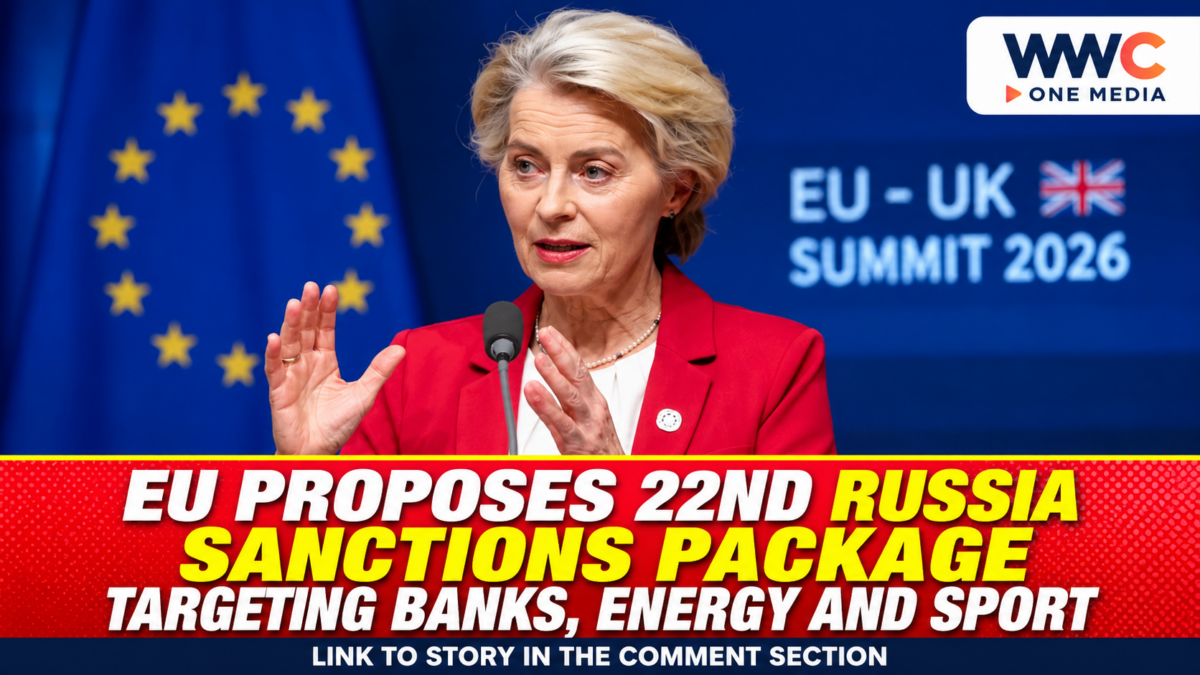
The European Commission presented its proposed 22nd Russia sanctions package on November 23, 2026, outlining new restrictions aimed at Russian financial institutions, energy services, shipping networks and participation in European sporting and cultural activities. European Commission President Ursula von der Leyen said the proposal would also strengthen enforcement against sanctions evasion, including through cryptocurrency and payment networks.
The proposal would expand the European Union’s pressure on several channels that support Russia’s international financial and commercial activity. But the announcement is not the same as a final legal decision: the package must pass through the EU’s Council approval process before proposed economic restrictions become binding.
The distinction matters for banks, shipping companies, energy service providers, sports organisations and businesses with European operations. They need to know not only what Brussels wants to restrict, but also when any new legal obligations actually take effect.
Russia sanctions package puts banks and crypto networks in focus
The financial provisions are among the most significant elements of the proposal. The Commission wants to extend transaction restrictions to approximately 60 Russian banks, with all 60 also set to be removed from the SWIFT financial messaging system.
SWIFT is a network used by financial institutions to exchange payment instructions and other financial messages. Exclusion can make cross-border transactions more difficult, although it is not the same as shutting down a bank or automatically blocking every possible international payment route.
The proposal also targets cryptocurrency and payment networks that may be used to move funds around existing restrictions. The Commission said its approach would cover not only Russian networks but also third-country facilitators involved in sanctions evasion.
A Crypto Sanctions Task Force has also been launched to support this effort and coordinate work with international partners.
The broader enforcement question is whether authorities can identify the companies, intermediaries and payment channels that help restricted transactions continue through alternative routes. WWC previously examined how changes in American restrictions affected the wider Russia sanctions environment and negotiations over Ukraine. The European proposal is a separate policy action, but both developments show why businesses must assess sanctions by jurisdiction and legal instrument rather than assume one country’s decision automatically changes another’s rules.
Energy restrictions extend beyond oil shipments
The proposed energy measures would widen restrictions on services provided by European companies to Russia’s energy infrastructure.
The Commission wants to prevent European firms from helping Russia build, operate or repair energy facilities, particularly refineries. It also says the proposed expansion would cover electricity services for the first time.
This is significant because sanctions can affect more than the sale or transport of commodities. Engineering, maintenance, technical support and other services can also be important to the operation of energy infrastructure.
The proposal also addresses Russia’s so-called shadow fleet: vessels associated with the transport of Russian oil outside conventional shipping and insurance arrangements. The Commission said it would list more than 70 additional ships.
Another proposed measure would prohibit tanker vessels insured in Russia. That proposal should not be confused with a rule already in force. Its final scope, definitions and implementation would depend on the legal text approved by the Council.
The shipping provisions matter because insurance and maritime services are essential parts of international oil transportation. Restrictions affecting vessels, insurers and service providers can complicate the arrangements available to companies moving cargoes.
WWC has previously reported on fuel shipments from South Korea to Russia, illustrating how international trade routes and shipping arrangements remain relevant to the wider sanctions debate. That earlier report concerns a separate development and does not establish how the proposed EU measures would affect any particular shipment.
Visa rules and restrictions on Russian participation in sport
The package also reaches beyond finance and energy.
The Commission has proposed a visa ban for current and former Russian combatants. Its accompanying November 23 press release says the proposed restrictions concern people who have served in the Russian Armed Forces since the beginning of Russia’s war against Ukraine.
The updated guidelines direct national authorities to pay particular attention to people who served in Russian armed forces or associated armed groups since February 24, 2022, and directly participated in combat operations. The guidance also identifies documents that may help authorities assess applications, including military-service questionnaires, self-declarations and military booklets.
The Commission has separately recommended stricter scrutiny of tourist visa applications from Russian nationals and said member states should no longer recognise non-biometric Russian passports. These are visa-assessment guidelines; they should not be described as an automatic ban on every Russian traveller.
The Commission also highlighted safeguards for people who may need protection, including human rights defenders, dissidents and independent journalists. It said humanitarian exceptions should be considered for Ukrainians who were forcibly granted Russian nationality and can demonstrate their previous Ukrainian citizenship.
Sport and culture form another part of the proposal. The Commission wants to prohibit Russian teams and athletes from competing at sporting events in the EU under the Russian flag, ban the display of official Russian symbols, restrict financial flows from Russian sponsors to European-based sports and cultural associations, and limit Russian nationals from holding positions in governing bodies of European sports federations.
The Commission also proposed restrictions on Europeans continuing to occupy governing positions in companies operating in Russia.
These measures would have consequences for organisations that depend on sponsorship, international competitions and cross-border management. WWC has previously covered Ukraine’s use of sanctions against people and organisations linked to Russian cultural influence. That was a separate Ukrainian sanctions action, not part of the EU’s new proposal.
Why the Council decision is the decisive stage
The European Commission can develop and present proposals, but EU sanctions are adopted through the Council of the European Union.
The Council’s published procedure states that restrictive measures are examined by relevant preparatory bodies before the Council adopts a sanctions decision. Decisions and regulations on sanctions are adopted by unanimity.
Where a package includes asset freezes or economic and financial restrictions, a Council regulation is also required to establish the detailed legal obligations. The regulation sets out the scope of the measures and how they are to be implemented.
That process means the November 23 announcement should be read as a proposal, not as proof that every new restriction is already enforceable.
The distinction is especially important for businesses. A company may need to review its exposure to proposed restrictions, but it must rely on the final legal acts and their effective dates to determine its binding obligations.
The EU’s existing Russia sanctions framework already covers financial services, trade, transport, energy and individual listings. The Commission’s published sanctions overview identifies the 21st package, adopted in July 2026, as the previous numbered package before this new proposal.
What happens next
The next stage is examination by the Council and its preparatory bodies. Member states will need to consider the proposed measures and agree on the legal instruments required for implementation.
The Commission’s separate visa announcement makes the sequence particularly clear: the High Representative has put forward the proposal to activate the visa ban on Russian combatants, but the Council will decide when that restriction enters into force across the EU.
As of November 24, the public documents reviewed do not establish that the entire 22nd package has been adopted. The Commission’s November 23 statement also says the documents corresponding to its communication would be made available later.
For companies and institutions, the practical task is to monitor the final legal text rather than rely solely on political announcements. The details will determine which banks, vessels, services, transactions and individuals are covered, as well as any exemptions or implementation requirements.
The proposal signals an effort to widen pressure on financial, energy and shipping channels while extending restrictions into sport, culture and travel. Its actual effect will depend on what EU member states approve and the rules eventually published in the Official Journal.
Frequently asked questions
Has the EU adopted its 22nd sanctions package against Russia?
The European Commission presented the proposal on November 23, 2026. The official records reviewed do not establish that the full package has been adopted by the Council.
How many Russian banks could face new restrictions?
The Commission proposed extending transaction restrictions to approximately 60 Russian banks and removing all 60 from the SWIFT system.
What is the proposed shadow fleet measure?
The Commission said it would list more than 70 additional ships and proposed a ban on tanker vessels insured in Russia.
Will Russian athletes be banned from all sporting events worldwide?
No. The proposal concerns Russian athletes competing on behalf of Russia at sporting events in the European Union. It does not establish a worldwide ban.
When could the new sanctions take effect?
The measures must pass through the Council’s approval process. Their effective dates and precise legal scope will depend on the final decisions and regulations.