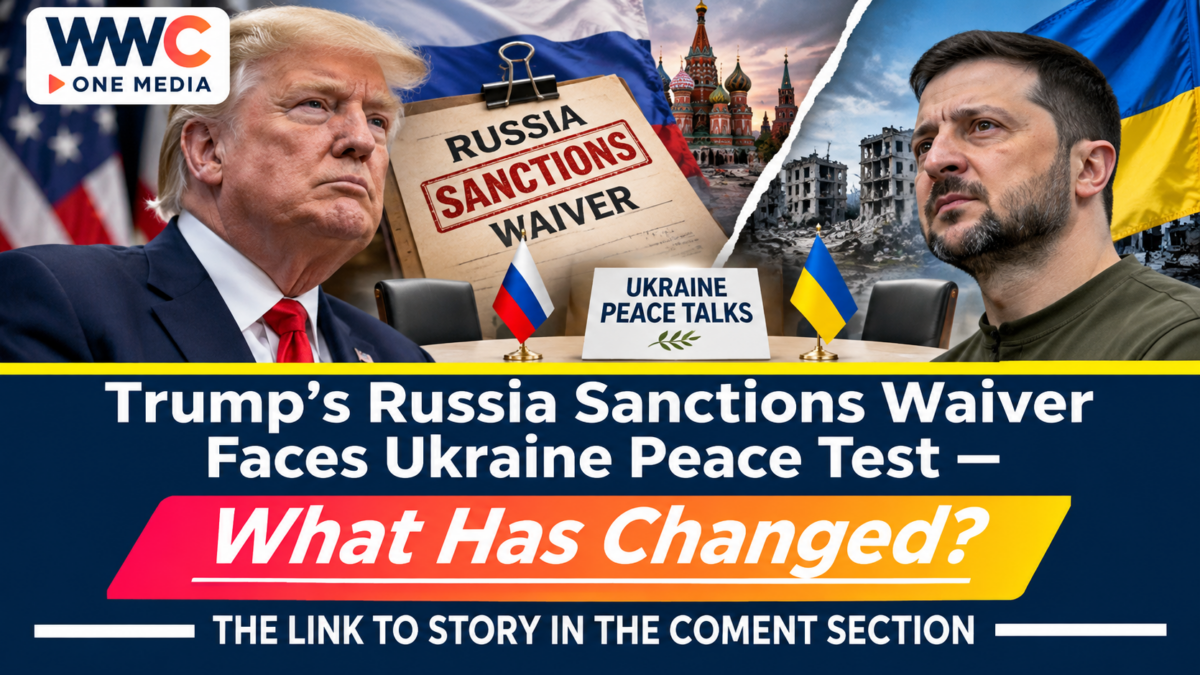
KYIV / WASHINGTON / BRUSSELS — Nov. 17, 2026. Fresh diplomatic discussions involving Ukraine, the United States and European partners are continuing after another round of talks aimed at ending Russia’s war. But an October decision by US President Donald Trump to waive parts of a new sanctions law has raised a different question: how can negotiators combine incentives for dialogue with pressure for a durable agreement?
A temporary ceasefire differs from a settlement with enforceable security arrangements. Any relaxation of pressure also raises questions about reciprocal commitments.
What the Russia Sanctions Waiver Actually Changed
On Oct. 16, Trump issued Executive Order 14436, implementing the Lindsey O. Graham Sanctioning Russia and Iran Act of 2026. The order set out substantial prospective tariffs and restrictions, then exercised presidential waiver authority over specified provisions on national-interest grounds.
The waiver applies to identified provisions, not every Russia-related restriction. The order expressly preserves specified existing sanctions.
That makes the Russia sanctions waiver a measurable policy decision, not proof that Washington abandoned all economic pressure. Whether the decision improves negotiating leverage or weakens it is a question for analysis, rather than a fact established by the order itself.
A separate October Treasury authorisation permitted certain transactions involving Russian-origin diesel for a limited period, with exceptions. Such licences can change which transactions are lawful without amounting to a comprehensive lifting of sanctions.
Ukraine Peace Discussions Gain a Wider European Table
On Nov. 16, Ukrainian President Volodymyr Zelenskyy reported discussions among Ukrainian, American and European negotiating teams. American representatives Steve Witkoff and Jared Kushner joined remotely, while France, Germany, the United Kingdom, Italy, Poland, European Union institutions and NATO were represented in the wider consultations.
Ukraine said the participants planned to meet again in Berlin as part of the Coalition of the Willing to develop joint steps. A planned meeting is not an agreed peace settlement; officials have not published a final treaty resolving the war.
These consultations follow meetings in Abu Dhabi. Readers who followed WWC’s earlier coverage of the Abu Dhabi talks will recognise the central difficulty: bringing representatives into a room is different from securing agreement over territory, security guarantees and implementation.
The Nov. 16 Ukrainian statement identified a desire for a dignified end to the war and guarantees for Ukraine. Those are negotiating objectives, not proof that Moscow has accepted them.
European Sanctions and Financing Move in Parallel
While the United States has used waiver authority in one sanctions law, the European Union continued adding restrictions. On Nov. 16, the EU Council adopted new listings covering 12 individuals and 101 entities, including participants in sectors associated with Russian revenue and shipping.
The Council approved a decision enabling Ukraine to receive just under €8 billion under the Ukraine Facility. Around €5 billion of that amount comes from resources made available through the 2026 Ukraine Support Loan. The announcement describes an approved payment that Ukraine is expected to receive, not money already in its accounts at the moment of the decision.
The payment is reform-linked. The Council said Ukraine had completed more than 20 steps covering governance, energy and economic administration.
These actions reveal different instruments at work: financial support for Ukraine, restrictions targeting Russia, and diplomatic engagement involving multiple governments. As WWC’s report on Europe’s security concerns explains, European participation is significant because a lasting settlement would directly affect the continent’s defence and future responsibilities.
Why a Diplomatic Meeting Is Not Yet a Peace Deal
Diplomatic activity can produce smaller agreements even when the underlying war continues. Ukraine’s presidential office described an October prisoner exchange that returned 270 service members and nine civilians to Ukraine, alongside American mediation in a separate humanitarian operation.
These are important outcomes for the people involved. But humanitarian steps do not, by themselves, determine borders, military deployments, reconstruction obligations or how an eventual ceasefire would be monitored.
The difference is reflected in WWC’s coverage of the prisoner-exchange negotiations. A prospective exchange and a comprehensive peace treaty are not interchangeable measures of success.
One US government announcement also described a local ceasefire in Oleshky in October. That statement concerns a specific locality and should not be misread as confirmation that a nationwide ceasefire has ended the broader war.
What This Could Mean for Negotiating Leverage
Analysis: Sanctions, financial support and security guarantees influence different parts of a negotiation. A waiver may provide short-term economic flexibility; additional restrictions may increase costs; assistance can help Ukraine maintain public services and sustain its bargaining position.
The official documents do not establish that any one measure caused Russia to change its demands. Nor do they establish that American diplomacy has failed simply because no comprehensive agreement has yet been announced.
A fair evaluation would examine verifiable outcomes: whether the parties commit to an enforceable ceasefire, whether attacks stop, what protections Ukraine receives and how compliance would be checked. Counting political gestures without defining those benchmarks risks turning a complex negotiation into a misleading scorecard.
For the Philippines, the practical importance lies in the wider consequences of prolonged conflict for energy markets, shipping and international security. The records reviewed here do not justify predicting a specific change in Philippine pump prices or household costs.
What Happens Next
European leaders are due to discuss Ukraine’s financing needs at their Nov. 26–27 meeting, while another sanctions proposal is expected to be presented. Ukrainian officials also expect further coordination in Berlin, with dates and outcomes subject to confirmation.
The next test is whether diplomatic engagement produces written, implementable commitments rather than additional announcements alone. Until that happens, claims of either a decisive breakthrough or a complete collapse of negotiations go beyond the available public record.
FAQ
Did Trump remove all US sanctions on Russia?
No. Executive Order 14436 waives specified provisions of the 2026 Graham Act and expressly leaves certain existing sanctions unaffected.
Is there a Ukraine–Russia peace agreement in November 2026?
The official records reviewed describe continuing talks and planned consultations, not a signed comprehensive agreement ending the war.
What did the EU announce on Nov. 16?
It imposed additional sanctions on 12 people and 101 entities and approved a decision enabling a payment of just under €8 billion to Ukraine.
Why are European countries involved in the negotiations?
Their security, reconstruction commitments and financial support would be affected by the terms and implementation of a lasting settlement.
Does a prisoner exchange mean the war is ending?
No. A humanitarian exchange may reduce suffering without resolving the political and military questions required for a lasting peace.